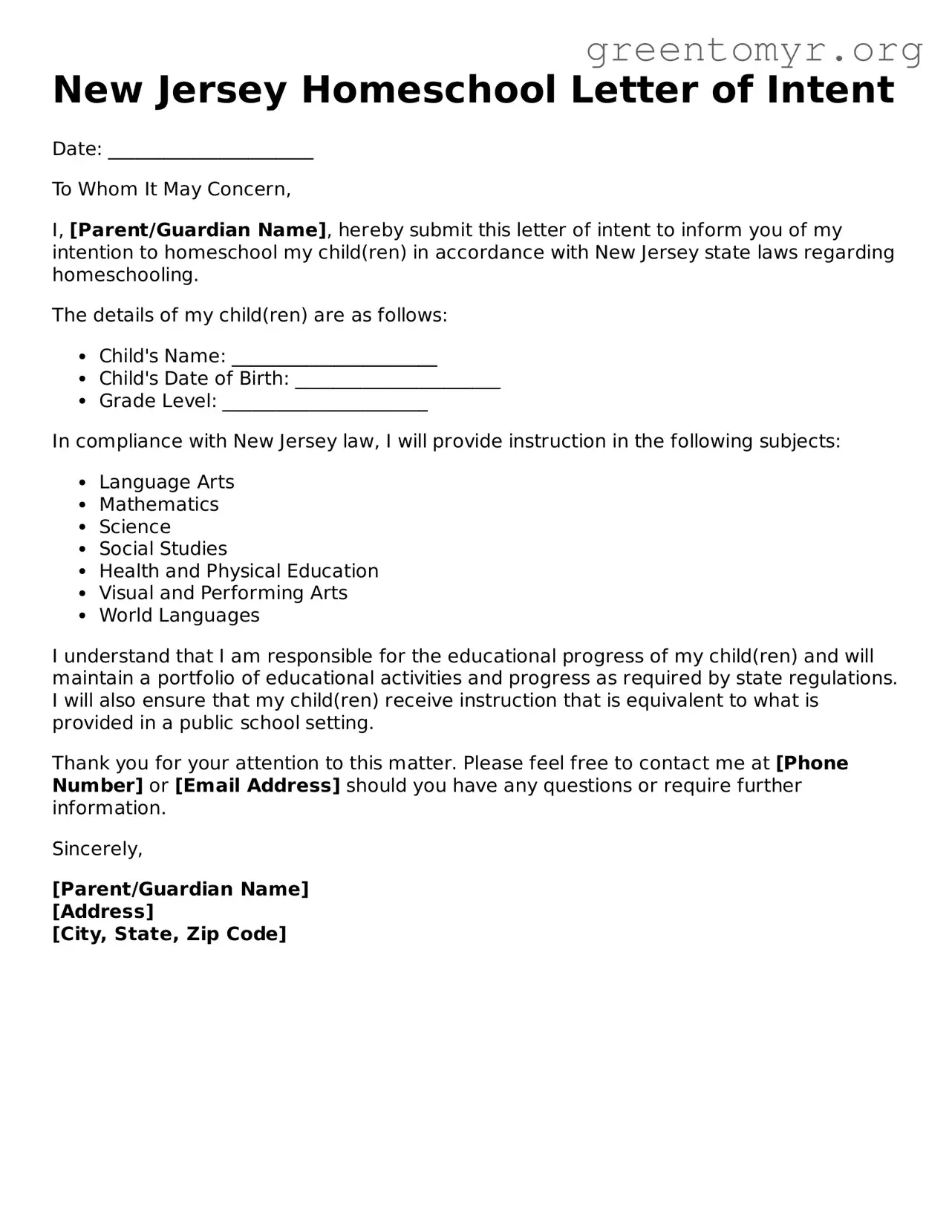
In New Jersey, families who choose to homeschool their children must submit a Homeschool Letter of Intent to their local school district. This essential document serves as a formal notification to the district that parents or guardians are opting out of traditional schooling in favor of home-based education. The form typically requires basic information, including the names and ages of the children being homeschooled, as well as the educational plan that will be followed. Additionally, it is important to note that while the state does not mandate a specific curriculum, parents must outline their educational approach to demonstrate compliance with state education laws. The submission of this letter not only initiates the homeschooling process but also establishes a record of intent, which can be crucial for future educational assessments and interactions with local education authorities. Understanding the requirements and implications of this form is vital for families embarking on their homeschooling journey in New Jersey.
New Jersey Homeschool Letter of Intent
Date: ______________________
To Whom It May Concern,
I, [Parent/Guardian Name], hereby submit this letter of intent to inform you of my intention to homeschool my child(ren) in accordance with New Jersey state laws regarding homeschooling.
The details of my child(ren) are as follows:
In compliance with New Jersey law, I will provide instruction in the following subjects:
I understand that I am responsible for the educational progress of my child(ren) and will maintain a portfolio of educational activities and progress as required by state regulations. I will also ensure that my child(ren) receive instruction that is equivalent to what is provided in a public school setting.
Thank you for your attention to this matter. Please feel free to contact me at [Phone Number] or [Email Address] should you have any questions or require further information.
Sincerely,
[Parent/Guardian Name]
[Address]
[City, State, Zip Code]
| Fact Name | Details |
|---|---|
| Purpose | The New Jersey Homeschool Letter of Intent form is used to officially notify the local school district of a parent's intent to homeschool their child. |
| Governing Law | The form is governed by New Jersey Statute 18A:38-25, which outlines the requirements for homeschooling in the state. |
| Submission Deadline | Parents must submit the Letter of Intent within 14 days of beginning the homeschool program. |
| Information Required | The form requires the child's name, age, and the address of the homeschooling location. |
| Annual Notification | Parents are required to submit a new Letter of Intent each school year to continue homeschooling. |
| Local School District | The Letter of Intent must be submitted to the local school district where the family resides. |
| Format | The form can typically be submitted in a written format, either by mail or electronically, depending on the district's policies. |
| Record Keeping | It is recommended that parents keep a copy of the submitted Letter of Intent for their records. |
| Contact Information | Parents should include their contact information on the form for any follow-up from the school district. |
| Support Resources | Many local homeschooling organizations provide resources and support for completing the Letter of Intent. |
Filling out the New Jersey Homeschool Letter of Intent form is an important step in your homeschooling journey. Once you've completed the form, you'll be ready to submit it to your local school district, which will officially recognize your intent to homeschool your child.
The New Jersey Homeschool Letter of Intent is a formal document that parents or guardians must submit to their local school district when they decide to homeschool their children. This letter serves as a notification to the school authorities that the parents are opting for an alternative educational path. It is an essential step in the homeschooling process in New Jersey.
Any parent or guardian who wishes to homeschool a child between the ages of 6 and 16 in New Jersey must submit this letter. This requirement applies regardless of whether the child has previously attended public or private school. It is crucial to notify the school district to ensure compliance with state laws regarding education.
The Letter of Intent should contain the following information:
Including this information helps to provide clarity and ensures that the local school district has all necessary details regarding the homeschooling arrangement.
The Letter of Intent should be submitted at the beginning of the school year or when a family decides to switch to homeschooling at any point during the year. It is advisable to send the letter at least two weeks before the start of the school year or before the child begins homeschooling. This allows the school district sufficient time to process the notification.
While there is no official form provided by the state, the Letter of Intent should be written in a clear and concise manner. It can be handwritten or typed. It is important to ensure that all required information is included and that the letter is signed by the parent or guardian. Keeping a copy for personal records is also recommended.
Once the Letter of Intent is submitted, the local school district will acknowledge receipt. They may not respond formally, but it is essential to keep a record of the submission. Parents should also be aware that they are responsible for creating an educational plan and ensuring that their child receives an appropriate education. Regular assessments may be required, depending on the district's policies.
Yes, parents or guardians can revoke their Letter of Intent if they decide to return their child to a traditional school setting. It is advisable to notify the local school district in writing, indicating the decision to discontinue homeschooling. This helps maintain clear communication and ensures that the child’s educational records are properly managed.
Filling out the New Jersey Homeschool Letter of Intent form can seem straightforward, but many families encounter pitfalls along the way. One common mistake is failing to provide complete information about the child. The form requires specific details, including the child’s full name and date of birth. Omitting any of these details can lead to confusion or delays in processing.
Another frequent error is neglecting to include the address of the homeschooling family. This information is crucial for establishing residency and ensuring that the local school district can maintain accurate records. Without a proper address, the form may be deemed incomplete.
Many parents also overlook the requirement to sign and date the form. A signature is not just a formality; it confirms that the information provided is accurate and that the parent or guardian is committed to homeschooling. Forgetting this step can result in the form being returned or rejected.
Some families may mistakenly think that they can submit the form anytime during the school year. However, New Jersey law requires that the Letter of Intent be filed within 14 days of the start of homeschooling. Delaying the submission can create unnecessary complications and may even affect the child’s educational status.
Another common mistake involves misunderstanding the educational plan requirement. While the form itself does not ask for a detailed curriculum outline, parents should be prepared to provide a general overview of their educational approach. Failing to have this information ready can lead to questions from the school district.
In addition, some parents might not realize that they need to keep a copy of the submitted Letter of Intent. This document serves as proof of the homeschooling arrangement and may be necessary for future reference. Keeping a copy can save a lot of trouble down the line.
Moreover, some families do not check for updates or changes in the form requirements. New Jersey may revise its regulations or procedures, and staying informed can prevent errors. Regularly reviewing the state’s homeschooling resources ensures compliance with current laws.
Another mistake is submitting the form to the wrong school district. Each homeschooling family must send their Letter of Intent to the district where they reside. Sending it to the wrong location can lead to significant delays and misunderstandings.
Lastly, some parents may underestimate the importance of following up after submission. Once the form is sent, it’s wise to confirm that it has been received and accepted. This proactive approach can help address any issues early on and ensure a smooth homeschooling experience.
When you decide to homeschool in New Jersey, submitting the Homeschool Letter of Intent is just the first step. Several other forms and documents may be necessary to ensure compliance with state regulations and to facilitate your homeschooling journey. Here’s a list of commonly used documents alongside the Homeschool Letter of Intent.
Gathering these documents not only helps you stay organized but also ensures that you meet all necessary requirements for homeschooling in New Jersey. Being prepared will make your homeschooling experience smoother and more effective.
When filling out the New Jersey Homeschool Letter of Intent form, it’s important to approach the process with care. Here are some key do's and don'ts to keep in mind:
When considering homeschooling in New Jersey, many parents encounter various misconceptions regarding the Homeschool Letter of Intent form. Understanding these misconceptions is crucial for a smooth homeschooling experience. Here are six common misunderstandings:
This is false. Homeschooling is completely legal in New Jersey, provided that parents follow the required procedures, including submitting a Letter of Intent.
Many believe that a teaching degree is necessary to educate their children at home. In reality, New Jersey law does not require parents to have formal teaching credentials.
Some think that the Letter of Intent can only be submitted at the start of the school year. However, parents can submit this form at any time, even mid-year.
This misconception suggests that parents cannot change their minds. In fact, families can decide to return to public school or change their homeschooling approach at any time.
Many fear that the form demands a lot of paperwork. In truth, the Letter of Intent is relatively straightforward and does not require detailed lesson plans or curriculum outlines.
Some believe that once they submit the Letter of Intent, they will have no further contact with the local school district. However, districts may still reach out for updates or to offer resources.
By clarifying these misconceptions, parents can navigate the process of homeschooling in New Jersey with confidence and assurance.
Filling out and using the New Jersey Homeschool Letter of Intent form is an important step for families choosing to homeschool their children. Here are some key takeaways to keep in mind:
By following these key points, you can navigate the process of homeschooling in New Jersey more smoothly and confidently.