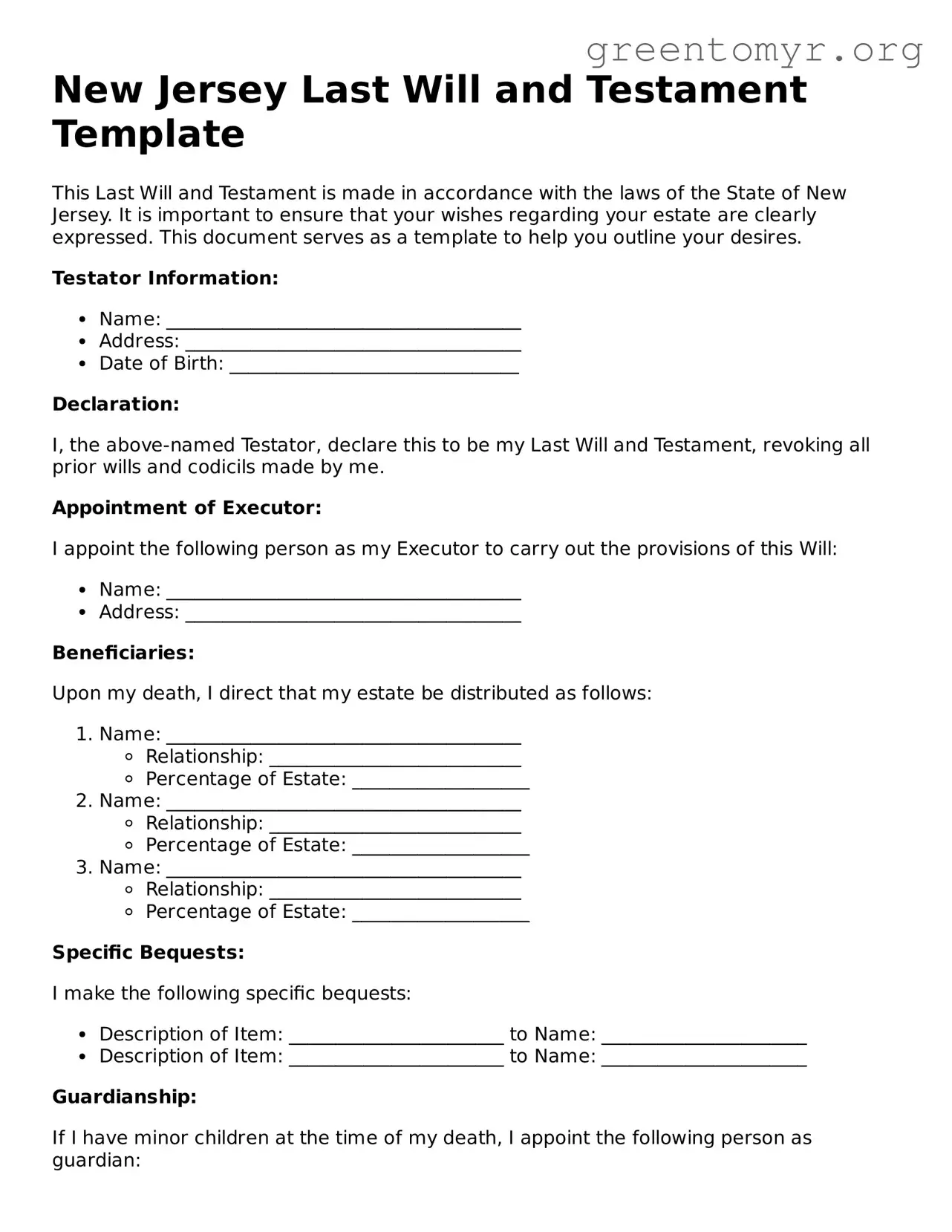
Creating a Last Will and Testament is an essential step in ensuring that your wishes are honored after your passing. In New Jersey, this legal document serves as a formal declaration of how you want your assets distributed, who will be responsible for managing your estate, and who will care for any minor children. The New Jersey Last Will and Testament form outlines important details such as the appointment of an executor, the identification of beneficiaries, and specific bequests. It also includes provisions for guardianship, should you have dependents. By clearly articulating your intentions, you can provide peace of mind for your loved ones and help avoid potential disputes. Understanding the structure and requirements of this form is vital, as it must adhere to state laws to be valid. Whether you are drafting a will for the first time or revisiting an existing one, being informed about the key components can make the process smoother and more effective.
New Jersey Last Will and Testament Template
This Last Will and Testament is made in accordance with the laws of the State of New Jersey. It is important to ensure that your wishes regarding your estate are clearly expressed. This document serves as a template to help you outline your desires.
Testator Information:
Declaration:
I, the above-named Testator, declare this to be my Last Will and Testament, revoking all prior wills and codicils made by me.
Appointment of Executor:
I appoint the following person as my Executor to carry out the provisions of this Will:
Beneficiaries:
Upon my death, I direct that my estate be distributed as follows:
Specific Bequests:
I make the following specific bequests:
Guardianship:
If I have minor children at the time of my death, I appoint the following person as guardian:
Signatures:
This Will is signed by me on this _____ day of ______________, 20____.
______________________________
(Testator's Signature)
Witnesses:
We, the undersigned witnesses, hereby attest that the Testator signed this Last Will and Testament in our presence.
| Fact Name | Description |
|---|---|
| Governing Law | The New Jersey Last Will and Testament is governed by the New Jersey Statutes Annotated (N.J.S.A.) 3B:3-1 et seq. |
| Requirements for Validity | To be valid, a will must be in writing, signed by the testator, and witnessed by at least two individuals who are present at the same time. |
| Revocation | A Last Will and Testament can be revoked by the testator at any time through a subsequent will or by physically destroying the document. |
| Self-Proving Wills | New Jersey allows for self-proving wills, which can simplify the probate process by including a notarized affidavit from the witnesses. |
| Age Requirement | In New Jersey, individuals must be at least 18 years old to create a valid Last Will and Testament. |
After obtaining the New Jersey Last Will and Testament form, the next step involves carefully filling it out to ensure that your wishes regarding the distribution of your assets are clearly documented. This process requires attention to detail and a thoughtful approach to your personal circumstances.
A Last Will and Testament is a legal document that outlines how a person’s assets and affairs should be managed after their death. In New Jersey, this document allows individuals to specify how they want their property distributed, name guardians for minor children, and appoint an executor to oversee the administration of their estate. Creating a will ensures that your wishes are honored and can help avoid disputes among family members.
In New Jersey, any individual who is at least 18 years old and of sound mind can create a Last Will and Testament. It is essential that the person understands the implications of the document and is not under any undue influence when making decisions about their estate. This means they should be able to comprehend the nature of their assets and the potential consequences of their choices.
To ensure that a Last Will and Testament is valid in New Jersey, the following requirements must be met:
It is advisable to have the will notarized, although it is not a requirement for validity.
Yes, you can change or revoke your Last Will and Testament at any time while you are alive and of sound mind. To make changes, you can create a new will that explicitly revokes the previous one or add a codicil, which is an amendment to the existing will. If you choose to revoke the will, you can do so by physically destroying it or by stating your intent to revoke in writing. Always ensure that any changes comply with New Jersey’s legal requirements.
If you pass away without a Last Will and Testament, you are considered to have died "intestate." In this case, New Jersey law will determine how your assets are distributed. The state has a hierarchy of heirs, which typically prioritizes spouses, children, and other relatives. Without a will, you lose the ability to control the distribution of your estate, which may lead to outcomes that do not align with your wishes.
While it is not legally required to have a lawyer draft your Last Will and Testament, consulting with one is highly recommended. A lawyer can provide valuable guidance to ensure that your will is legally sound and accurately reflects your wishes. They can also help address any complex issues, such as tax implications or unique family situations. If you choose to create a will on your own, make sure to follow all legal requirements to avoid potential challenges in the future.
Filling out a Last Will and Testament form in New Jersey can be a straightforward process, but several common mistakes can lead to complications. One frequent error is not clearly identifying the testator. The testator must provide their full legal name and address. If this information is incomplete or inaccurate, it can create confusion about the validity of the will.
Another mistake often made involves the selection of beneficiaries. Some individuals forget to specify alternate beneficiaries. If a primary beneficiary predeceases the testator without an alternate named, the assets may not be distributed according to the testator’s wishes. This oversight can lead to unintended consequences and disputes among surviving family members.
Additionally, failing to properly sign and date the will is a critical error. In New Jersey, the will must be signed in the presence of two witnesses, who must also sign the document. If these requirements are not met, the will may be considered invalid. Ensuring that the signing process is completed correctly is essential for the will to be legally binding.
People often neglect to update their wills after major life events, such as marriage, divorce, or the birth of a child. A will that does not reflect current circumstances can lead to confusion and conflict. Regularly reviewing and updating the will ensures that it accurately represents the testator’s intentions.
Finally, some individuals may not fully understand the implications of specific provisions included in their will. For instance, using vague language can lead to misinterpretation of the testator's wishes. It is crucial to be clear and precise when outlining how assets should be distributed. Taking the time to understand the language used can prevent future disputes and ensure that the will is executed as intended.
When preparing a Last Will and Testament in New Jersey, several other forms and documents often accompany it to ensure that your wishes are fully expressed and legally recognized. Understanding these documents can help streamline the estate planning process and provide peace of mind.
Having these documents in place can significantly ease the burden on your loved ones during a challenging time. Proper estate planning is not just about what you leave behind; it’s also about ensuring your wishes are honored and your family is taken care of. Be proactive in your planning to secure your legacy.
Living Will: A living will outlines a person's preferences for medical treatment in case they become unable to communicate their wishes. Like a Last Will and Testament, it serves to express individual desires regarding personal matters, but focuses specifically on health care decisions.
Power of Attorney: This document allows someone to make financial or legal decisions on behalf of another person. Similar to a Last Will and Testament, it provides a way to ensure that a person's wishes are respected, particularly when they cannot act for themselves.
Trust Agreement: A trust agreement establishes a trust to manage assets for beneficiaries. Like a Last Will and Testament, it addresses how a person's assets will be distributed, but it can take effect during the person's lifetime rather than only after death.
Advance Directive: An advance directive is a broader term that includes living wills and other documents outlining a person's healthcare preferences. It shares the goal of the Last Will and Testament in ensuring that an individual's wishes are honored when they can no longer express them.
Letter of Instruction: This informal document provides guidance to loved ones regarding personal wishes and funeral arrangements. While a Last Will and Testament is a legal document that dictates asset distribution, a letter of instruction can complement it by addressing personal matters and preferences.
When filling out the New Jersey Last Will and Testament form, it’s important to approach the process with care. Here are some key things to keep in mind:
By following these guidelines, you can help ensure that your wishes are honored and that your loved ones are taken care of after you’re gone.
Understanding the New Jersey Last Will and Testament form is crucial for effective estate planning. Unfortunately, several misconceptions can lead to confusion. Here are ten common misunderstandings:
By addressing these misconceptions, individuals can make informed decisions about their estate planning and ensure their wishes are properly documented.
When filling out and using the New Jersey Last Will and Testament form, consider these key takeaways:
Following these steps will help ensure that your wishes are respected and that the process is smooth for your loved ones.