In New Jersey, a Living Will is a crucial document that allows individuals to express their wishes regarding medical treatment in the event they become unable to communicate those wishes themselves. This form is designed to guide healthcare providers and loved ones in making decisions about life-sustaining treatments, ensuring that your preferences are honored even when you cannot voice them. Key aspects of the Living Will include specifying which medical interventions you would want or refuse, such as resuscitation efforts or artificial nutrition and hydration. It also provides a space to appoint a healthcare representative, someone you trust to make decisions on your behalf if you are incapacitated. By preparing a Living Will, you take an important step toward maintaining control over your medical care, allowing your family to focus on supporting you rather than debating treatment options during a difficult time.
New Jersey Living Will Template
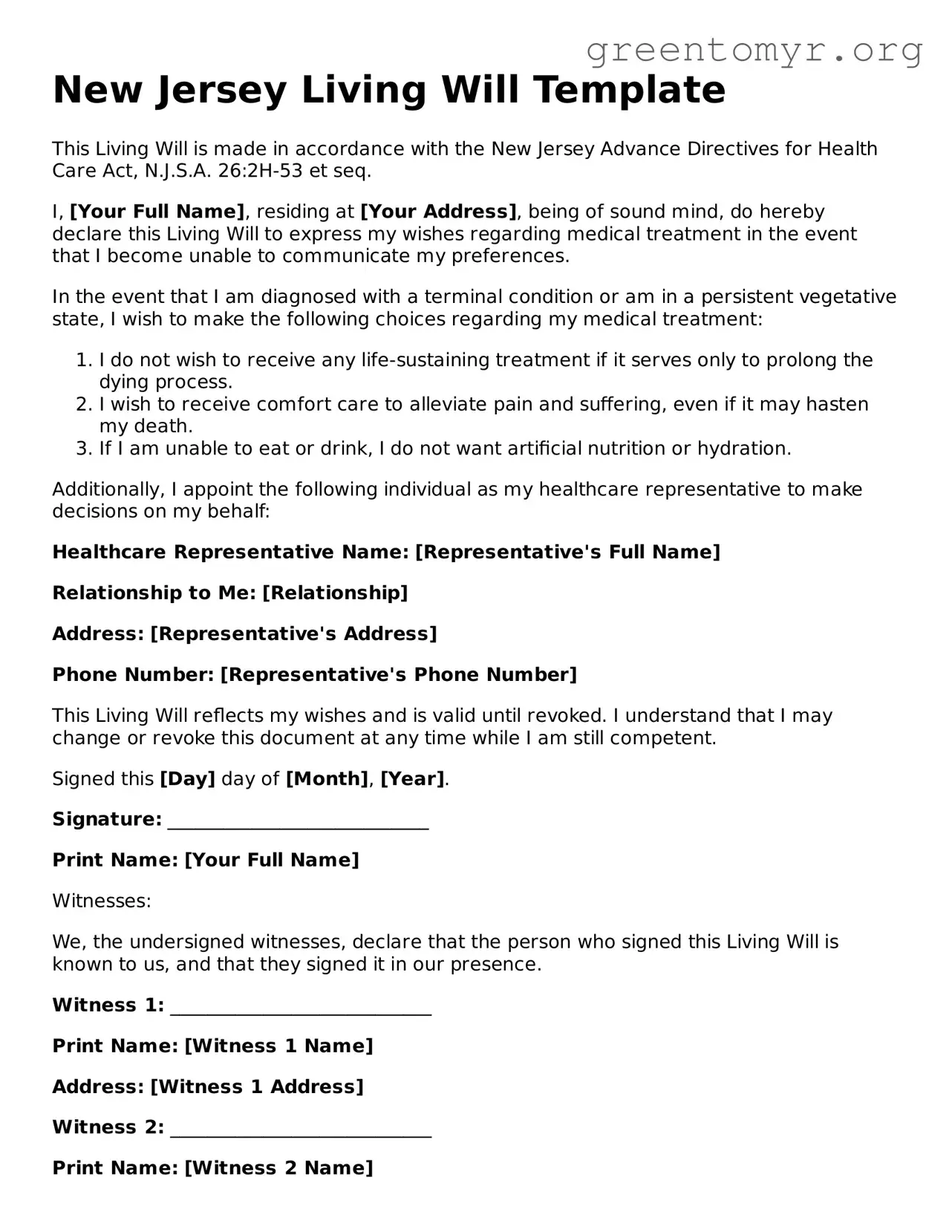
This Living Will is made in accordance with the New Jersey Advance Directives for Health Care Act, N.J.S.A. 26:2H-53 et seq.
I, [Your Full Name], residing at [Your Address], being of sound mind, do hereby declare this Living Will to express my wishes regarding medical treatment in the event that I become unable to communicate my preferences.
In the event that I am diagnosed with a terminal condition or am in a persistent vegetative state, I wish to make the following choices regarding my medical treatment:
Additionally, I appoint the following individual as my healthcare representative to make decisions on my behalf:
Healthcare Representative Name: [Representative's Full Name]
Relationship to Me: [Relationship]
Address: [Representative's Address]
Phone Number: [Representative's Phone Number]
This Living Will reflects my wishes and is valid until revoked. I understand that I may change or revoke this document at any time while I am still competent.
Signed this [Day] day of [Month], [Year].
Signature: ____________________________
Print Name: [Your Full Name]
Witnesses:
We, the undersigned witnesses, declare that the person who signed this Living Will is known to us, and that they signed it in our presence.
Witness 1: ____________________________
Print Name: [Witness 1 Name]
Address: [Witness 1 Address]
Witness 2: ____________________________
Print Name: [Witness 2 Name]
Address: [Witness 2 Address]
| Fact Name | Details |
|---|---|
| Governing Law | The New Jersey Living Will is governed by the New Jersey Statutes Annotated (N.J.S.A.) 26:2H-53 et seq. |
| Purpose | A Living Will allows individuals to outline their preferences for medical treatment in case they become unable to communicate their wishes. |
| Eligibility | Any adult resident of New Jersey can create a Living Will. |
| Witness Requirements | The Living Will must be signed in the presence of two witnesses who are not related to the individual or entitled to any portion of their estate. |
| Revocation | A Living Will can be revoked at any time by the individual, either verbally or in writing. |
| Use of Form | While a specific form is not required, it is advisable to use a standardized format to ensure clarity and compliance with state laws. |
Filling out a New Jersey Living Will form is an important step in ensuring that your healthcare preferences are known and respected. After completing the form, you will need to sign it and ensure that it is witnessed appropriately to make it legally binding.
Once you have completed these steps, store the Living Will in a safe place and share copies with your healthcare representative and family members. This ensures that your wishes are known and can be acted upon when necessary.
A Living Will is a legal document that allows individuals to outline their preferences for medical treatment in the event they become unable to communicate their wishes. In New Jersey, this document provides guidance to healthcare providers and loved ones regarding end-of-life decisions.
Any adult who is at least 18 years old and is of sound mind can create a Living Will in New Jersey. This includes individuals who are capable of understanding the nature and consequences of their decisions regarding medical treatment.
A Living Will should clearly state your wishes regarding:
Being specific helps ensure your wishes are honored.
To execute a Living Will in New Jersey, you must sign the document in the presence of two witnesses. These witnesses cannot be your healthcare providers or anyone who stands to benefit from your estate. Alternatively, you can have the document notarized.
Yes, you can change or revoke your Living Will at any time, as long as you are competent. To revoke it, you can destroy the document or create a new one that explicitly states your intention to revoke the previous version.
No, a Living Will and a Durable Power of Attorney for Healthcare are different documents. A Living Will focuses on your treatment preferences, while a Durable Power of Attorney designates someone to make healthcare decisions on your behalf if you are unable to do so.
No, you do not need a lawyer to create a Living Will in New Jersey. However, consulting with a legal professional can provide valuable guidance and ensure that your document meets all legal requirements.
Keep your Living Will in a safe but accessible place. Inform your family members and healthcare providers about its location. Consider giving copies to your healthcare proxy and loved ones so they can act on your wishes if needed.
If you do not have a Living Will, medical decisions may be made by your family members or healthcare providers based on what they believe is in your best interest. This can lead to confusion and disagreements during critical moments, making it important to have your wishes documented.
Completing a New Jersey Living Will form is an important step in ensuring that your healthcare wishes are respected. However, many individuals make mistakes during this process that can lead to confusion or even conflict among family members and healthcare providers. One common error is failing to specify clear and detailed instructions regarding medical treatments. Without explicit directions, healthcare professionals may be uncertain about your preferences, which can result in unwanted interventions.
Another mistake often made is neglecting to sign the document in the presence of a witness. In New Jersey, a Living Will must be signed by the individual and witnessed by at least one adult who is not a family member or a healthcare provider. Omitting this step can render the document invalid, leaving your wishes unprotected. It is crucial to ensure that all legal requirements are met to avoid complications in the future.
Additionally, individuals frequently overlook the importance of updating their Living Will as circumstances change. Major life events, such as marriage, divorce, or the diagnosis of a serious illness, can impact your healthcare preferences. Regularly reviewing and updating the document ensures that it accurately reflects your current wishes. Failing to do so can lead to situations where outdated instructions are followed, potentially causing distress for you and your loved ones.
Finally, some people mistakenly assume that a Living Will is the same as a Power of Attorney for healthcare. While both documents serve to express your medical preferences, they have different functions. A Living Will outlines your wishes regarding end-of-life care, while a Power of Attorney designates someone to make healthcare decisions on your behalf if you are unable to do so. Understanding this distinction is vital to ensure that your healthcare needs are fully addressed.
When preparing a New Jersey Living Will, it's essential to consider additional documents that can support your healthcare decisions. These forms help ensure that your wishes are respected and provide clarity to your loved ones and healthcare providers.
Having these documents in place alongside your Living Will can provide comprehensive guidance for your healthcare and end-of-life wishes. It's crucial to discuss these options with your family and healthcare providers to ensure everyone understands your preferences.
A Living Will is an important document that outlines an individual's wishes regarding medical treatment in the event they become unable to communicate those wishes themselves. Several other documents serve similar purposes, each with unique features. Here are six documents that share similarities with a Living Will:
Each of these documents plays a vital role in ensuring that individuals' wishes regarding medical treatment and care are respected, especially during challenging times.
When completing a Living Will form in New Jersey, it is essential to approach the process with care and consideration. Below is a list of important do's and don'ts to keep in mind.
Many people have misconceptions about the New Jersey Living Will form. Understanding the truth behind these beliefs can help individuals make informed decisions about their healthcare preferences. Here are four common misconceptions:
By clarifying these misconceptions, individuals can better navigate their healthcare choices and ensure their preferences are respected.
When considering a Living Will in New Jersey, understanding the key elements can greatly assist in making informed decisions. Here are some important takeaways:
By understanding these key aspects, individuals can better navigate the process of creating a Living Will that truly reflects their healthcare preferences.