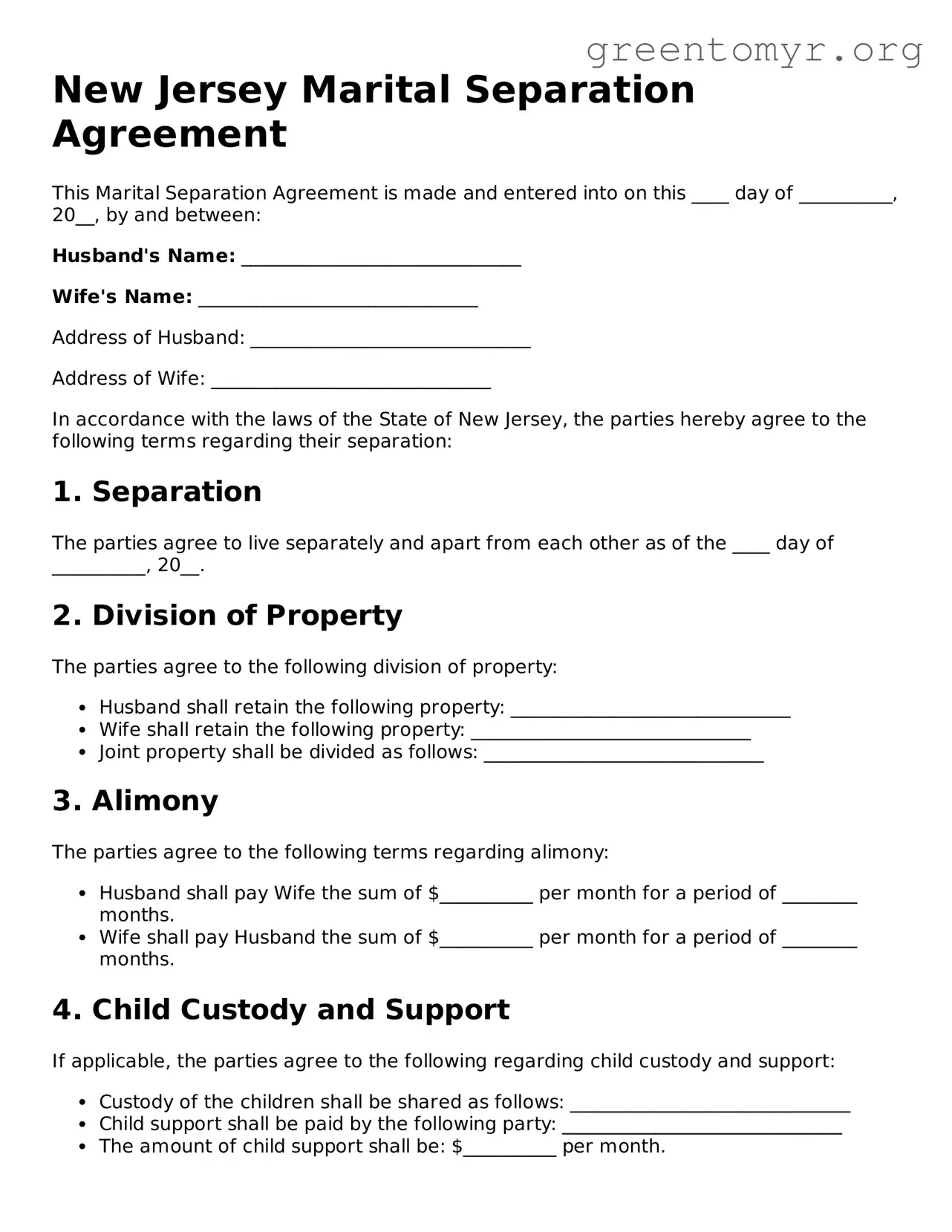
In New Jersey, a Marital Separation Agreement serves as a crucial tool for couples navigating the complexities of separation. This legally binding document outlines the terms and conditions agreed upon by both parties, addressing essential aspects such as the division of assets and debts, child custody arrangements, and spousal support. By clearly delineating responsibilities and expectations, the agreement helps to minimize conflict and confusion during a challenging time. It can cover various elements, including the care and financial support of children, visitation schedules, and the management of shared property. Ultimately, this form aims to provide a framework that protects the interests of both spouses while promoting a smoother transition into separate lives.
New Jersey Marital Separation Agreement
This Marital Separation Agreement is made and entered into on this ____ day of __________, 20__, by and between:
Husband's Name: ______________________________
Wife's Name: ______________________________
Address of Husband: ______________________________
Address of Wife: ______________________________
In accordance with the laws of the State of New Jersey, the parties hereby agree to the following terms regarding their separation:
1. Separation
The parties agree to live separately and apart from each other as of the ____ day of __________, 20__.
2. Division of Property
The parties agree to the following division of property:
3. Alimony
The parties agree to the following terms regarding alimony:
4. Child Custody and Support
If applicable, the parties agree to the following regarding child custody and support:
5. Health Insurance
The parties agree to the following regarding health insurance:
6. Miscellaneous
This agreement constitutes the entire understanding between the parties. No modifications shall be valid unless in writing and signed by both parties.
IN WITNESS WHEREOF, the parties have executed this Marital Separation Agreement as of the date first above written.
______________________________
Husband's Signature
______________________________
Wife's Signature
______________________________
Date
| Fact Name | Details |
|---|---|
| Definition | A Marital Separation Agreement outlines the terms of separation between spouses, including division of assets, debts, and responsibilities. |
| Governing Law | The agreement is governed by New Jersey state law, specifically under the New Jersey Statutes Annotated (N.J.S.A.) Title 2A. |
| Voluntary Nature | Both parties must voluntarily agree to the terms outlined in the agreement for it to be valid. |
| Written Requirement | The agreement must be in writing to be enforceable in court. |
| Not a Divorce | It is important to note that a separation agreement does not legally end the marriage. |
| Child Custody | The agreement can include provisions for child custody and support, addressing the best interests of the children. |
| Asset Division | Assets and debts must be clearly outlined and divided according to the agreement to avoid future disputes. |
| Modification | Changes to the agreement can be made if both parties consent to the modifications in writing. |
After obtaining the New Jersey Marital Separation Agreement form, you will need to complete it carefully. Ensure that all information is accurate and clearly presented. This will help in the processing of your agreement.
Once the form is completed, you can proceed with filing it according to local requirements. Ensure you keep copies for your records.
A Marital Separation Agreement is a legal document that outlines the terms and conditions under which a couple agrees to live apart while still legally married. This agreement can cover various aspects such as division of property, child custody, and financial responsibilities. It serves to clarify the rights and obligations of each party during the separation period.
Couples may choose to create a Marital Separation Agreement for several reasons:
While the specifics can vary based on individual circumstances, a comprehensive Marital Separation Agreement typically includes:
Yes, a Marital Separation Agreement can be legally binding if both parties voluntarily agree to its terms and sign the document. However, it is essential for both individuals to understand the agreement fully and, ideally, seek legal advice before signing. This can help ensure that the agreement is fair and enforceable in court.
A Marital Separation Agreement is a temporary arrangement that allows couples to live apart while still being legally married. In contrast, a divorce is the legal dissolution of the marriage. A separation agreement may be used as a precursor to divorce, helping to outline terms that can later be formalized in a divorce settlement.
Yes, a Marital Separation Agreement can be modified if both parties agree to the changes. It is advisable to document any modifications in writing and have both parties sign the revised agreement. This helps maintain clarity and ensures that both individuals are on the same page regarding any new terms.
Couples can create a Marital Separation Agreement by following these steps:
Filling out a Marital Separation Agreement form in New Jersey can be a daunting task, and many individuals make common mistakes that can lead to complications down the road. One frequent error is failing to provide accurate information about assets and debts. When individuals underestimate or overlook certain properties, they may end up with an unfair division of marital assets. It is crucial to take the time to thoroughly assess all financial holdings and obligations before submitting the agreement.
Another mistake often made is not considering the tax implications of the separation. Many people overlook how their decisions regarding asset division might affect their tax situation. For example, transferring ownership of a home or investment account can have significant tax consequences. Understanding these implications can help individuals make more informed choices and avoid unexpected financial burdens.
Additionally, some individuals rush through the process without fully understanding the terms they are agreeing to. A Marital Separation Agreement is a legally binding document, and it is essential to comprehend each provision before signing. Misinterpretations can lead to future disputes or unintended consequences. Seeking legal advice can provide clarity and help ensure that the agreement reflects one's intentions accurately.
Another common pitfall is neglecting to address child custody and support arrangements adequately. When parents separate, it is vital to consider the best interests of the children involved. Failing to outline clear custody and support terms can lead to confusion and conflict later on. A well-defined plan can provide stability for children and reduce the likelihood of future disagreements.
Finally, some individuals may forget to include provisions for future modifications. Life circumstances can change, and having a flexible agreement allows for adjustments as needed. Not including this option can lead to complications if either party's situation evolves, making it more difficult to reach an amicable resolution in the future. Being proactive about potential changes can save time and stress later on.
A Marital Separation Agreement is an important document for couples who decide to live apart but are not yet divorced. Along with this agreement, there are several other forms and documents that may be necessary to ensure a smooth separation process. Here’s a list of some commonly used documents in New Jersey:
Each of these documents plays a crucial role in the separation process. They help clarify responsibilities and protect the interests of both parties, especially when children are involved. Understanding these forms can make the transition smoother for everyone.
The Marital Separation Agreement form shares similarities with several other legal documents. Below is a list of seven documents that are comparable to the Marital Separation Agreement:
When completing the New Jersey Marital Separation Agreement form, it's essential to approach the process with care. Here are some important dos and don'ts to keep in mind:
The New Jersey Marital Separation Agreement form is often misunderstood. Below are six common misconceptions, along with clarifications to provide a better understanding.
A marital separation agreement is not a divorce. It is a legal document that outlines the terms of a couple's separation, including asset division and child custody, while divorce formally ends the marriage.
Even couples without children can benefit from a marital separation agreement. This document helps clarify financial obligations and property division, regardless of whether children are part of the equation.
A marital separation agreement can be modified after it has been signed, provided both parties agree to the changes. This flexibility allows couples to adapt to changing circumstances.
While a marital separation agreement outlines terms, it does not guarantee that a court will uphold all provisions during divorce proceedings. Courts may modify terms based on fairness and legal standards.
While individuals can create a marital separation agreement without legal counsel, it is advisable to seek legal representation. An attorney can ensure that the agreement complies with state laws and adequately protects one's interests.
A marital separation agreement is not a permanent solution. It serves as a temporary arrangement until the couple decides on a divorce or reconciliation. Couples may choose to revisit and revise the agreement as needed.
When filling out and using the New Jersey Marital Separation Agreement form, there are several important points to consider. Here are key takeaways to keep in mind:
By following these guidelines, individuals can navigate the process of creating a Marital Separation Agreement more effectively. Clarity and thoroughness are key to a successful separation.