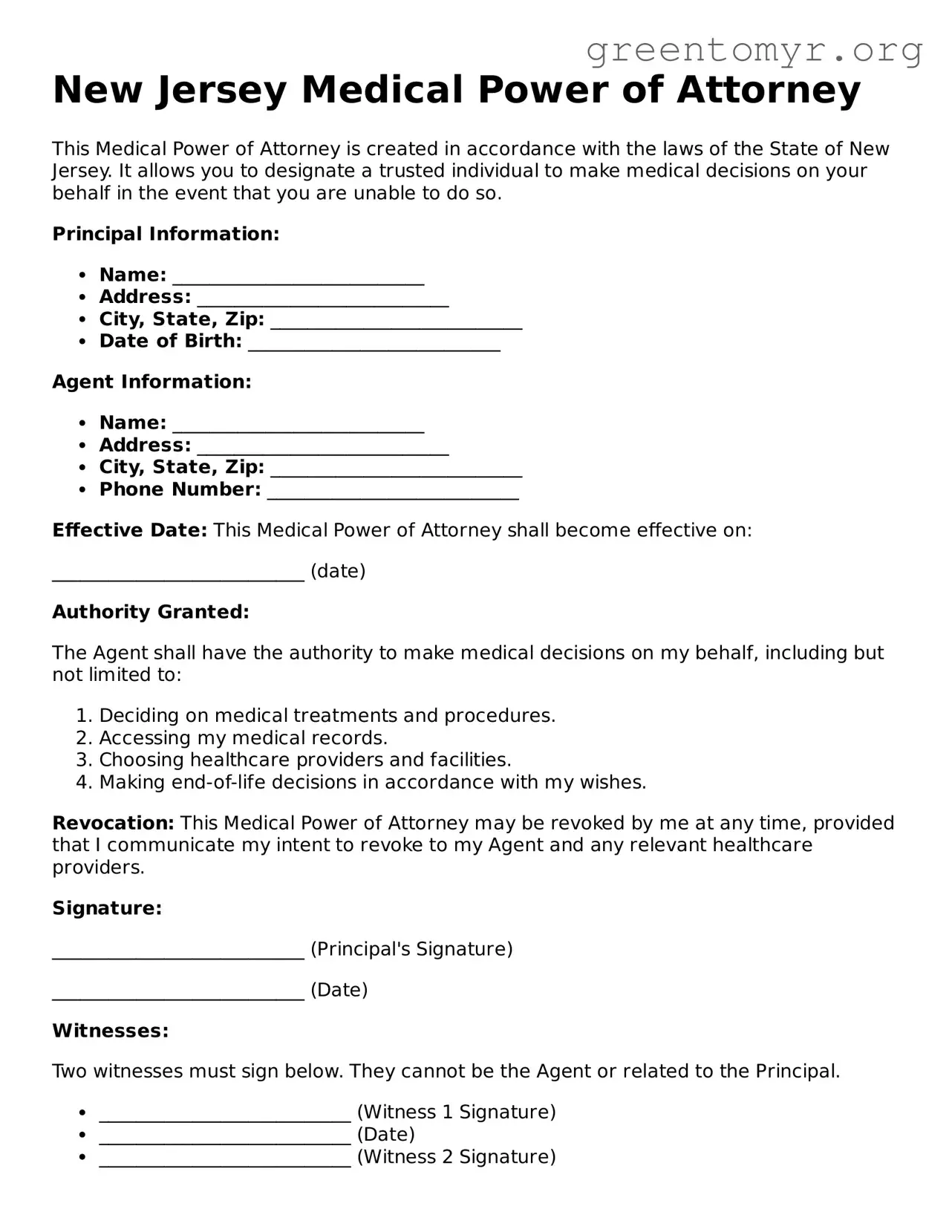
In New Jersey, the Medical Power of Attorney form serves as a vital tool for individuals wishing to ensure their healthcare preferences are honored when they are unable to communicate their wishes. This legal document allows a person, known as the principal, to designate a trusted individual, referred to as the agent or proxy, to make medical decisions on their behalf. The form typically covers various aspects, including the types of medical treatments the principal would want or refuse, the authority granted to the agent, and any specific instructions regarding end-of-life care. It is essential for individuals to thoughtfully consider who they appoint as their agent, as this person will play a crucial role in making healthcare choices during critical times. Additionally, the form can be tailored to reflect personal values and beliefs, ensuring that the principal's wishes are respected. By completing this document, individuals can gain peace of mind, knowing that their healthcare decisions will align with their preferences, even when they cannot voice them themselves.
New Jersey Medical Power of Attorney
This Medical Power of Attorney is created in accordance with the laws of the State of New Jersey. It allows you to designate a trusted individual to make medical decisions on your behalf in the event that you are unable to do so.
Principal Information:
Agent Information:
Effective Date: This Medical Power of Attorney shall become effective on:
___________________________ (date)
Authority Granted:
The Agent shall have the authority to make medical decisions on my behalf, including but not limited to:
Revocation: This Medical Power of Attorney may be revoked by me at any time, provided that I communicate my intent to revoke to my Agent and any relevant healthcare providers.
Signature:
___________________________ (Principal's Signature)
___________________________ (Date)
Witnesses:
Two witnesses must sign below. They cannot be the Agent or related to the Principal.
Notary Public:
State of New Jersey, County of _______________
Subscribed and sworn to before me this ____ day of __________, 20__.
___________________________ (Notary Public Signature)
My commission expires: ________________
| Fact Name | Description |
|---|---|
| Definition | A New Jersey Medical Power of Attorney form allows individuals to designate an agent to make healthcare decisions on their behalf if they become unable to do so. |
| Governing Law | This form is governed by the New Jersey Advance Directives for Health Care Act, N.J.S.A. 26:2H-53 et seq. |
| Agent Requirements | The appointed agent must be at least 18 years old and cannot be a healthcare provider currently involved in the individual's care. |
| Execution Requirements | The form must be signed by the principal in the presence of two witnesses or a notary public to be valid. |
| Revocation | The principal can revoke the Medical Power of Attorney at any time, provided they are competent to do so. |
| Durability | This document remains effective even if the principal becomes incapacitated, ensuring continuous representation in healthcare decisions. |
| Related Documents | It is often recommended to complete a living will alongside the Medical Power of Attorney to provide clear guidance on healthcare preferences. |
Filling out the New Jersey Medical Power of Attorney form is an important step in ensuring that your healthcare wishes are respected. Once you have completed the form, it should be signed and witnessed to be valid. Below are the steps to help you fill out the form correctly.
A Medical Power of Attorney (MPOA) in New Jersey is a legal document that allows you to appoint someone to make healthcare decisions on your behalf if you become unable to do so. This person, known as your agent or proxy, will have the authority to make medical choices based on your wishes and best interests.
You can choose any competent adult to be your agent. This can be a family member, friend, or trusted individual. However, there are some restrictions. For example, your healthcare provider or an employee of your healthcare provider cannot serve as your agent unless they are related to you.
To create an MPOA in New Jersey, follow these steps:
Yes, you can change or revoke your MPOA at any time as long as you are mentally competent. To revoke it, simply create a new MPOA or provide a written statement that clearly indicates your intention to revoke the previous document. Inform your agent and any healthcare providers of the change to avoid confusion.
If you do not have an MPOA and become unable to make your own medical decisions, your family members may need to go through a legal process to obtain guardianship. This can be time-consuming and may not reflect your personal wishes. Having an MPOA ensures that your preferences are honored and that someone you trust is making decisions for you.
Filling out a Medical Power of Attorney form in New Jersey is a significant step in ensuring that your healthcare wishes are respected. However, many people make common mistakes that can lead to complications down the line. Understanding these pitfalls can help you avoid them.
One frequent error is not clearly identifying the appointed agent. It is crucial to provide the full name and contact information of the person you trust to make medical decisions on your behalf. Without this information, the document may be considered incomplete or invalid.
Another mistake is failing to specify the powers granted to the agent. The form should clearly outline what decisions your agent can make regarding your medical treatment. If this section is vague or left blank, it may lead to confusion when decisions need to be made.
Many individuals overlook the importance of witnessing and notarization. In New Jersey, the Medical Power of Attorney must be signed in front of a witness and may also require notarization. Neglecting these steps can render the document unenforceable.
Additionally, some people do not date their forms. A lack of a date can create ambiguity regarding when the document was executed, which may lead to disputes about its validity. Always include the date to ensure clarity.
Another common mistake involves not reviewing the form for accuracy. Simple typos or incorrect information can lead to significant issues. It is essential to double-check all entries to ensure that everything is correct before finalizing the document.
Failing to communicate your wishes with your appointed agent is another critical oversight. It is vital that your agent understands your healthcare preferences. Without this conversation, they may struggle to make decisions that align with your values and desires.
Some individuals forget to update their Medical Power of Attorney when their circumstances change. Life events such as marriage, divorce, or the death of a previously appointed agent necessitate a review and possible revision of the document.
Another mistake is not providing copies of the signed form to relevant parties. After completing the Medical Power of Attorney, it is important to share copies with your agent, healthcare providers, and family members. This ensures that everyone is aware of your wishes.
Lastly, neglecting to consider alternative agents can lead to complications. It is wise to designate a backup agent in case your primary choice is unable or unwilling to act. This step can prevent delays in decision-making during critical times.
By being aware of these common mistakes, you can take the necessary steps to ensure that your Medical Power of Attorney is completed correctly. This document is a vital part of your healthcare planning, and getting it right is essential for your peace of mind.
When considering a New Jersey Medical Power of Attorney, it is important to understand other related documents that can support your healthcare decisions. These forms work together to ensure that your wishes are honored and that your healthcare is managed according to your preferences. Below is a list of commonly used forms alongside the Medical Power of Attorney.
Understanding these forms can help you create a comprehensive plan for your healthcare. Each document plays a unique role in ensuring that your medical wishes are respected, making it easier for your loved ones and healthcare providers to act in accordance with your desires.
A Medical Power of Attorney (MPOA) is an important document that allows you to appoint someone to make healthcare decisions on your behalf if you become unable to do so. While the MPOA has its unique features, it shares similarities with several other legal documents. Here are six documents that are similar to the Medical Power of Attorney, along with a brief explanation of how they relate:
Understanding these documents can empower you to make informed decisions about your healthcare and legal rights. Each serves a distinct purpose, yet they all aim to ensure that your wishes are honored when you are unable to voice them yourself.
When filling out the New Jersey Medical Power of Attorney form, it’s essential to approach the task with care. This document allows you to designate someone to make medical decisions on your behalf if you become unable to do so. Here are some important dos and don’ts to keep in mind:
Understanding the New Jersey Medical Power of Attorney form is crucial for anyone looking to make informed decisions about their healthcare. However, several misconceptions can cloud this important topic. Below is a list of common misunderstandings about the form, along with clarifications to help you navigate the process.
This is not true. The Medical Power of Attorney is effective whenever a person is unable to make their own medical decisions, regardless of their health status.
While consulting a lawyer can be beneficial, individuals can prepare their own Medical Power of Attorney using state-approved forms, as long as they meet the legal requirements.
This is incorrect. A Medical Power of Attorney specifically grants authority for healthcare decisions only. For financial matters, a separate document, like a Durable Power of Attorney, is needed.
The agent must act according to the wishes outlined in the Medical Power of Attorney. They cannot make decisions that contradict the principal's stated preferences.
In reality, the principal can revoke the Medical Power of Attorney at any time, as long as they are mentally competent to do so.
In New Jersey, while it's a good practice to have a witness, it is not a legal requirement for the Medical Power of Attorney to be valid.
This misconception overlooks the fact that anyone, regardless of age, can benefit from having a Medical Power of Attorney in place to ensure their healthcare wishes are honored.
This is false. Individuals can update or change their Medical Power of Attorney whenever they wish, as long as they follow the proper legal procedures.
Being informed about these misconceptions can empower you to make the best choices for your healthcare planning. Always consider discussing your specific situation with a qualified professional to ensure your documents meet your needs.
Filling out and using the New Jersey Medical Power of Attorney form is an important step in ensuring that your healthcare wishes are respected. Below are key takeaways to consider: