Content Navigation

When buying or selling a mobile home in New Jersey, having a Mobile Home Bill of Sale form is essential to ensure a smooth transaction. This form serves as a legal document that outlines the details of the sale, including the names and addresses of both the buyer and seller, the mobile home’s identification details, and the purchase price. It also provides space for important disclosures, such as any liens on the property and the condition of the mobile home at the time of sale. By using this form, both parties can protect their interests, as it creates a clear record of the transaction and helps prevent future disputes. Whether you are a seasoned buyer or a first-time seller, understanding the components of the Mobile Home Bill of Sale is crucial for navigating the process with confidence.

New Jersey Mobile Home Bill of Sale Example

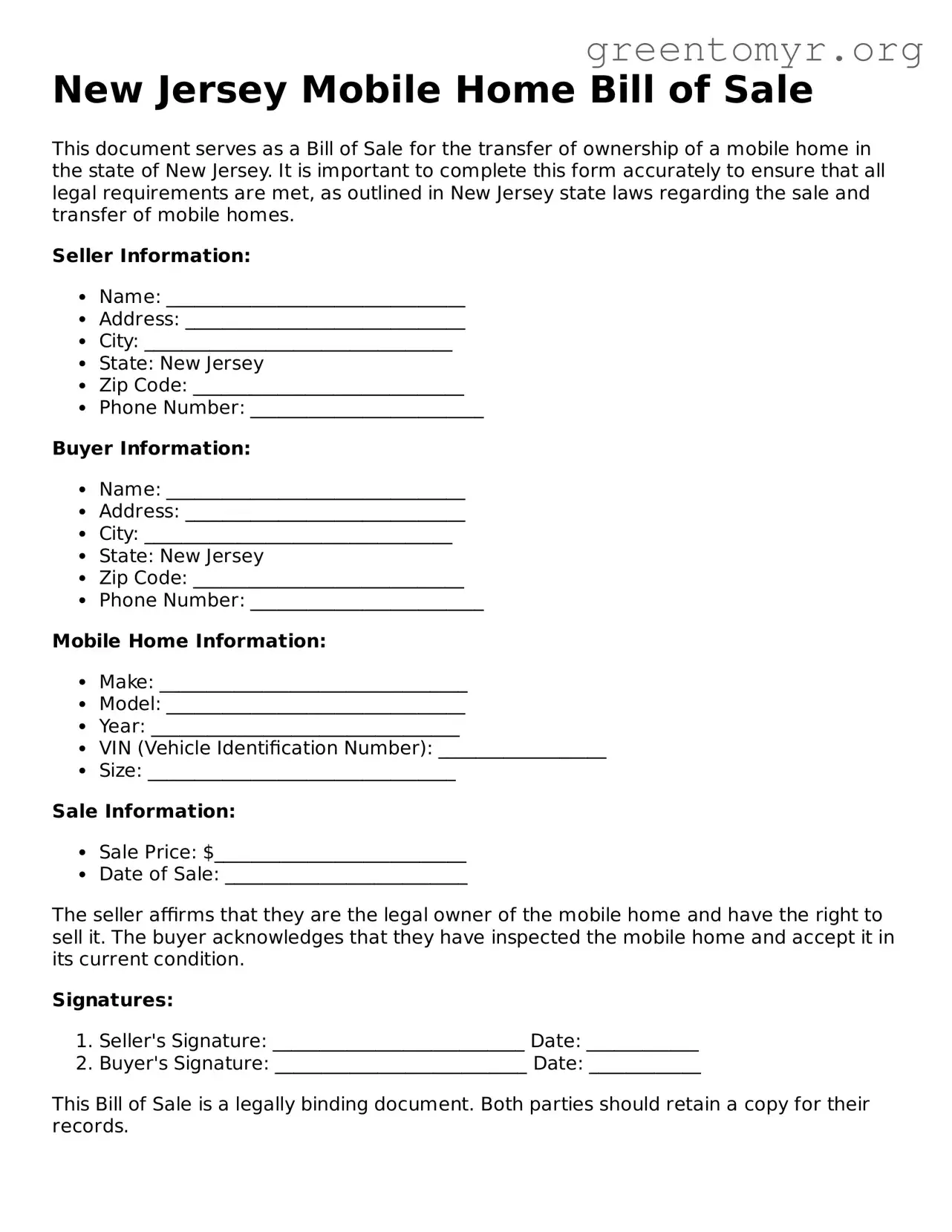
New Jersey Mobile Home Bill of Sale

This document serves as a Bill of Sale for the transfer of ownership of a mobile home in the state of New Jersey. It is important to complete this form accurately to ensure that all legal requirements are met, as outlined in New Jersey state laws regarding the sale and transfer of mobile homes.

Seller Information:

  • Name: ________________________________
  • Address: ______________________________
  • City: _________________________________
  • State: New Jersey
  • Zip Code: _____________________________
  • Phone Number: _________________________

Buyer Information:

  • Name: ________________________________
  • Address: ______________________________
  • City: _________________________________
  • State: New Jersey
  • Zip Code: _____________________________
  • Phone Number: _________________________

Mobile Home Information:

  • Make: _________________________________
  • Model: ________________________________
  • Year: _________________________________
  • VIN (Vehicle Identification Number): __________________
  • Size: _________________________________

Sale Information:

  • Sale Price: $___________________________
  • Date of Sale: __________________________

The seller affirms that they are the legal owner of the mobile home and have the right to sell it. The buyer acknowledges that they have inspected the mobile home and accept it in its current condition.

Signatures:

  1. Seller's Signature: ___________________________ Date: ____________
  2. Buyer's Signature: ___________________________ Date: ____________

This Bill of Sale is a legally binding document. Both parties should retain a copy for their records.

PDF Form Features

Fact Name Description
Purpose The New Jersey Mobile Home Bill of Sale form is used to document the sale of a mobile home.
Governing Law This form is governed by New Jersey state laws regarding the sale and transfer of personal property.
Parties Involved The form requires the names and addresses of both the seller and the buyer.
Mobile Home Details Specific details about the mobile home, such as make, model, and VIN, must be included.
Purchase Price The agreed-upon purchase price for the mobile home should be clearly stated.
Date of Sale The date on which the sale occurs must be documented on the form.
Signatures Required Both the seller and buyer must sign the form to validate the transaction.
Notarization While notarization is not always required, it can provide additional legal protection.
Record Keeping Both parties should keep a copy of the completed form for their records.

Guide to Using New Jersey Mobile Home Bill of Sale

After obtaining the New Jersey Mobile Home Bill of Sale form, you will need to complete it carefully. This document serves as proof of the sale and transfer of ownership for a mobile home. Ensure that all information is accurate to avoid potential issues in the future.

  1. Begin by entering the date of the sale at the top of the form.
  2. Provide the full name and address of the seller. Make sure to include the city, state, and ZIP code.
  3. Next, fill in the buyer's full name and address, including city, state, and ZIP code.
  4. Clearly describe the mobile home. Include details such as the make, model, year, and Vehicle Identification Number (VIN).
  5. Indicate the sale price of the mobile home. Be specific about the amount agreed upon.
  6. If applicable, note any additional terms or conditions of the sale. This may include items included in the sale or any warranties provided.
  7. Both the seller and buyer must sign and date the form at the designated areas. Ensure that signatures are clear and legible.
  8. Make copies of the completed form for both parties for their records.

Get Answers on New Jersey Mobile Home Bill of Sale

What is a Mobile Home Bill of Sale in New Jersey?

A Mobile Home Bill of Sale is a legal document that serves as proof of the sale and transfer of ownership of a mobile home from one party to another. In New Jersey, this form is essential for both the seller and the buyer, as it outlines the details of the transaction, including the sale price, the condition of the mobile home, and any warranties or representations made by the seller.

Why is a Mobile Home Bill of Sale necessary?

This document is crucial for several reasons:

  • It provides legal evidence of the transaction, protecting both parties in case of disputes.
  • It helps establish a clear chain of ownership, which is important for future sales or transfers.
  • It may be required by the state for registration purposes, ensuring that the mobile home is properly titled in the new owner's name.

What information is typically included in the form?

The Mobile Home Bill of Sale generally includes the following information:

  1. The names and addresses of both the seller and the buyer.
  2. A detailed description of the mobile home, including its make, model, year, and Vehicle Identification Number (VIN).
  3. The sale price and payment terms.
  4. Any warranties or representations made by the seller regarding the condition of the mobile home.
  5. The date of the sale.

How is the Mobile Home Bill of Sale completed?

Completing the Mobile Home Bill of Sale involves several steps:

  • Both parties should carefully review the form to ensure all necessary information is included.
  • Accurate descriptions of the mobile home and transaction details must be provided.
  • Once completed, both the seller and the buyer should sign and date the document to make it legally binding.

Do I need to have the Mobile Home Bill of Sale notarized?

In New Jersey, notarization is not typically required for a Mobile Home Bill of Sale. However, having the document notarized can add an extra layer of authenticity and may help prevent disputes in the future. It is advisable to check with local regulations or consult with a legal professional for specific requirements.

Where can I obtain a Mobile Home Bill of Sale form?

You can obtain a Mobile Home Bill of Sale form from various sources:

  • Online legal document providers often offer customizable templates.
  • Local government offices or the New Jersey Division of Motor Vehicles may have official forms available.
  • Consulting with a real estate attorney can ensure that you have the correct form and that it meets all legal requirements.

Common mistakes

Filling out the New Jersey Mobile Home Bill of Sale form can be straightforward, but several common mistakes can lead to complications. One frequent error is failing to provide complete information about the mobile home. It's essential to include details such as the make, model, year, and Vehicle Identification Number (VIN). Omitting any of this information can create issues when transferring ownership.

Another mistake often made is not including the correct names of the buyer and seller. Both parties must ensure that their names are spelled correctly and match the names on their identification. Any discrepancies can result in delays or even disputes over ownership.

Many individuals overlook the need for signatures. Both the buyer and seller must sign the form to validate the transaction. Failing to do so can render the Bill of Sale ineffective, complicating the transfer process.

Some people also forget to date the form. Including the date of the transaction is crucial for establishing when the sale occurred. This information can be important for tax purposes and future ownership verification.

Another common mistake is not providing the sale price. The form should clearly state the amount agreed upon for the mobile home. Without this information, the transaction may lack clarity, leading to potential misunderstandings between the buyer and seller.

Lastly, individuals sometimes neglect to check local regulations regarding the sale of mobile homes. Each municipality may have specific requirements or additional paperwork that must be completed. Being unaware of these regulations can result in fines or complications in the sale process.

Documents used along the form

When transferring ownership of a mobile home in New Jersey, several documents may accompany the Mobile Home Bill of Sale. Each of these forms plays a crucial role in ensuring a smooth transaction and compliance with state regulations.

  • Title Certificate: This document proves ownership of the mobile home. It must be transferred from the seller to the buyer during the sale.
  • Manufacturer's Certificate of Origin (MCO): If the mobile home is new, this certificate is issued by the manufacturer. It serves as proof of the mobile home's origin and is necessary for registration.
  • Affidavit of Affixation: This form is used when a mobile home is permanently attached to land. It helps establish that the home is no longer considered personal property.
  • Sales Tax Form: New Jersey requires the payment of sales tax on mobile home purchases. This form documents the tax paid and is essential for the buyer's records.
  • Transfer of Title Application: This application must be submitted to the New Jersey Motor Vehicle Commission to officially record the change in ownership.
  • Bill of Sale for Personal Property: If any additional items are included in the sale, such as appliances or furniture, this document outlines those items and their agreed-upon value.

Using these documents in conjunction with the Mobile Home Bill of Sale will help ensure a legally sound transfer of ownership and protect the interests of both parties involved in the transaction.

Similar forms

  • Vehicle Bill of Sale: Similar to the Mobile Home Bill of Sale, this document transfers ownership of a vehicle. It includes details about the buyer, seller, and the vehicle itself, such as make, model, and VIN.

  • Boat Bill of Sale: This form serves a similar purpose for boats. It outlines the sale terms, including the boat's specifications and the identities of the parties involved, ensuring a clear transfer of ownership.

  • Real Estate Purchase Agreement: While more complex, this document also facilitates the transfer of ownership. It details the property, purchase price, and terms of sale, similar to how the Mobile Home Bill of Sale outlines the sale of a mobile home.

  • Equipment Bill of Sale: Used for transferring ownership of equipment, this document shares similarities in structure and purpose. It specifies the equipment details and the parties involved, ensuring a legal transfer of ownership.

Dos and Don'ts

When filling out the New Jersey Mobile Home Bill of Sale form, it is essential to follow specific guidelines to ensure accuracy and compliance. Here is a list of things you should and shouldn't do:

  • Do provide accurate information about the mobile home, including make, model, and year.
  • Do include the Vehicle Identification Number (VIN) for identification purposes.
  • Do clearly state the purchase price in the designated section.
  • Do ensure both the buyer and seller sign the form.
  • Do date the document to indicate when the sale occurred.
  • Don't leave any sections blank; fill out all required fields.
  • Don't use incorrect or outdated information about the mobile home.
  • Don't forget to make copies of the completed form for both parties.
  • Don't alter the form in any way that could misrepresent the sale.
  • Don't submit the form without verifying all details are correct.

Misconceptions

There are several misconceptions surrounding the New Jersey Mobile Home Bill of Sale form. Understanding these can help clarify the process and ensure that all parties involved are informed. Below is a list of common misconceptions:

  • The form is only necessary for sales between private parties. This is not true. The form is required for any transfer of ownership, regardless of whether it is between individuals or through a dealership.
  • Once the Bill of Sale is signed, the transaction is final. While signing the form is an important step, it does not automatically finalize the sale. Other steps, like transferring the title, must also be completed.
  • The Bill of Sale serves as a title. The Bill of Sale is not the same as a title. It acts as proof of the transaction but does not provide legal ownership on its own.
  • All mobile homes require a Bill of Sale. Some mobile homes may not require a Bill of Sale if they are being transferred as part of a larger property sale or if they are being gifted.
  • Only licensed dealers can sell mobile homes. This is incorrect. Individuals can sell their mobile homes privately, but they must still complete the Bill of Sale form.
  • The form is the same for all states. Each state has its own requirements and forms. The New Jersey Mobile Home Bill of Sale is specific to New Jersey and may differ from those in other states.
  • Notarization is always required. In New Jersey, notarization is not always necessary for the Bill of Sale. However, it is recommended for added security and verification.
  • There is no fee associated with the Bill of Sale. While there may not be a fee for the form itself, there could be costs related to title transfer or registration.
  • The form can be filled out after the sale is complete. It is best practice to complete the Bill of Sale at the time of the sale to ensure all details are accurately captured.
  • Once the form is filed, it cannot be changed. If there are errors or changes needed after filing, amendments can typically be made, but it’s important to follow the correct procedures.

Being informed about these misconceptions can help individuals navigate the sale of mobile homes in New Jersey more effectively. Always consult with a professional if you have questions or need assistance with the process.

Key takeaways

When filling out and using the New Jersey Mobile Home Bill of Sale form, keep the following key takeaways in mind:

  1. Accurate Information: Ensure all information provided is accurate. This includes the names of both the buyer and seller, as well as the mobile home details.
  2. Identification: Both parties should provide valid identification to verify their identities during the transaction.
  3. Mobile Home Details: Include the make, model, year, and Vehicle Identification Number (VIN) of the mobile home.
  4. Purchase Price: Clearly state the purchase price of the mobile home in the form. This amount should reflect the agreed-upon price.
  5. Signatures Required: Both the buyer and seller must sign the form to validate the transaction.
  6. Notarization: While notarization is not always required, it is recommended to add an extra layer of security to the sale.
  7. Delivery of Title: The seller should provide the title to the buyer at the time of sale, ensuring a smooth transfer of ownership.
  8. Record Keeping: Keep a copy of the completed Bill of Sale for your records. This document serves as proof of the transaction.
  9. Local Regulations: Be aware of any local regulations or requirements that may apply to mobile home sales in your area.

Completing the New Jersey Mobile Home Bill of Sale form correctly can help ensure a successful transaction. Take the time to review all details before finalizing the sale.