The New Jersey Motor Vehicle Power of Attorney form serves as an important legal document that allows individuals to appoint someone else to handle specific motor vehicle-related tasks on their behalf. This includes transactions such as registering a vehicle, transferring ownership, or obtaining a title. By completing this form, the principal grants authority to an agent, who can then act in their stead, ensuring that necessary actions are taken without requiring the principal's direct involvement. This form is particularly useful in situations where the principal is unable to attend to these matters personally, whether due to distance, health issues, or other obligations. It is essential to ensure that the form is filled out correctly, as any errors could lead to complications in the processing of motor vehicle transactions. Understanding the requirements and implications of this form can help individuals make informed decisions when it comes to managing their motor vehicle affairs.
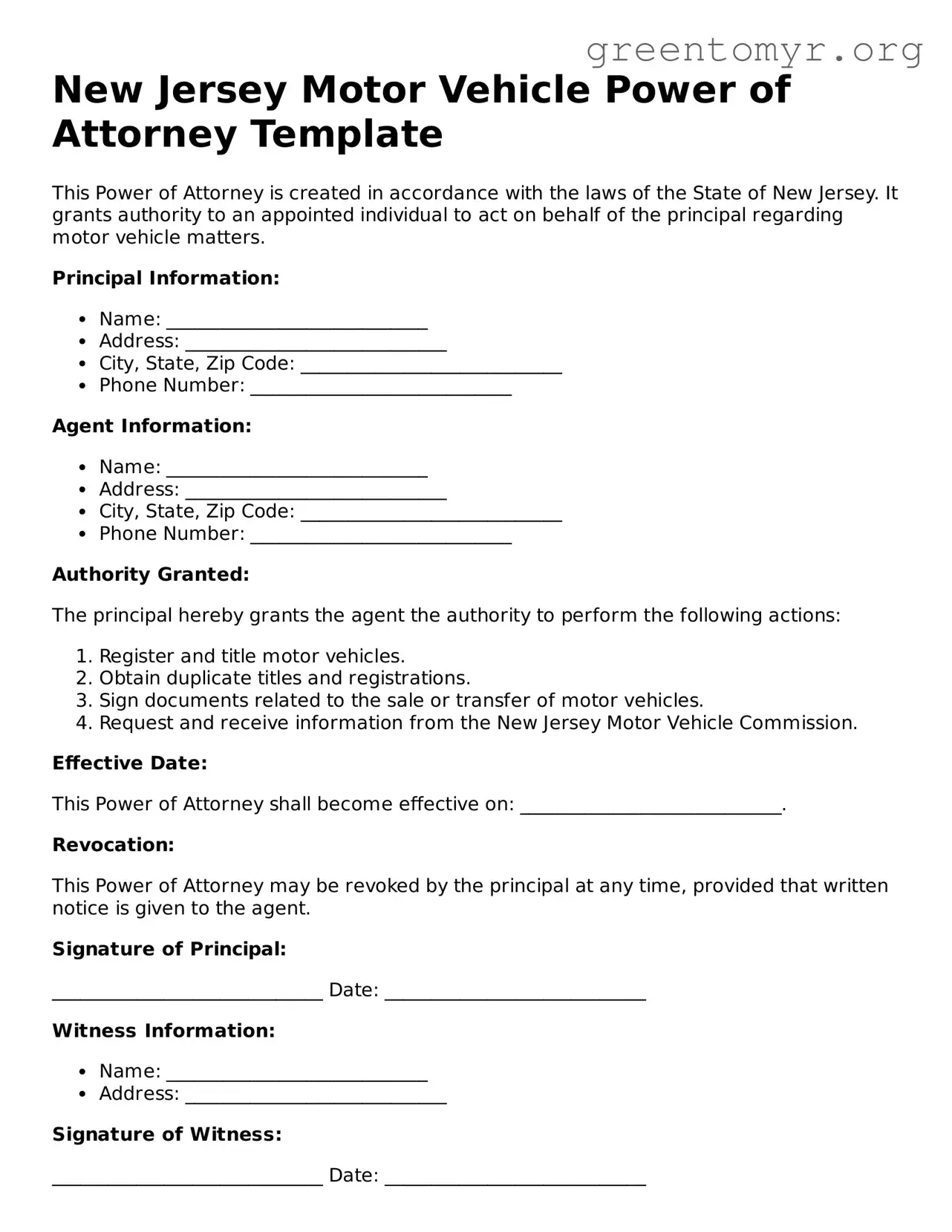
New Jersey Motor Vehicle Power of Attorney Template
This Power of Attorney is created in accordance with the laws of the State of New Jersey. It grants authority to an appointed individual to act on behalf of the principal regarding motor vehicle matters.
Principal Information:
Agent Information:
Authority Granted:
The principal hereby grants the agent the authority to perform the following actions:
Effective Date:
This Power of Attorney shall become effective on: ____________________________.
Revocation:
This Power of Attorney may be revoked by the principal at any time, provided that written notice is given to the agent.
Signature of Principal:
_____________________________ Date: ____________________________
Witness Information:
Signature of Witness:
_____________________________ Date: ____________________________
This document should be kept in a safe place and copies should be provided to the agent and any relevant parties.
| Fact Name | Details |
|---|---|
| Purpose | The New Jersey Motor Vehicle Power of Attorney form allows an individual to authorize another person to handle motor vehicle transactions on their behalf. |
| Governing Law | This form is governed by New Jersey Statutes Annotated (N.J.S.A.) 39:10-1 et seq. |
| Who Can Be an Agent | Any adult can be designated as an agent. This includes friends, family members, or professionals. |
| Revocation | The Power of Attorney can be revoked at any time by the principal, as long as they are competent to do so. |
| Signature Requirement | The form must be signed by the principal in the presence of a notary public to be valid. |
| Specific Transactions | The agent can perform specific tasks such as registering a vehicle, transferring title, or obtaining license plates. |
| Duration | The authority granted lasts until the principal revokes it or until the principal passes away. |
| Accessibility | The form is available online through the New Jersey Motor Vehicle Commission's website or at local MVC offices. |
Completing the New Jersey Motor Vehicle Power of Attorney form requires careful attention to detail. This document allows you to designate someone to act on your behalf regarding motor vehicle matters. Follow the steps below to ensure that the form is filled out correctly.
After completing these steps, the form will be ready for submission to the appropriate authorities or for use as needed. Ensure that all parties involved understand their responsibilities under this power of attorney.
The New Jersey Motor Vehicle Power of Attorney form allows an individual (the principal) to authorize another person (the agent) to act on their behalf in matters related to motor vehicle transactions. This can include tasks such as registering a vehicle, transferring ownership, or obtaining a title.
Any competent adult can be designated as an agent. This could be a family member, friend, or a professional such as a lawyer or a notary. It’s important to choose someone you trust, as they will have the authority to handle your motor vehicle affairs.
The agent can perform various transactions, including but not limited to:
Yes, the New Jersey Motor Vehicle Power of Attorney form must be notarized. This ensures that the document is legally binding and that the identity of the principal is verified. Notarization adds an extra layer of security to the transaction.
The Power of Attorney remains valid until it is revoked by the principal or until the specific tasks outlined in the document are completed. It’s important to communicate with your agent about the duration and scope of their authority.
Yes, you can revoke the Power of Attorney at any time, as long as you are competent to do so. To revoke, you should provide a written notice to your agent and any relevant parties, such as the New Jersey Motor Vehicle Commission.
While there is no fee specifically for the Power of Attorney form itself, you may incur costs for notarization and any related transactions at the New Jersey Motor Vehicle Commission. It’s advisable to check for any applicable fees before proceeding.
You can obtain the New Jersey Motor Vehicle Power of Attorney form from the New Jersey Motor Vehicle Commission's website or at any local MVC agency office. It’s important to ensure that you are using the most current version of the form.
If your agent is unable to perform their duties, you may need to appoint a new agent. Make sure to formally revoke the previous Power of Attorney and create a new one if necessary. Clear communication with your new agent is key to ensuring a smooth transition.
The New Jersey Motor Vehicle Power of Attorney form is specifically designed for use within New Jersey. If you need to conduct transactions in another state, you may need to check that state's requirements and possibly use a different form. Always verify the rules in the state where the transaction will occur.
Filling out the New Jersey Motor Vehicle Power of Attorney form can be straightforward, but mistakes can lead to delays or complications. One common error is not providing complete information. Every field on the form is important. Missing details can cause the application to be rejected or returned for correction.
Another frequent mistake is failing to sign the form. The signature serves as a critical validation of the document. Without it, the form is incomplete and cannot be processed. Always double-check for a signature before submission.
People often overlook the importance of using the correct names. The names provided must match the official documents, such as a driver's license or registration. Any discrepancies can create confusion and may require additional documentation.
Incorrect dates are another pitfall. The form requires specific dates, and entering the wrong ones can lead to misunderstandings regarding the authority granted. It’s essential to verify that all dates are accurate and current.
Some individuals fail to specify the scope of authority clearly. The form allows you to define what powers are being granted. Not doing so can result in ambiguity, which may lead to disputes or limitations in the authority given.
Another mistake is neglecting to provide identification information. The Power of Attorney form requires identification details for both the principal and the agent. Omitting this information can delay processing.
Many people forget to check the form for errors after completing it. A simple review can catch typos or missing information. Taking a moment to proofread can save time and frustration later on.
In some cases, individuals do not keep a copy of the completed form. Retaining a copy is crucial for reference and accountability. It ensures that both parties have a record of the authority granted.
Another common error is not understanding the implications of the Power of Attorney. Some individuals may not fully grasp what powers they are granting. It’s important to read and understand the document before signing.
Lastly, submitting the form without the required supporting documents can lead to processing delays. Always check the requirements and ensure that all necessary documentation accompanies the form.
The New Jersey Motor Vehicle Power of Attorney form allows an individual to designate another person to act on their behalf regarding motor vehicle transactions. This form is often accompanied by several other documents to ensure a smooth process. Below is a list of related forms and documents that may be necessary or beneficial when completing motor vehicle transactions in New Jersey.
Having these documents prepared and organized can facilitate the process of managing vehicle-related transactions in New Jersey. Each form serves a specific purpose, ensuring compliance with state regulations and protecting the interests of all parties involved.
Filling out the New Jersey Motor Vehicle Power of Attorney form can seem daunting, but with a little guidance, you can navigate the process smoothly. Here are some important do's and don'ts to keep in mind:
Understanding the New Jersey Motor Vehicle Power of Attorney form is crucial for anyone needing to delegate authority regarding vehicle transactions. However, several misconceptions can lead to confusion. Here are four common misunderstandings:
Many people believe that the Motor Vehicle Power of Attorney is only applicable for selling a vehicle. In reality, this form can also be used for various other transactions, such as registering a vehicle, obtaining title transfers, and handling other motor vehicle-related matters.
Some individuals think that only a legal professional can complete the Power of Attorney form. However, this form is designed to be user-friendly, allowing anyone to fill it out as long as they understand the requirements and the information needed.
There is a common belief that notarization is mandatory for the Power of Attorney form to be valid. While notarization can add an extra layer of authenticity, it is not a strict requirement for the form to be effective in New Jersey.
Many assume that the Power of Attorney is only valid for a limited duration. In fact, the validity of this document depends on the terms specified within it. Unless otherwise stated, it remains effective until the task is completed or the principal revokes it.
By clarifying these misconceptions, individuals can better navigate the process of using the New Jersey Motor Vehicle Power of Attorney form and ensure they are making informed decisions.
Filling out and using the New Jersey Motor Vehicle Power of Attorney form can be a straightforward process when you understand the key points. Here are some important takeaways to keep in mind:
Understanding these key points can help ensure a smooth process when using the New Jersey Motor Vehicle Power of Attorney form.