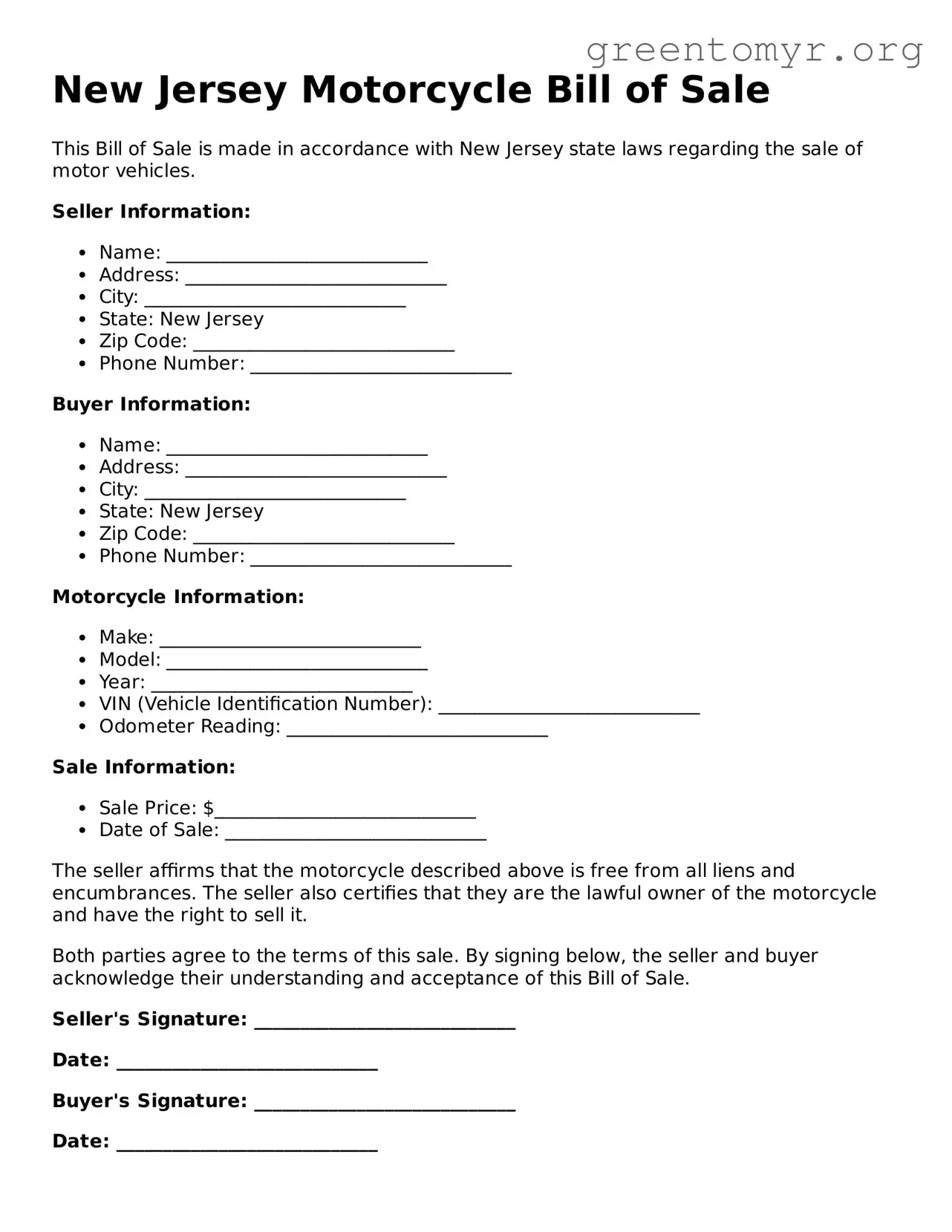
The New Jersey Motorcycle Bill of Sale form is an essential document for anyone involved in the buying or selling of a motorcycle in the state. This form serves as a legal record of the transaction, detailing important information such as the names and addresses of both the buyer and seller, the motorcycle's make, model, year, and Vehicle Identification Number (VIN). Additionally, it outlines the sale price and includes a space for signatures, ensuring that both parties acknowledge the agreement. Having this form properly filled out can help prevent disputes and provide proof of ownership. It is important to note that while the bill of sale is not required for registration, it is highly recommended to protect both the buyer's and seller's interests. Understanding the components of the Motorcycle Bill of Sale can simplify the transaction process and ensure compliance with New Jersey state regulations.
New Jersey Motorcycle Bill of Sale
This Bill of Sale is made in accordance with New Jersey state laws regarding the sale of motor vehicles.
Seller Information:
Buyer Information:
Motorcycle Information:
Sale Information:
The seller affirms that the motorcycle described above is free from all liens and encumbrances. The seller also certifies that they are the lawful owner of the motorcycle and have the right to sell it.
Both parties agree to the terms of this sale. By signing below, the seller and buyer acknowledge their understanding and acceptance of this Bill of Sale.
Seller's Signature: ____________________________
Date: ____________________________
Buyer's Signature: ____________________________
Date: ____________________________
| Fact Name | Description |
|---|---|
| Purpose | The New Jersey Motorcycle Bill of Sale form is used to document the sale and transfer of ownership of a motorcycle between parties. |
| Governing Law | This form is governed by New Jersey state law, specifically under the New Jersey Motor Vehicle Code. |
| Required Information | Essential details include the names and addresses of both the seller and buyer, motorcycle identification number (VIN), make, model, year, and sale price. |
| Notarization | While notarization is not required, it can provide additional legal protection for both parties involved in the transaction. |
| Tax Implications | Sales tax may be applicable based on the sale price. Buyers should be aware of their responsibility to report and pay this tax. |
| Record Keeping | Both the seller and buyer should retain a copy of the completed Bill of Sale for their records, as it serves as proof of the transaction. |
| Transfer of Title | The Bill of Sale is often required when applying for a new title in the buyer's name at the New Jersey Motor Vehicle Commission. |
| Dispute Resolution | In case of disputes regarding the sale, the Bill of Sale can serve as a key document to resolve issues between the buyer and seller. |
After completing the New Jersey Motorcycle Bill of Sale form, you will need to keep a copy for your records and provide the other copy to the buyer. This document serves as proof of the transaction and is essential for the registration process.
A New Jersey Motorcycle Bill of Sale is a legal document that serves as proof of the sale and transfer of ownership of a motorcycle. It includes essential details about the transaction, such as the buyer's and seller's information, the motorcycle's description, and the sale price.
While a Bill of Sale is not legally required for every motorcycle transaction in New Jersey, it is highly recommended. This document provides a record of the sale, which can protect both the buyer and seller in case of disputes or issues that arise after the transaction.
A comprehensive Bill of Sale should include the following information:
Yes, you can create your own Bill of Sale. However, it is essential to ensure that all necessary information is included and that it complies with New Jersey laws. Many templates are available online that can help guide you in drafting an effective document.
Notarization is not required for a Bill of Sale in New Jersey, but having it notarized can add an extra layer of legitimacy to the document. It can be beneficial in case of future disputes or if you need to prove the transaction occurred.
The Bill of Sale is an important document when registering a motorcycle in New Jersey. It acts as proof of ownership, which you will need to provide to the New Jersey Motor Vehicle Commission (MVC) when applying for a title and registration.
If the motorcycle is financed, the lender typically holds the title until the loan is paid off. In this case, the Bill of Sale should note that the motorcycle is under financing. The seller must ensure that the buyer understands the financing situation before completing the sale.
Yes, a Bill of Sale is commonly used for private sales. It serves as a record of the transaction between individuals, ensuring that both parties have documented the sale. This is particularly important in private sales, where there may not be a dealership involved.
If a dispute arises after the sale, the Bill of Sale can serve as critical evidence. It outlines the terms of the transaction and can help clarify responsibilities. Both parties should keep a copy of the Bill of Sale for their records to facilitate any necessary follow-up.
You can obtain a Bill of Sale form from various sources, including:
Make sure to choose a reputable source to ensure that the form meets New Jersey's requirements.
Filling out the New Jersey Motorcycle Bill of Sale form can be straightforward, but several common mistakes can lead to complications. One frequent error is failing to include all required information. It is crucial to provide complete details about the motorcycle, including the make, model, year, and Vehicle Identification Number (VIN). Missing any of these details can create issues during registration.
Another common mistake is not accurately recording the sale price. The sale price should reflect the actual transaction amount. If it is significantly lower than market value, it may raise questions from the New Jersey Motor Vehicle Commission. Providing an accurate sale price ensures that both parties are protected and that taxes are correctly assessed.
People often overlook the importance of signatures. Both the buyer and seller must sign the form. Without these signatures, the document is not valid. This oversight can delay the transfer of ownership and create unnecessary frustration for both parties.
In addition, some individuals forget to date the form. The date of the sale is critical for establishing the timeline of ownership transfer. Including the date helps to clarify when the transaction took place, which can be important for future reference.
Another mistake is not keeping a copy of the completed Bill of Sale. This document serves as proof of the transaction and should be retained by both the buyer and seller. In case of disputes or questions in the future, having a copy can provide clarity and support for both parties.
Incorrectly filling out the buyer's information is also a common error. It is essential to provide accurate details, including the buyer's full name and address. Errors in this section can complicate the registration process and may lead to difficulties in contacting the new owner.
Some individuals fail to check for any outstanding liens on the motorcycle. Before completing the sale, it is advisable to ensure that there are no financial claims against the vehicle. This step protects the buyer from potential legal issues down the line.
People sometimes neglect to include any additional terms or conditions of the sale. If there are specific agreements between the buyer and seller, such as warranties or included accessories, these should be clearly stated in the Bill of Sale. This clarity helps prevent misunderstandings later on.
Lastly, many individuals do not familiarize themselves with state-specific requirements. New Jersey may have unique stipulations regarding the Bill of Sale. It is vital to review these requirements to ensure compliance and a smooth transaction process.
When purchasing or selling a motorcycle in New Jersey, several documents may accompany the Motorcycle Bill of Sale form. Each of these documents serves a specific purpose in the transaction process, ensuring that both parties are protected and that all legal requirements are met.
Having these documents prepared and organized can facilitate a smoother transaction when buying or selling a motorcycle in New Jersey. Ensuring that all necessary paperwork is completed helps protect both the buyer and the seller, making the process more efficient and legally sound.
The Motorcycle Bill of Sale form serves a specific purpose in the transfer of ownership for motorcycles. However, it shares similarities with several other documents used in various transactions. Here are four documents that are comparable to the Motorcycle Bill of Sale:
Each of these documents plays a crucial role in ensuring that ownership is clearly defined and legally recognized, just like the Motorcycle Bill of Sale.
When filling out the New Jersey Motorcycle Bill of Sale form, following the right steps can make the process smoother. Here’s a list of things to do and avoid:
Many individuals have misunderstandings regarding the New Jersey Motorcycle Bill of Sale form. Here are nine common misconceptions:
Understanding these misconceptions can help ensure a smoother transaction when buying or selling a motorcycle in New Jersey.
When filling out and using the New Jersey Motorcycle Bill of Sale form, it is essential to understand the key elements involved in the process. Here are eight important takeaways: