In the competitive landscape of today’s job market, protecting business interests while respecting employees’ rights is crucial. The New Jersey Non-compete Agreement form serves as a vital tool in this balancing act. This document outlines the terms under which an employee agrees not to engage in certain competitive activities after leaving a company. It typically includes specific clauses detailing the duration of the non-compete period, the geographical scope, and the types of employment or business activities that are restricted. Understanding these elements is essential for both employers and employees. Employers aim to safeguard their trade secrets and customer relationships, while employees seek to ensure their career mobility and opportunities. Crafting a fair and legally enforceable agreement requires careful consideration of these aspects, making it important for both parties to be informed and prepared.
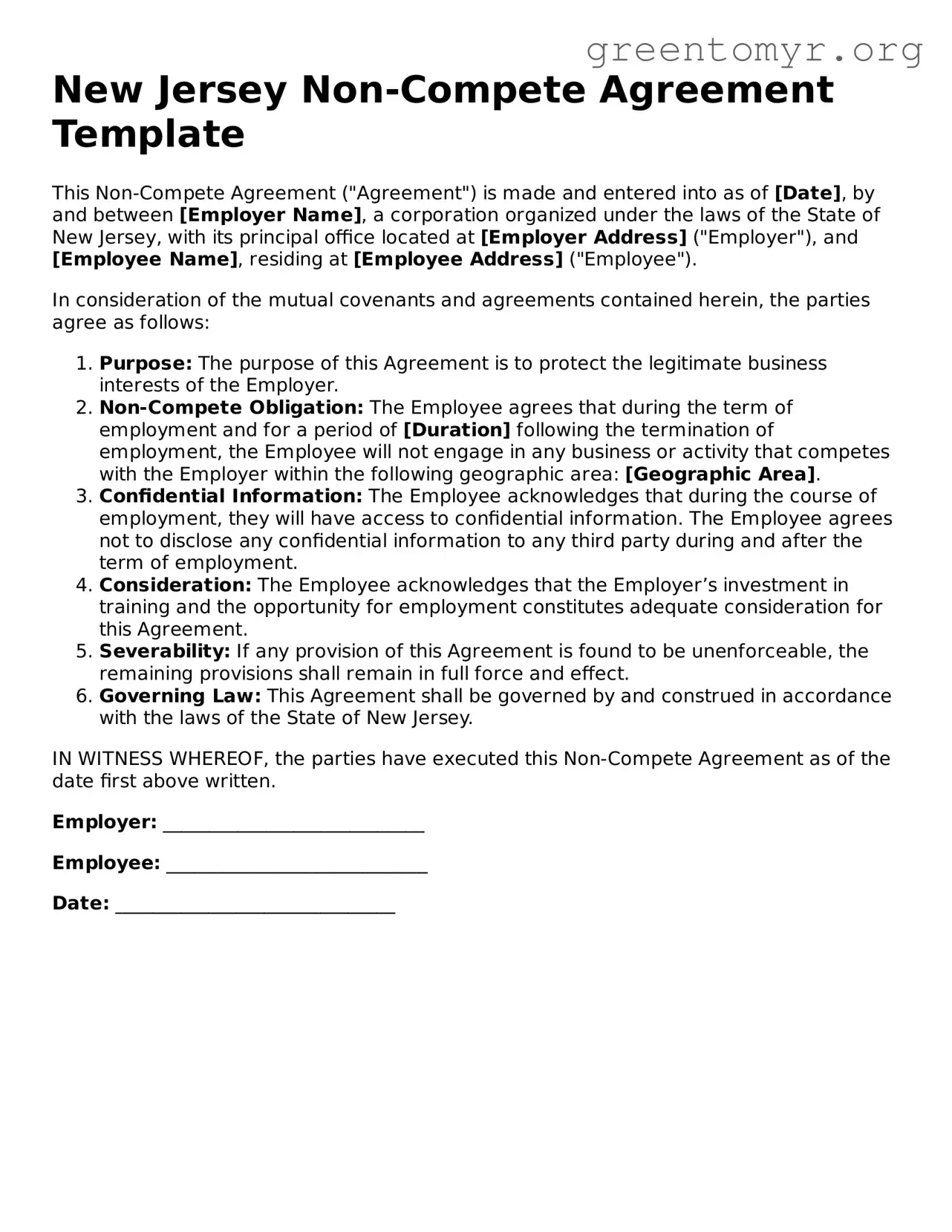
New Jersey Non-Compete Agreement Template
This Non-Compete Agreement ("Agreement") is made and entered into as of [Date], by and between [Employer Name], a corporation organized under the laws of the State of New Jersey, with its principal office located at [Employer Address] ("Employer"), and [Employee Name], residing at [Employee Address] ("Employee").
In consideration of the mutual covenants and agreements contained herein, the parties agree as follows:
IN WITNESS WHEREOF, the parties have executed this Non-Compete Agreement as of the date first above written.
Employer: ____________________________
Employee: ____________________________
Date: ______________________________
| Fact Name | Description |
|---|---|
| Governing Law | The New Jersey Non-compete Agreement is governed by New Jersey state law. |
| Enforceability | Non-compete agreements in New Jersey are enforceable if they are reasonable in scope and duration. |
| Reasonableness Standard | Courts assess the reasonableness based on the interests of the employer and the employee. |
| Duration Limitations | Typically, a duration of one to two years is considered reasonable, depending on the industry. |
| Geographic Scope | The geographic area covered by the agreement must be limited to what is necessary to protect the employer’s interests. |
| Consideration Requirement | For a non-compete agreement to be valid, there must be adequate consideration, such as employment or a promotion. |
| Employee Rights | Employees have the right to negotiate the terms of the agreement before signing. |
| Judicial Scrutiny | New Jersey courts may scrutinize the agreement closely to ensure it does not impose undue hardship on the employee. |
| Public Policy | Non-compete agreements must align with public policy, promoting fair competition and employee mobility. |
Filling out the New Jersey Non-compete Agreement form is a straightforward process. You'll need to provide specific information about the parties involved and the terms of the agreement. Once completed, the form should be signed by both parties to make it effective.
A Non-compete Agreement is a contract between an employer and an employee that restricts the employee from working for competitors or starting a competing business for a certain period after leaving the company. In New Jersey, these agreements are enforceable under specific conditions.
For a Non-compete Agreement to be valid in New Jersey, it generally must include:
The duration of a Non-compete Agreement can vary, but it should be reasonable. Typically, courts in New Jersey may find durations ranging from six months to two years acceptable, depending on the nature of the business and the employee's role.
The geographic scope of a Non-compete Agreement should also be reasonable. It should not be overly broad. For example, if the business operates primarily in New Jersey, restricting the employee from working in other states may not be enforceable.
Yes, employees can negotiate the terms of a Non-compete Agreement before signing. It is advisable to discuss any concerns with the employer to reach a mutually agreeable arrangement.
Non-compete Agreements are enforceable in New Jersey if they meet specific criteria. Courts will evaluate whether the agreement protects legitimate business interests and is reasonable in scope and duration.
If an employee violates a Non-compete Agreement, the employer may seek legal action. This can result in a court issuing an injunction to prevent the employee from working with a competitor, and the employer may also seek damages for any losses incurred.
An employee may challenge a Non-compete Agreement by arguing that it is overly broad, lacks consideration, or does not protect a legitimate business interest. Legal advice can be beneficial in these situations.
Yes, a Non-compete Agreement restricts an employee from working for competitors, while a Non-solicitation Agreement prohibits an employee from soliciting clients or employees from their former employer. Both serve different purposes in protecting business interests.
Consulting a lawyer before signing a Non-compete Agreement is a wise decision. A legal professional can help clarify the terms, assess the agreement's enforceability, and ensure that your rights are protected.
Filling out the New Jersey Non-compete Agreement form can be a complex task. Many individuals make mistakes that could impact their rights and obligations. Understanding these common pitfalls can help ensure the agreement is completed correctly.
One frequent error is failing to read the entire form thoroughly. Skimming through the document may lead to misunderstandings about the terms and conditions. It’s essential to take the time to understand each section to avoid signing something that could limit future employment opportunities.
Another mistake is leaving out crucial information. Incomplete forms can lead to delays or even rejection. Make sure to provide all requested details, such as the parties involved, the duration of the non-compete, and the geographic area it covers.
Many individuals also overlook the importance of defining the scope of the non-compete. A vague description can lead to confusion and disputes down the line. Clearly outline what activities are restricted to avoid ambiguity.
Some people fail to consider the enforceability of the agreement. Non-compete clauses must be reasonable in scope and duration to be upheld in court. Be cautious about making commitments that may not hold up legally.
Additionally, individuals often neglect to seek legal advice. Consulting with an attorney can provide valuable insights and help identify potential issues. This step is crucial, especially if the agreement could significantly affect future job prospects.
Another common mistake is not keeping a copy of the signed agreement. Without documentation, it can be challenging to reference the terms later. Always retain a copy for personal records.
People sometimes rush through the signing process. It’s important to take the time to review the document before signing. Rushing can lead to overlooking critical details that could have significant implications.
Failing to update the agreement when circumstances change is another oversight. If there are changes in employment status or job responsibilities, the non-compete may need to be revised. Keeping the agreement current is vital for its effectiveness.
Lastly, individuals may disregard the consequences of violating the agreement. Understanding the potential repercussions is crucial. Violating a non-compete can lead to legal action and financial penalties, which can have lasting effects on one’s career.
When entering into a Non-compete Agreement in New Jersey, several other forms and documents may be relevant. These documents help clarify the terms of the agreement and ensure all parties understand their rights and obligations. Below are four commonly used documents associated with a Non-compete Agreement.
These documents are essential in establishing a clear understanding between the parties involved. They help protect business interests while ensuring compliance with New Jersey laws regarding non-compete agreements.
When filling out the New Jersey Non-compete Agreement form, it is essential to proceed with caution. Here are some guidelines to help you navigate this process effectively.
Non-compete agreements are often misunderstood, leading to confusion for both employers and employees. Here are six common misconceptions about the New Jersey Non-compete Agreement form, along with clarifications to help clear up any misunderstandings.
Understanding these misconceptions can help both employers and employees navigate the complexities of non-compete agreements in New Jersey more effectively.
When filling out and using the New Jersey Non-compete Agreement form, there are several important considerations to keep in mind. Here are six key takeaways: