In the world of business, protecting sensitive information is crucial. The New Jersey Non-disclosure Agreement (NDA) form plays a vital role in safeguarding proprietary data, trade secrets, and confidential information from being disclosed to unauthorized parties. This legally binding document establishes a clear understanding between the parties involved, outlining what information is considered confidential and the obligations of each party to maintain that confidentiality. It typically includes key elements such as the definition of confidential information, the duration of the agreement, and the consequences of breach. By using this form, businesses can foster trust while minimizing the risk of information leaks that could potentially harm their competitive edge. Whether you are an employer sharing trade secrets with employees or a business partner exchanging sensitive data, having a well-drafted NDA in place is essential for maintaining confidentiality and protecting your interests.
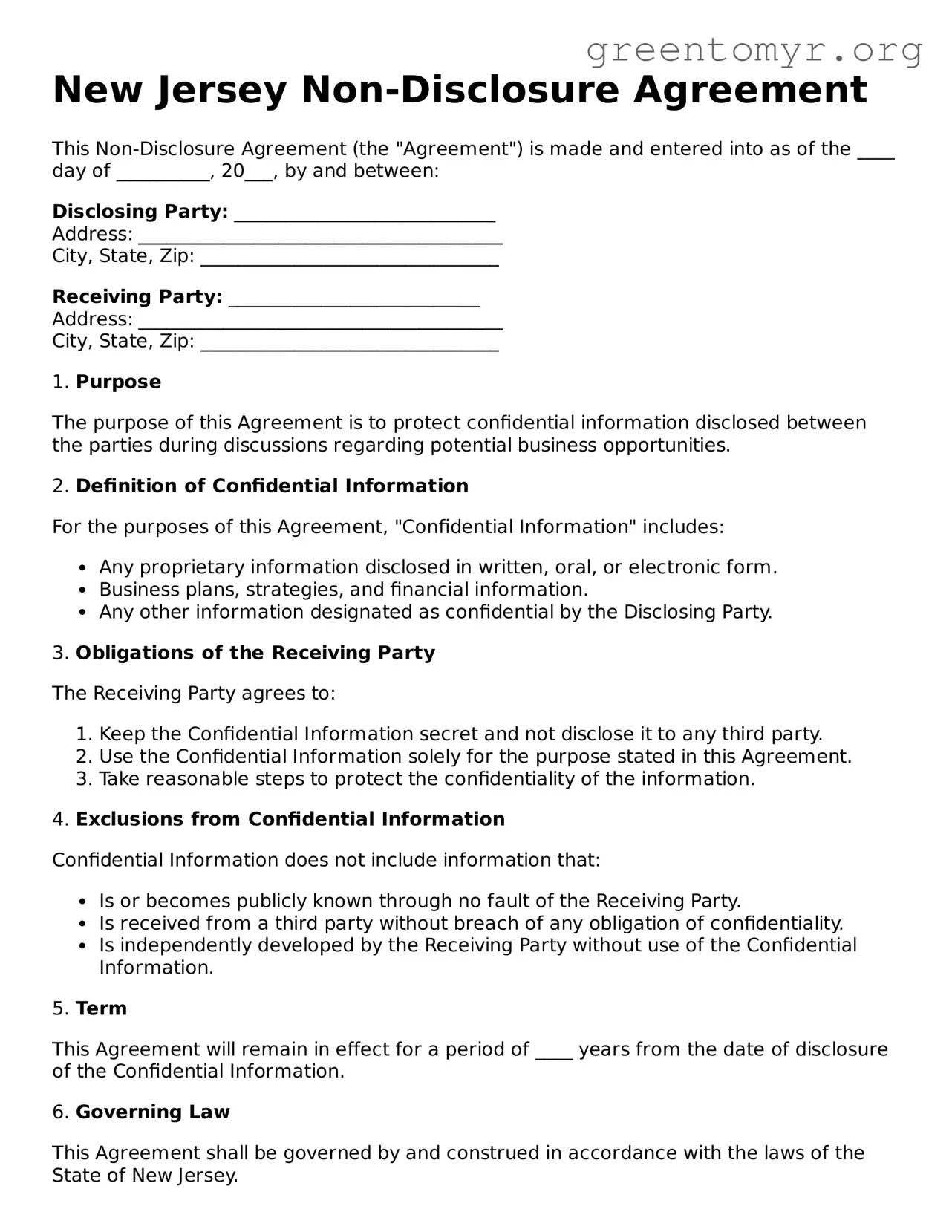
New Jersey Non-Disclosure Agreement
This Non-Disclosure Agreement (the "Agreement") is made and entered into as of the ____ day of __________, 20___, by and between:
Disclosing Party: ____________________________
Address: _______________________________________
City, State, Zip: ________________________________
Receiving Party: ___________________________
Address: _______________________________________
City, State, Zip: ________________________________
1. Purpose
The purpose of this Agreement is to protect confidential information disclosed between the parties during discussions regarding potential business opportunities.
2. Definition of Confidential Information
For the purposes of this Agreement, "Confidential Information" includes:
3. Obligations of the Receiving Party
The Receiving Party agrees to:
4. Exclusions from Confidential Information
Confidential Information does not include information that:
5. Term
This Agreement will remain in effect for a period of ____ years from the date of disclosure of the Confidential Information.
6. Governing Law
This Agreement shall be governed by and construed in accordance with the laws of the State of New Jersey.
7. Signatures
IN WITNESS WHEREOF, the parties hereto have executed this Non-Disclosure Agreement as of the date first above written.
Disclosing Party: ____________________________
Signature: ____________________________
Date: ____________
Receiving Party: ___________________________
Signature: ____________________________
Date: ____________
| Fact Name | Details |
|---|---|
| Purpose | The New Jersey Non-disclosure Agreement (NDA) protects confidential information shared between parties. |
| Governing Law | This agreement is governed by New Jersey state law, specifically the Uniform Trade Secrets Act. |
| Parties Involved | Typically, the NDA involves a disclosing party and a receiving party, both of whom must agree to the terms. |
| Duration of Confidentiality | The NDA should specify how long the information must remain confidential, which can vary based on the agreement. |
| Enforceability | New Jersey courts generally uphold NDAs as long as they are reasonable in scope and duration. |
Filling out the New Jersey Non-disclosure Agreement form is an important step in protecting sensitive information. This document serves to ensure that both parties understand their obligations regarding confidentiality. Once completed, the form will need to be signed by all involved parties, and copies should be distributed for everyone's records.
A Non-disclosure Agreement (NDA) in New Jersey is a legal contract that protects confidential information shared between parties. It ensures that sensitive information remains private and is not disclosed to unauthorized individuals or entities.
You should use an NDA when sharing confidential information with another party. This could include business plans, trade secrets, proprietary information, or any sensitive data that, if disclosed, could harm your interests. Common scenarios include:
An effective NDA should include several key elements:
The duration of an NDA can vary. Typically, the agreement will specify a time frame during which the information must remain confidential. This period can range from a few years to indefinitely, depending on the nature of the information and the agreement between the parties.
Yes, NDAs can be enforced in New Jersey, provided they meet the legal requirements for contracts. If one party breaches the agreement, the other party may seek legal remedies, which could include monetary damages or injunctive relief to prevent further disclosure.
Consequences for breaching an NDA can include:
Yes, not all information can be protected by an NDA. For example, information that is publicly available or already known to the receiving party may not be protected. Additionally, the agreement cannot prevent disclosure required by law or court order.
Yes, an NDA can be modified if both parties agree to the changes. It is essential to document any modifications in writing to ensure that all parties are aware of and consent to the new terms.
While it is possible to create an NDA without legal assistance, consulting a lawyer is advisable. A legal professional can help ensure that the agreement is comprehensive, enforceable, and tailored to your specific needs.
Filling out a Non-disclosure Agreement (NDA) in New Jersey can be straightforward, but many people make mistakes that can lead to misunderstandings or legal issues. One common mistake is failing to clearly define the confidential information. If the information is vague, it can be difficult to enforce the agreement later on. Always specify what information is considered confidential.
Another frequent error is not including the purpose of the NDA. It's important to state why the information is being shared and how it will be used. This clarity helps both parties understand their obligations and expectations. Without this, the agreement may lack context.
People often overlook the importance of specifying the duration of confidentiality. An NDA should clearly state how long the information must remain confidential. Some individuals leave this section blank, which can lead to confusion down the line. A well-defined timeline protects both parties.
Additionally, many forget to include the obligations of both parties. It's crucial to outline what each party is expected to do with the confidential information. This includes how it should be handled and any restrictions on sharing it with others. Without this, one party might assume they can use the information freely.
Another mistake is neglecting to include the consequences of a breach. The NDA should specify what happens if one party violates the agreement. This could include financial penalties or legal action. Having this in writing serves as a deterrent against breaches.
Some individuals also fail to have the NDA signed by both parties. An unsigned agreement may not hold up in court. Ensure that both parties sign and date the document to make it legally binding.
People sometimes use outdated or generic templates without customizing them. Each NDA should be tailored to fit the specific situation and relationship between the parties involved. Relying on a one-size-fits-all approach can lead to gaps in protection.
Another common oversight is not consulting with a legal professional. While it may seem like a simple document, having an expert review the NDA can prevent potential issues. They can offer insights that might not be obvious to those unfamiliar with legal language.
Lastly, many individuals forget to keep a copy of the signed NDA. It’s essential to retain a copy for your records. This ensures that you can refer back to the agreement if any disputes arise in the future.
By avoiding these mistakes, individuals can create a more effective Non-disclosure Agreement that protects their interests and fosters trust between parties.
When entering into a Non-disclosure Agreement (NDA) in New Jersey, several other forms and documents may be necessary to ensure comprehensive protection and clarity in business dealings. Here are some commonly used documents that complement an NDA.
Using these documents in conjunction with a Non-disclosure Agreement can enhance legal protections and clarify expectations between parties. Always consider consulting with a legal professional to tailor these documents to your specific needs.
When filling out the New Jersey Non-disclosure Agreement form, it is important to follow certain guidelines to ensure accuracy and legality. Below is a list of things to do and avoid.
Things to Do:
Things to Avoid:
Understanding the New Jersey Non-disclosure Agreement (NDA) form is crucial for anyone looking to protect sensitive information. However, several misconceptions can lead to confusion. Here are four common misunderstandings:
Many people believe that all NDAs are identical. In reality, each NDA can be tailored to fit the specific needs of the parties involved. Factors like the type of information being protected and the duration of the agreement can vary significantly.
Some assume that NDAs are only relevant for corporations or businesses. However, individuals can also use NDAs to protect personal information, such as trade secrets or proprietary ideas.
While an NDA provides a legal framework for confidentiality, it does not guarantee that sensitive information will never be disclosed. Enforcement depends on the actions of the parties and the legal system.
Many think that NDAs signed in New Jersey are only valid within the state. In fact, NDAs can be enforceable across state lines, depending on the circumstances and the governing law specified in the agreement.
Being aware of these misconceptions can help individuals and businesses make informed decisions about using NDAs effectively.
When filling out and using the New Jersey Non-disclosure Agreement (NDA) form, consider the following key takeaways:
By keeping these points in mind, you can effectively fill out and utilize the New Jersey Non-disclosure Agreement form to protect your interests.