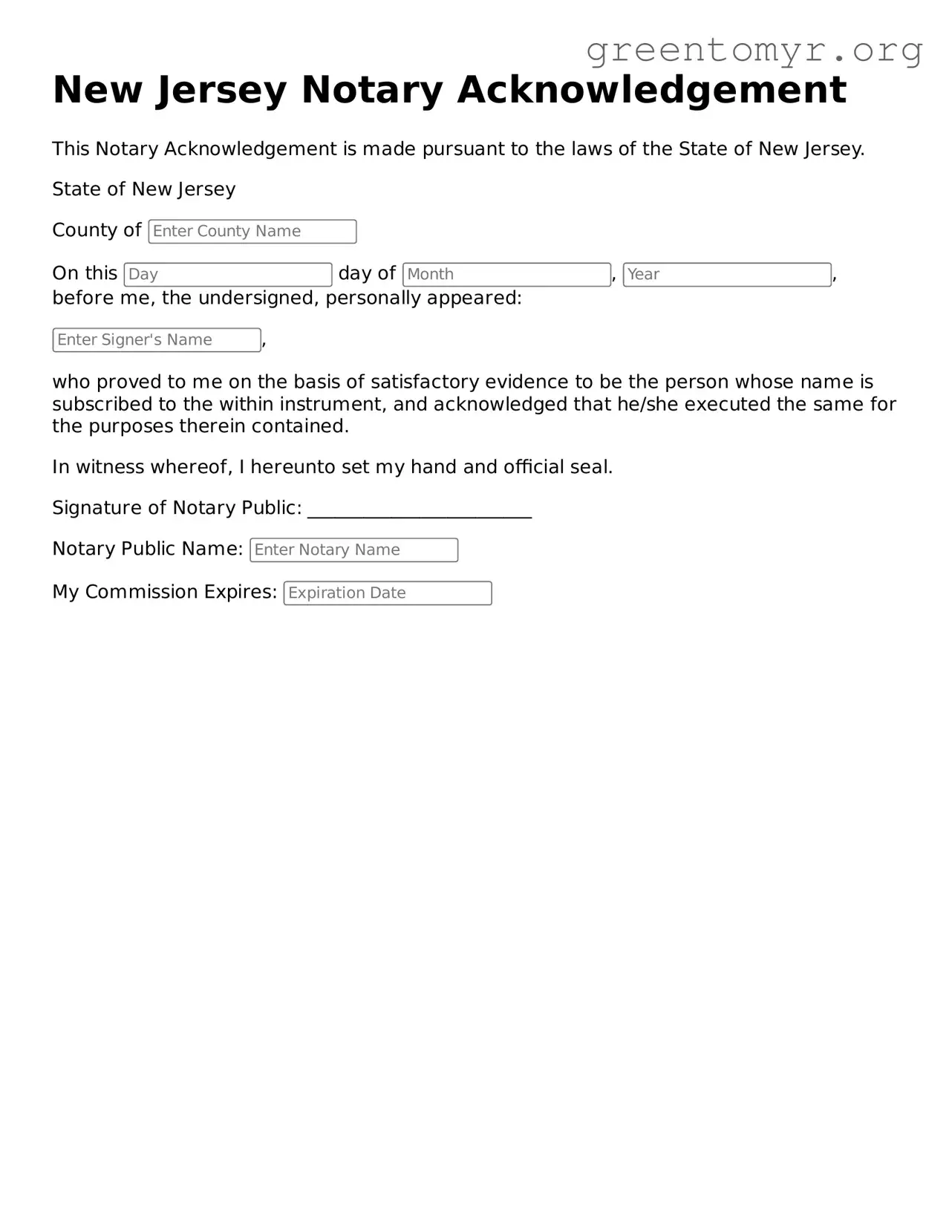
The New Jersey Notary Acknowledgement form serves as a crucial document in various legal transactions, ensuring that signatures on important papers are authentic and voluntary. This form is commonly used when individuals need to verify their identity before a notary public, which adds a layer of security to the process. It typically includes essential details such as the name of the signer, the date of the acknowledgment, and the notary's signature and seal. By using this form, parties can confirm that the signer appeared in person and acknowledged their signature on the document. Understanding the nuances of this form is vital for anyone involved in real estate transactions, legal agreements, or any situation requiring notarization. Proper completion of the Notary Acknowledgement form helps prevent fraud and ensures that documents hold up in court, making it an indispensable tool in New Jersey's legal landscape.
New Jersey Notary Acknowledgement
This Notary Acknowledgement is made pursuant to the laws of the State of New Jersey.
State of New Jersey
County of
On this day of , , before me, the undersigned, personally appeared:
,
who proved to me on the basis of satisfactory evidence to be the person whose name is subscribed to the within instrument, and acknowledged that he/she executed the same for the purposes therein contained.
In witness whereof, I hereunto set my hand and official seal.
Signature of Notary Public: ________________________
Notary Public Name:
My Commission Expires:
| Fact Name | Description |
|---|---|
| Purpose | The New Jersey Notary Acknowledgement form is used to confirm that a signature on a document is genuine. |
| Governing Law | This form is governed by the New Jersey Notary Public Act, N.J.S.A. 52:7-1 et seq. |
| Signature Requirement | The signer must personally appear before the notary public when the acknowledgement is made. |
| Identification | The notary must verify the identity of the signer through a valid form of identification. |
| Form Components | The form typically includes the name of the signer, the date of the acknowledgement, and the notary’s signature and seal. |
| Record Keeping | Notaries are required to keep a record of all acknowledgements in a journal. |
| Validity | The acknowledgement is valid only if completed and signed in the presence of the notary. |
| Fee Structure | Notaries in New Jersey can charge a fee for their services, which is set by state law. |
After obtaining the New Jersey Notary Acknowledgement form, you will need to fill it out accurately. This form is essential for confirming the identity of a signer and the signing of a document. Follow these steps to complete the form correctly.
Once the form is filled out, make sure to review it for any errors. It's important that all information is accurate before it is used. After verification, the form is ready for submission or filing as needed.
The New Jersey Notary Acknowledgment form is a legal document used to verify the identity of a signer and confirm that they willingly signed a document. This form is essential in various transactions, such as real estate deals, contracts, and other legal agreements. The acknowledgment ensures that the signer understands the content of the document and is doing so voluntarily, without any coercion.
In New Jersey, a notary public is an individual appointed by the state to serve as an impartial witness in the signing of documents. To become a notary, one must meet specific requirements, including:
Once appointed, notaries must adhere to state laws and guidelines to perform their duties effectively and ethically.
Completing a Notary Acknowledgment form involves several straightforward steps:
It is crucial to ensure that all information is accurate and complete to avoid any potential issues later on.
A Notary Acknowledgment serves several vital purposes:
Ultimately, a Notary Acknowledgment is an essential part of many legal processes, providing peace of mind to all parties involved.
When filling out the New Jersey Notary Acknowledgement form, it’s easy to overlook key details. One common mistake is failing to include the correct date of the acknowledgment. This date is crucial as it verifies when the notary witnessed the signature. Without it, the document may be deemed incomplete.
Another frequent error is neglecting to provide the signer’s name exactly as it appears on their identification. If there is a discrepancy, the acknowledgment could be challenged later. Always double-check the spelling and ensure it matches the ID.
People often forget to include the notary's seal or stamp. This is a vital component of the acknowledgment. Without it, the document may not hold up in legal situations, as the seal signifies that the notary has fulfilled their duties.
Additionally, some individuals skip the signature line for the notary. It’s essential for the notary to sign the form, as this affirms their role in the acknowledgment process. Leaving this blank can lead to complications later.
Another mistake involves the failure to complete the venue section. This area specifies where the acknowledgment took place. Omitting this information can raise questions about the validity of the notarization.
Moreover, people sometimes use an outdated version of the form. New Jersey may update its forms periodically, and using an old version can lead to unnecessary delays or rejections. Always ensure you have the most current form.
Some individuals do not include the notary’s commission expiration date. This detail is important because it indicates that the notary was authorized to perform the acknowledgment at the time it was completed. Failing to provide this can cast doubt on the legitimacy of the notarization.
Lastly, a common oversight is not reviewing the entire document before submission. Even small errors can lead to significant issues down the line. Taking a moment to review everything can save time and prevent future headaches.
When dealing with the New Jersey Notary Acknowledgement form, several other documents often accompany it to ensure proper legal procedures are followed. Here’s a brief overview of some common forms and documents you might encounter:
Using these forms along with the New Jersey Notary Acknowledgement can help streamline the legal process. Always ensure that you have the necessary documents ready for notarization to avoid delays.
When filling out the New Jersey Notary Acknowledgement form, there are several important guidelines to follow. Adhering to these can help ensure that the document is valid and accepted without issues. Below is a list of dos and don'ts to keep in mind.
Following these guidelines will help ensure that the notarization process goes smoothly and that the document is legally binding.
Understanding the New Jersey Notary Acknowledgement form can be challenging. Here are five common misconceptions about this important document:
This is incorrect. A notary must witness the signer’s signature in person to provide a valid acknowledgment. Remote notarization is only allowed under specific circumstances and not for all documents.
Notaries in New Jersey have specific duties and limitations. Their authority is limited to the state in which they are commissioned, and they cannot perform notarial acts outside of New Jersey.
This is a misunderstanding. A notary's primary responsibility is to confirm the identity of the signer and ensure they are signing voluntarily. The notary does not verify the accuracy or legality of the document itself.
Notarization does not make a document legally binding. It merely serves as a verification of the signature and the identity of the signer. Legal validity depends on the document's content and adherence to applicable laws.
This is false. A notarized document can be amended, but any changes must be made in accordance with the law. If significant changes occur, a new notarization may be necessary to ensure validity.
Being aware of these misconceptions can help individuals navigate the notary process more effectively and understand the role of a notary in New Jersey.
When filling out and using the New Jersey Notary Acknowledgment form, there are several important points to keep in mind. Understanding these key takeaways can help ensure the process goes smoothly and that the form is used correctly.
By following these guidelines, individuals can ensure that the New Jersey Notary Acknowledgment form is completed properly and serves its intended purpose effectively.