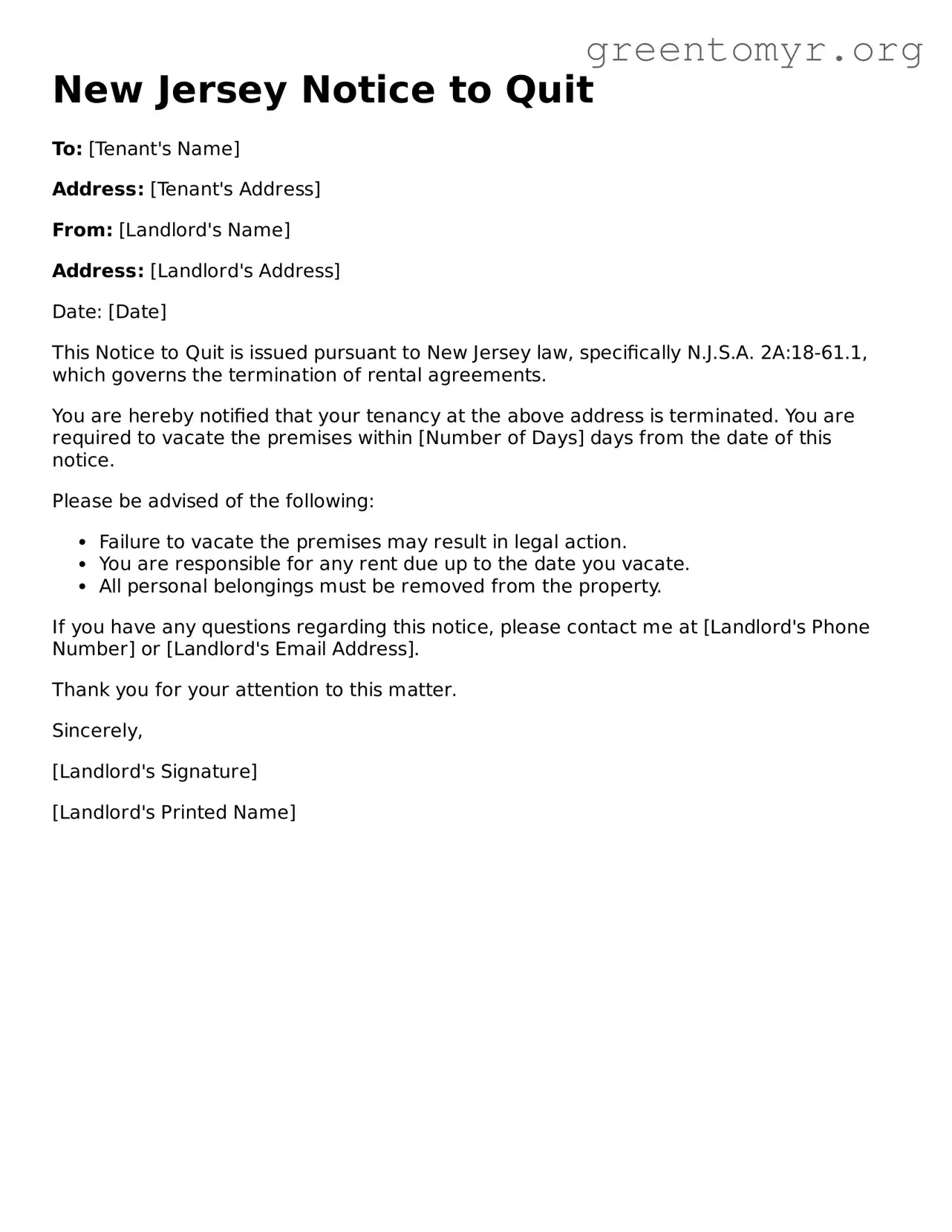
The New Jersey Notice to Quit form is a crucial document in the landlord-tenant relationship, serving as a formal request for tenants to vacate a rental property. This form is typically used when a landlord seeks to terminate a lease agreement due to non-payment of rent, lease violations, or other breaches of the rental agreement. It outlines the reasons for eviction and specifies a deadline by which the tenant must leave the premises. The Notice to Quit must adhere to specific state laws regarding notice periods, which can vary depending on the circumstances surrounding the eviction. Proper completion and delivery of this form are essential, as failure to follow legal protocols may hinder the eviction process. Tenants receiving this notice should take it seriously, as it marks the beginning of potential legal proceedings. Understanding the implications of the Notice to Quit can help both landlords and tenants navigate the complexities of rental agreements and ensure compliance with New Jersey’s housing laws.
New Jersey Notice to Quit
To: [Tenant's Name]
Address: [Tenant's Address]
From: [Landlord's Name]
Address: [Landlord's Address]
Date: [Date]
This Notice to Quit is issued pursuant to New Jersey law, specifically N.J.S.A. 2A:18-61.1, which governs the termination of rental agreements.
You are hereby notified that your tenancy at the above address is terminated. You are required to vacate the premises within [Number of Days] days from the date of this notice.
Please be advised of the following:
If you have any questions regarding this notice, please contact me at [Landlord's Phone Number] or [Landlord's Email Address].
Thank you for your attention to this matter.
Sincerely,
[Landlord's Signature]
[Landlord's Printed Name]
| Fact Name | Description |
|---|---|
| Purpose | The New Jersey Notice to Quit form is used by landlords to inform tenants of the termination of their lease agreement, typically due to non-payment of rent or other lease violations. |
| Governing Law | The form is governed by New Jersey Statutes Annotated (N.J.S.A.) 2A:18-61.1 et seq., which outlines the procedures for eviction and tenant rights. |
| Delivery Method | The Notice to Quit must be delivered to the tenant in person or sent via certified mail to ensure proper notification. |
| Timeframe | After the notice is served, tenants typically have a specific period, often 30 days, to vacate the premises before further legal action can be taken by the landlord. |
Once you have the New Jersey Notice to Quit form ready, you will need to fill it out accurately to ensure it meets the legal requirements. Completing this form is an important step in the process of terminating a lease or rental agreement.
After filling out the form, you will need to deliver it to the tenant. This can be done in person, by mail, or through other legal means. Ensure you keep a record of how and when the notice was delivered.
A Notice to Quit is a legal document that a landlord uses to inform a tenant that they must vacate the rental property. This notice is typically issued when a tenant has violated the lease agreement, failed to pay rent, or engaged in illegal activities on the premises.
A landlord may issue a Notice to Quit under several circumstances, including:
Each situation may have different requirements regarding the notice period, so it’s important to understand the specifics of the case.
The required notice period can vary based on the reason for the eviction:
Always check the latest laws or consult with a legal professional for specific cases.
Yes, the Notice to Quit must be in writing. A verbal notice is not legally sufficient. The written notice should clearly state the reason for eviction and the timeframe in which the tenant must vacate the property.
Yes, a tenant has the right to contest a Notice to Quit. If a tenant believes the notice is unjust, they can respond to the landlord or take the matter to court. It is advisable for tenants to seek legal assistance to understand their rights and options.
If a tenant does not vacate the property by the deadline stated in the Notice to Quit, the landlord may initiate eviction proceedings. This typically involves filing a complaint in the local court and may lead to a court hearing.
While there is no universally mandated format, the Notice to Quit should include essential information such as:
Using a clear and concise format helps ensure that the notice is legally valid.
No, a landlord cannot issue a Notice to Quit for any reason. The reasons must comply with New Jersey landlord-tenant laws. Common lawful reasons include non-payment of rent, lease violations, or illegal activities. Landlords must follow proper procedures to avoid potential legal issues.
Upon receiving a Notice to Quit, a tenant should:
Taking prompt action can help address the situation effectively.
Templates for a Notice to Quit can often be found online through legal aid websites, local government resources, or by consulting with a legal professional. It is important to ensure that any template used complies with New Jersey laws.
When filling out the New Jersey Notice to Quit form, many people make common mistakes that can lead to delays or complications in the eviction process. Understanding these pitfalls can help ensure the form is completed correctly and effectively.
One frequent mistake is failing to provide accurate tenant information. It is essential to include the full name of the tenant and their current address. Omitting any details can cause confusion and may result in the notice being deemed invalid.
Another common error is not specifying the reason for the eviction. The form requires a clear explanation of why the notice is being issued. Whether it's for non-payment of rent or lease violations, clarity is crucial. A vague reason can lead to disputes later on.
Many people forget to include the date the notice is issued. This date is vital as it marks the beginning of the notice period. Without it, the tenant may not know when they are expected to vacate the property.
Some individuals also overlook the importance of the signature. A signature is necessary to validate the notice. A form that is unsigned may be considered incomplete and ineffective.
Inaccurate calculations of the notice period can lead to significant issues. New Jersey law requires a specific notice period based on the reason for eviction. Not adhering to these timelines can result in the eviction being challenged in court.
Additionally, failing to deliver the notice properly can invalidate the process. The Notice to Quit must be delivered in accordance with state law. Whether through certified mail or personal delivery, proper delivery methods are essential.
People often neglect to keep a copy of the completed form for their records. This step is important for future reference and can serve as proof that the notice was issued. Without a copy, it can be challenging to track the process.
Misunderstanding the legal requirements for the notice can also lead to mistakes. Each situation may have specific legal nuances. It is advisable to review the relevant laws or seek guidance to ensure compliance.
Finally, rushing through the form can result in careless errors. Taking the time to carefully review each section before submission can prevent many of these mistakes. A well-prepared Notice to Quit can make the eviction process smoother and more effective.
When dealing with rental agreements and tenant evictions in New Jersey, the Notice to Quit form is just one part of the process. Several other documents may be necessary to ensure compliance with local laws and to protect the rights of both landlords and tenants. Below is a list of commonly used forms and documents that often accompany the Notice to Quit.
Each of these documents plays a crucial role in the eviction process, ensuring that both landlords and tenants follow the appropriate legal steps. Understanding their functions can help navigate the complexities of rental agreements and disputes effectively.
The Notice to Quit form is a crucial document in the eviction process. It serves as a formal notification to a tenant to vacate the premises. Similar documents also play important roles in landlord-tenant relationships. Below are eight documents that share similarities with the Notice to Quit form:
Each of these documents serves a unique purpose but shares a common goal of managing the landlord-tenant relationship effectively.
When filling out the New Jersey Notice to Quit form, it is essential to follow specific guidelines to ensure the document is completed correctly. Below is a list of things you should and shouldn't do.
When it comes to the New Jersey Notice to Quit form, many people hold misconceptions that can lead to confusion. Understanding the truth behind these myths is essential for both landlords and tenants. Here are nine common misconceptions:
Understanding these misconceptions can help both landlords and tenants navigate the complexities of rental agreements and eviction processes in New Jersey more effectively.
When dealing with the New Jersey Notice to Quit form, it is essential to understand its purpose and requirements. Here are some key takeaways: