In New Jersey, the Power of Attorney form is a vital legal document that allows individuals to appoint someone they trust to make decisions on their behalf. This form can cover a wide range of powers, from managing financial matters to making healthcare decisions, depending on the specific needs of the person granting authority. It’s important to understand that the person chosen, known as the agent or attorney-in-fact, will have the ability to act in the best interest of the individual, which can be especially crucial in times of illness or incapacity. The Power of Attorney can be tailored to be effective immediately or to become effective only under certain conditions, providing flexibility for various situations. Additionally, the form can be revoked at any time, as long as the individual is still capable of making decisions. Understanding these key aspects can help ensure that your wishes are respected and that your affairs are managed according to your preferences.
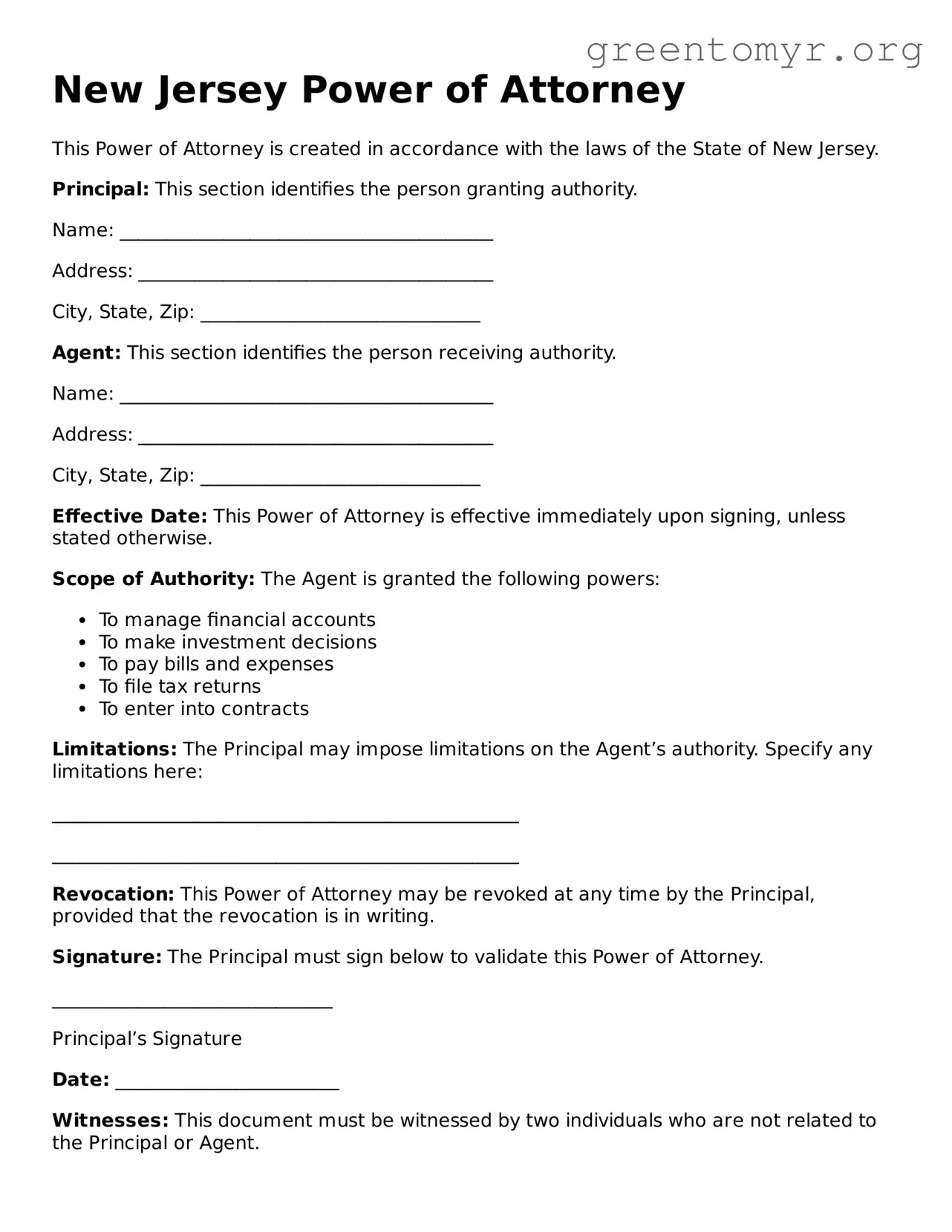
New Jersey Power of Attorney
This Power of Attorney is created in accordance with the laws of the State of New Jersey.
Principal: This section identifies the person granting authority.
Name: ________________________________________
Address: ______________________________________
City, State, Zip: ______________________________
Agent: This section identifies the person receiving authority.
Name: ________________________________________
Address: ______________________________________
City, State, Zip: ______________________________
Effective Date: This Power of Attorney is effective immediately upon signing, unless stated otherwise.
Scope of Authority: The Agent is granted the following powers:
Limitations: The Principal may impose limitations on the Agent’s authority. Specify any limitations here:
__________________________________________________
__________________________________________________
Revocation: This Power of Attorney may be revoked at any time by the Principal, provided that the revocation is in writing.
Signature: The Principal must sign below to validate this Power of Attorney.
______________________________
Principal’s Signature
Date: ________________________
Witnesses: This document must be witnessed by two individuals who are not related to the Principal or Agent.
Witness 1 Name: __________________________
Witness 1 Signature: ______________________
Date: ________________________
Witness 2 Name: __________________________
Witness 2 Signature: ______________________
Date: ________________________
Notary Public: This Power of Attorney must be notarized to be valid.
State of New Jersey
County of ___________________________
Subscribed and sworn to before me this ____ day of __________, 20__.
_______________________________
Notary Public Signature
My Commission Expires: _______________
| Fact Name | Description |
|---|---|
| Governing Law | The New Jersey Power of Attorney form is governed by the New Jersey Uniform Power of Attorney Act, N.J.S.A. 46:2B-8 et seq. |
| Definition | A Power of Attorney (POA) is a legal document that allows one person to act on behalf of another in legal or financial matters. |
| Types of POA | In New Jersey, there are two primary types of Power of Attorney: General and Limited. General grants broad powers, while Limited specifies certain actions. |
| Durability | A Durable Power of Attorney remains effective even if the principal becomes incapacitated, provided it is explicitly stated in the document. |
| Principal | The individual who grants authority through the Power of Attorney is referred to as the principal. |
| Agent | The person designated to act on behalf of the principal is known as the agent or attorney-in-fact. |
| Execution Requirements | The Power of Attorney must be signed by the principal in the presence of a notary public and, in some cases, witnesses. |
| Revocation | The principal can revoke the Power of Attorney at any time, as long as they are competent to do so. |
| Fiduciary Duty | The agent has a fiduciary duty to act in the best interests of the principal, maintaining transparency and accountability. |
| Statutory Form | New Jersey provides a statutory Power of Attorney form, which can be used to ensure compliance with state laws. |
Filling out the New Jersey Power of Attorney form is a straightforward process that allows you to designate someone to act on your behalf in financial or legal matters. Once you have completed the form, it will need to be signed and witnessed to ensure its validity.
A Power of Attorney (POA) is a legal document that allows one person, known as the "principal," to grant another person, called the "agent" or "attorney-in-fact," the authority to make decisions on their behalf. In New Jersey, this can include financial decisions, healthcare choices, or other matters as specified in the document.
There are several reasons why a person might need a Power of Attorney:
Creating a Power of Attorney in New Jersey involves a few steps:
New Jersey recognizes several types of Power of Attorney:
Yes, you can revoke a Power of Attorney at any time as long as you are mentally competent. To do this, you should create a written revocation document, inform your agent, and notify any institutions or individuals who may have relied on the original Power of Attorney.
If you do not have a Power of Attorney and become incapacitated, a court may need to appoint a guardian to make decisions on your behalf. This process can be time-consuming, costly, and may not reflect your wishes. Having a POA in place allows you to choose someone you trust to manage your affairs.
A Power of Attorney created in New Jersey is generally recognized in other states, but the rules can vary. It is advisable to check the specific requirements of the state where the POA will be used. Some states may require additional documentation or specific forms.
While it is not required to hire a lawyer to create a Power of Attorney in New Jersey, it is often recommended. A legal professional can help ensure that the document meets all legal requirements and accurately reflects your intentions, reducing the risk of issues in the future.
Filling out a Power of Attorney form in New Jersey can be straightforward, but several common mistakes often occur. One frequent error is not specifying the powers granted to the agent. Without clear definitions, the agent may not have the authority to act as intended. It is essential to outline specific powers, such as managing finances or making healthcare decisions.
Another mistake is failing to date the document. A Power of Attorney must be dated to be valid. If the date is omitted, it may lead to confusion about when the authority was granted, potentially causing complications in the future.
People sometimes overlook the need for witnesses or notarization. In New Jersey, a Power of Attorney must be signed in front of a notary public or two witnesses. Neglecting this requirement can invalidate the document.
Additionally, individuals may choose an agent who is not trustworthy or lacks the necessary skills. It is crucial to select someone who can handle the responsibilities effectively. A poorly chosen agent can lead to mismanagement of assets or personal affairs.
Another common error is not reviewing the document carefully before signing. Typos or unclear language can lead to misunderstandings about the agent's authority. It is advisable to read through the entire form thoroughly.
Some people fail to provide copies of the signed document to relevant parties. Once the Power of Attorney is executed, it is important to share it with the agent, financial institutions, and healthcare providers to ensure they recognize the authority granted.
Moreover, individuals sometimes forget to revoke previous Powers of Attorney. If multiple documents exist, confusion may arise regarding which one is currently valid. It is vital to revoke any prior documents to avoid conflicts.
People may also neglect to discuss their wishes with the appointed agent. Open communication helps ensure that the agent understands the individual’s preferences and intentions. Without this discussion, the agent may make decisions that do not align with the person’s wishes.
Finally, failing to keep the document updated can lead to issues. Life changes, such as marriage, divorce, or relocation, may affect the validity of the Power of Attorney. Regularly reviewing and updating the document is essential to ensure it remains effective.
A Power of Attorney (POA) is a vital document that allows one person to act on behalf of another in legal and financial matters. In New Jersey, several other forms and documents often accompany the POA to ensure comprehensive legal coverage and to address specific situations. Below is a list of these documents along with brief descriptions.
These documents work together to provide a comprehensive legal framework for managing personal, financial, and healthcare decisions. Ensuring that all necessary forms are in place can help protect an individual’s interests and ensure their wishes are honored.
The Power of Attorney (POA) form is a crucial legal document that allows one person to act on behalf of another. Several other documents share similarities with the POA, each serving distinct yet related purposes. Below are five such documents:
When filling out the New Jersey Power of Attorney form, it is essential to approach the process with care. Here are some things you should and shouldn't do:
Understanding the New Jersey Power of Attorney form is important, but there are many misconceptions surrounding it. Here are seven common myths and the truths behind them.
This is not true. Anyone can create a Power of Attorney at any age. It is a useful tool for anyone who wants to designate someone to make decisions on their behalf.
While many people use it for financial decisions, a Power of Attorney can also cover medical decisions and other personal matters. The scope depends on how it is drafted.
This is a misconception. You can still manage your own affairs if you are capable. A Power of Attorney only comes into effect when you choose it to, or if you become incapacitated.
This is false. There are different types of Powers of Attorney, such as durable, springing, and limited. Each serves different purposes and has specific rules.
This is incorrect. You can revoke or change your Power of Attorney at any time, as long as you are mentally competent to do so.
This is misleading. An agent must act in your best interest and according to the powers granted in the document. They cannot act outside of those powers.
While notarization is recommended for added security, it is not always required in New Jersey. However, certain institutions may require it, so check with them first.
Being informed about these misconceptions can help you make better decisions regarding your Power of Attorney in New Jersey.
When considering the New Jersey Power of Attorney form, it's essential to understand its significance and the steps involved in completing it. Here are some key takeaways to guide you through the process:
By keeping these key points in mind, you can navigate the process of filling out and using the New Jersey Power of Attorney form with greater confidence and clarity.