In the realm of family law, ensuring the well-being of children is paramount, and one crucial tool that parents can utilize is the New Jersey Power of Attorney for a Child form. This legal document empowers a designated individual—often a relative or trusted friend—to make important decisions on behalf of a child when parents are unavailable or unable to do so. It can cover a wide range of responsibilities, including healthcare decisions, educational matters, and even day-to-day caregiving. By granting this authority, parents can ensure that their child's needs are met in their absence, whether due to work commitments, travel, or other circumstances. Importantly, the form is designed to be straightforward and accessible, allowing parents to tailor it to their specific needs. With the right understanding of this form, families can navigate unexpected situations with greater confidence, knowing that their child's welfare is in capable hands.
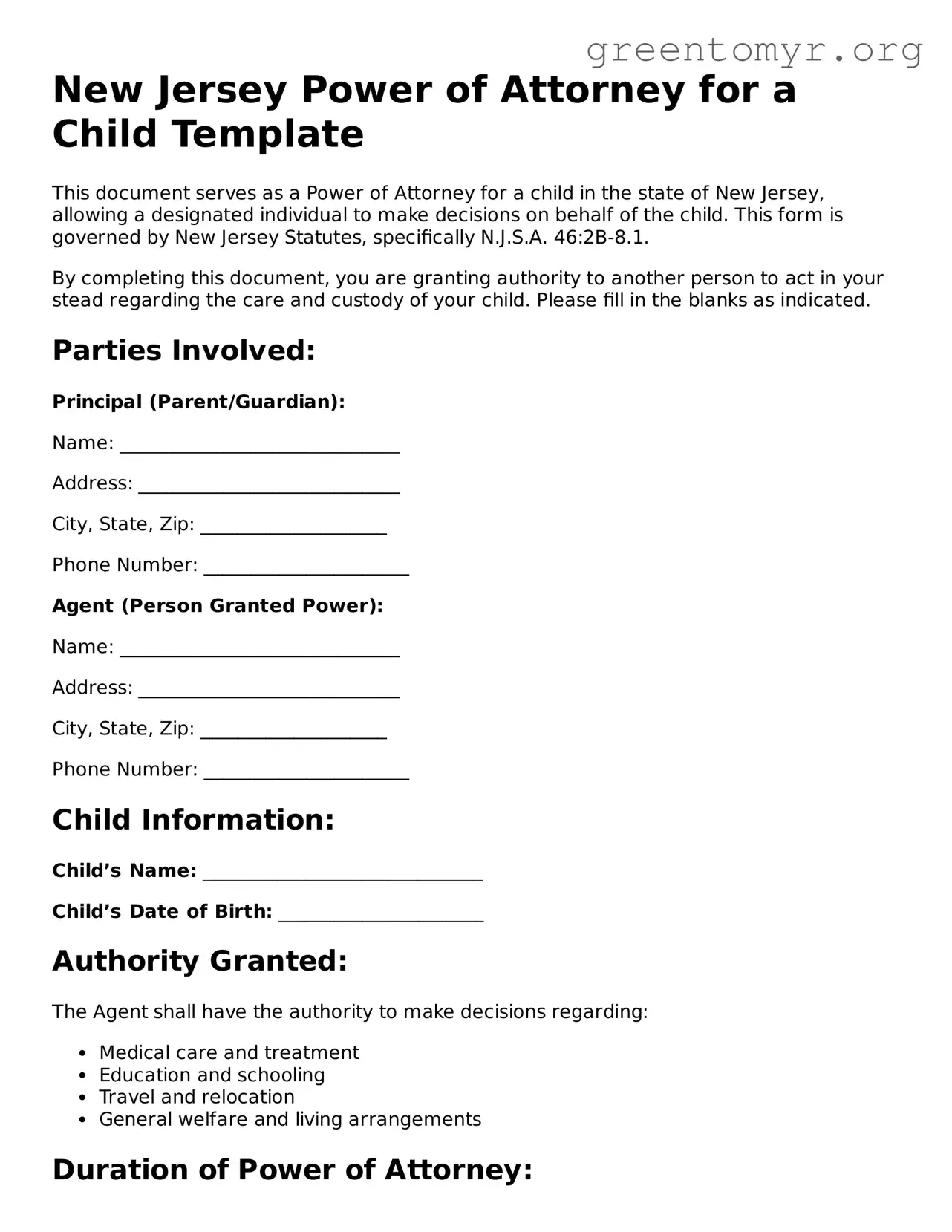
New Jersey Power of Attorney for a Child Template
This document serves as a Power of Attorney for a child in the state of New Jersey, allowing a designated individual to make decisions on behalf of the child. This form is governed by New Jersey Statutes, specifically N.J.S.A. 46:2B-8.1.
By completing this document, you are granting authority to another person to act in your stead regarding the care and custody of your child. Please fill in the blanks as indicated.
Parties Involved:
Principal (Parent/Guardian):
Name: ______________________________
Address: ____________________________
City, State, Zip: ____________________
Phone Number: ______________________
Agent (Person Granted Power):
Name: ______________________________
Address: ____________________________
City, State, Zip: ____________________
Phone Number: ______________________
Child Information:
Child’s Name: ______________________________
Child’s Date of Birth: ______________________
Authority Granted:
The Agent shall have the authority to make decisions regarding:
Duration of Power of Attorney:
This Power of Attorney shall commence on the date signed and remain in effect until:
Signatures:
By signing below, the Principal acknowledges that they understand the contents of this Power of Attorney and voluntarily grant the specified powers to the Agent.
Principal’s Signature: ______________________________
Date: ______________________
Agent’s Signature: ______________________________
Date: ______________________
This document should be kept in a safe place and copies provided to the Agent and any relevant parties involved in the care of the child.
| Fact Name | Details |
|---|---|
| Purpose | The New Jersey Power of Attorney for a Child form allows a parent or guardian to delegate authority for a child to another adult. |
| Governing Law | This form is governed by New Jersey Statutes, Title 9, Chapter 2, which addresses child custody and guardianship. |
| Duration | The authority granted can be limited to a specific time frame or event, making it flexible for various situations. |
| Requirements | Both the parent or guardian and the designated adult must sign the form in the presence of a notary public. |
| Revocation | The Power of Attorney can be revoked at any time by the parent or guardian, provided they communicate this decision clearly. |
Filling out the New Jersey Power of Attorney for a Child form is a straightforward process. Once completed, the form allows a designated individual to make decisions on behalf of a child in specific situations. This can be particularly useful for temporary arrangements, such as when parents are away or unable to care for their child for a period of time.
A Power of Attorney for a Child in New Jersey is a legal document that allows a parent or guardian to grant another adult the authority to make decisions on behalf of their child. This can include medical decisions, educational choices, and other important matters when the parent or guardian is unavailable.
Any responsible adult can be designated as an agent in the Power of Attorney for a Child. This could be a relative, friend, or trusted neighbor. It’s essential to choose someone who is reliable and understands the responsibilities involved.
While it is not legally required to have a lawyer, consulting one can be beneficial. A lawyer can help ensure that the document meets all legal requirements and addresses your specific needs. If you choose to create the document without legal assistance, make sure to follow all guidelines carefully.
The Power of Attorney for a Child remains valid until the specified end date in the document, or until it is revoked by the parent or guardian. If no end date is provided, it typically lasts until the child reaches the age of majority, which is 18 in New Jersey.
Yes, you can revoke a Power of Attorney for a Child at any time. To do so, you should create a written notice stating your intent to revoke the document and provide it to the agent and any relevant parties. It’s advisable to keep a copy of the revocation for your records.
The agent has a duty to act in the best interest of the child. This includes making decisions regarding healthcare, education, and other aspects of the child's life. The agent should communicate regularly with the parent or guardian and keep them informed about important decisions and events.
No, the Power of Attorney for a Child can cover a range of decisions. While it often includes medical decisions, it can also address educational matters, travel permissions, and other aspects of the child’s welfare. Parents can specify the scope of authority granted to the agent in the document.
If the child has special needs, the Power of Attorney can be tailored to address those specific requirements. It’s crucial to clearly outline the agent's authority regarding medical and educational decisions that cater to the child’s unique circumstances.
Yes, the Power of Attorney for a Child must be signed in front of a notary public to be considered valid in New Jersey. This step helps verify the identities of the signatories and ensures that the document is legally binding.
You can find a Power of Attorney for a Child form online through various legal websites or state resources. Additionally, many law offices may provide templates or assistance in creating the document. Always ensure that the form you use complies with New Jersey laws.
When completing the New Jersey Power of Attorney for a Child form, individuals often overlook important details that can lead to complications. One common mistake is failing to provide accurate information about the child. This includes the child's full name, date of birth, and any relevant identification numbers. Inaccuracies can create confusion and may delay the legal process.
Another frequent error involves not specifying the powers being granted. The form should clearly outline what decisions the agent can make on behalf of the child. Without this clarity, the agent may not have the authority to act in critical situations, which can lead to misunderstandings and potential legal issues.
People sometimes neglect to include the start and end dates of the power of attorney. Leaving these dates blank can result in the document being considered invalid. It is essential to indicate when the authority begins and when it ends, ensuring that both the agent and the child's needs are adequately addressed.
Additionally, signatures are often a point of contention. All required parties must sign the form for it to be valid. This includes the parent or guardian granting the power of attorney, as well as the agent accepting the role. Missing signatures can render the document ineffective.
Witness requirements can also be misunderstood. New Jersey law mandates that the form be signed in the presence of a notary public or witnesses, depending on the circumstances. Failing to meet these requirements may invalidate the power of attorney.
Lastly, individuals may not keep copies of the completed form. It is crucial to retain a copy for personal records and to provide a copy to the agent. Without this, communication can break down, leading to challenges in executing the powers granted.
When creating a Power of Attorney for a Child in New Jersey, several other forms and documents may be beneficial to ensure comprehensive legal authority and protection. These documents help clarify responsibilities and provide additional support for the child’s well-being. Below is a list of commonly used forms that accompany the Power of Attorney for a Child.
These forms and documents work together to create a comprehensive framework for the care and legal authority concerning the child. Ensuring that all necessary paperwork is in order can provide peace of mind for both parents and caregivers alike.
When filling out the New Jersey Power of Attorney for a Child form, it is essential to approach the task with care. Here is a list of ten things to consider, including both what to do and what to avoid.
Things You Should Do:
Things You Shouldn't Do:
Understanding the New Jersey Power of Attorney for a Child form can be challenging. Here are ten common misconceptions that people often have about this important legal document:
Clearing up these misconceptions can help parents and guardians make informed decisions about their child's care and ensure that they have the necessary legal tools in place.
When considering the New Jersey Power of Attorney for a Child form, it is important to understand its implications and requirements. Here are key takeaways to keep in mind:
Understanding these key points can help ensure that the New Jersey Power of Attorney for a Child form is filled out correctly and used effectively.