Content Navigation

In the landscape of modern relationships, a prenuptial agreement serves as a proactive measure for couples contemplating marriage. Particularly in New Jersey, this legal document allows partners to outline their financial rights and responsibilities before tying the knot. The New Jersey Prenuptial Agreement form addresses various essential aspects, including the division of assets and debts, spousal support, and the management of property acquired during the marriage. By clearly delineating these elements, couples can foster open communication about financial matters, reducing the potential for conflict in the future. Importantly, the form must be completed with careful consideration of state laws to ensure its enforceability. Additionally, both parties should ideally seek independent legal advice to ensure that their interests are adequately represented. This thoughtful approach not only protects individual assets but also lays a foundation of trust and transparency that can strengthen the marital relationship.

New Jersey Prenuptial Agreement Example

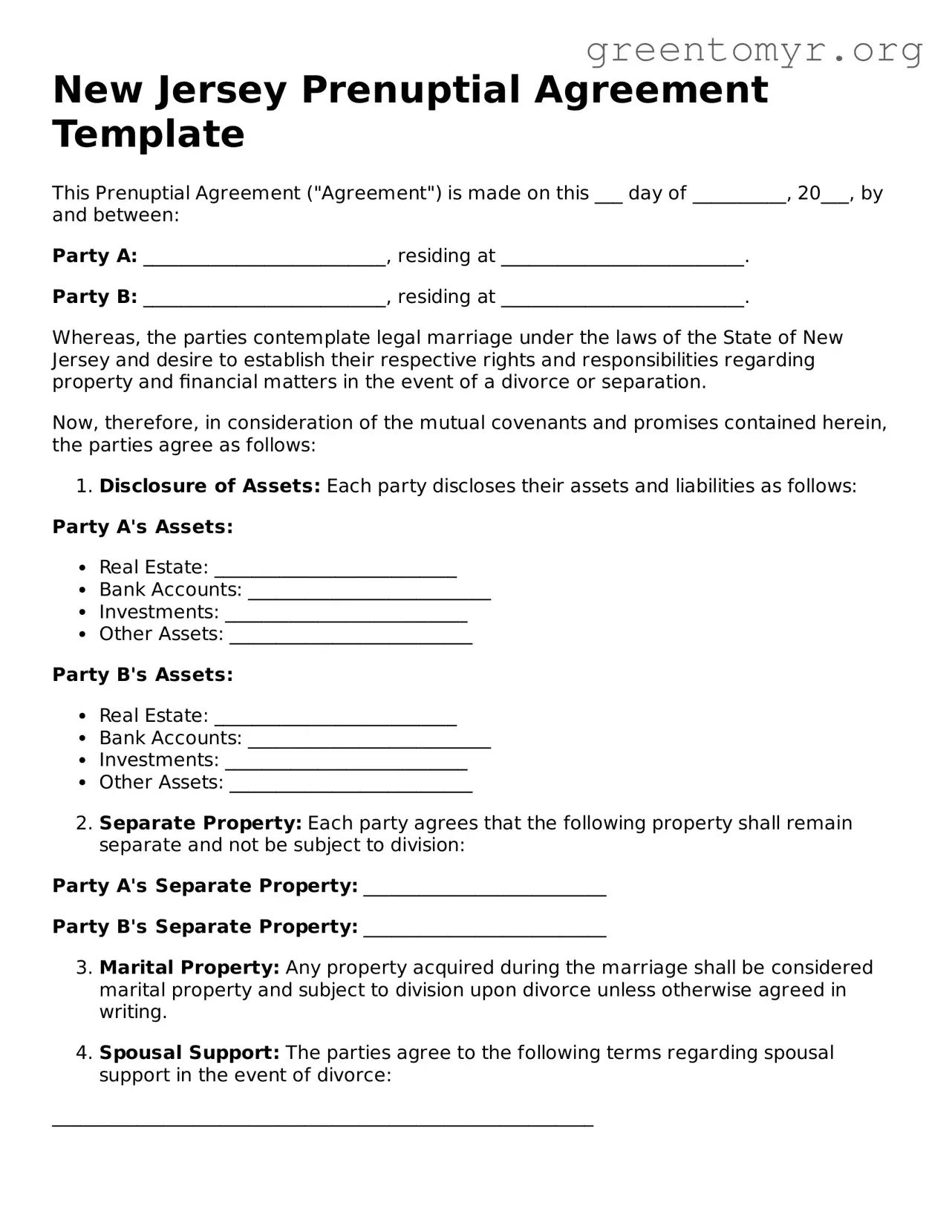
New Jersey Prenuptial Agreement Template

This Prenuptial Agreement ("Agreement") is made on this ___ day of __________, 20___, by and between:

Party A: __________________________, residing at __________________________.

Party B: __________________________, residing at __________________________.

Whereas, the parties contemplate legal marriage under the laws of the State of New Jersey and desire to establish their respective rights and responsibilities regarding property and financial matters in the event of a divorce or separation.

Now, therefore, in consideration of the mutual covenants and promises contained herein, the parties agree as follows:

  1. Disclosure of Assets: Each party discloses their assets and liabilities as follows:

Party A's Assets:

  • Real Estate: __________________________
  • Bank Accounts: __________________________
  • Investments: __________________________
  • Other Assets: __________________________

Party B's Assets:

  • Real Estate: __________________________
  • Bank Accounts: __________________________
  • Investments: __________________________
  • Other Assets: __________________________
  1. Separate Property: Each party agrees that the following property shall remain separate and not be subject to division:

Party A's Separate Property: __________________________

Party B's Separate Property: __________________________

  1. Marital Property: Any property acquired during the marriage shall be considered marital property and subject to division upon divorce unless otherwise agreed in writing.
  1. Spousal Support: The parties agree to the following terms regarding spousal support in the event of divorce:

__________________________________________________________

  1. Governing Law: This Agreement shall be governed by the laws of the State of New Jersey.

IN WITNESS WHEREOF, the parties hereto have executed this Prenuptial Agreement as of the date first above written.

Party A Signature: __________________________

Date: __________________________

Party B Signature: __________________________

Date: __________________________

Witness Signature: __________________________

Date: __________________________

PDF Form Features

Fact Name Details
Governing Law The New Jersey Prenuptial Agreement is governed by the Uniform Premarital Agreement Act (UPAA).
Definition A prenuptial agreement is a contract between two individuals before marriage that outlines the division of assets and responsibilities in the event of divorce or separation.
Enforceability To be enforceable, the agreement must be in writing and signed by both parties.
Disclosure Requirement Both parties must fully disclose their financial circumstances, including assets and debts, before signing the agreement.
Amendments The agreement can be amended or revoked at any time, but any changes must also be in writing and signed by both parties.
Judicial Review A court may review the agreement for fairness and may refuse to enforce it if it finds it unconscionable or if there was coercion involved.

Guide to Using New Jersey Prenuptial Agreement

Filling out the New Jersey Prenuptial Agreement form is a crucial step for couples planning to marry. This process requires careful attention to detail, ensuring that both parties clearly understand their rights and obligations. Below are the steps you need to follow to complete the form accurately.

  1. Begin by clearly stating the full names of both parties. Include any middle names or suffixes.
  2. Provide the current addresses for both individuals. Make sure the addresses are up-to-date.
  3. Indicate the date of the marriage. This should be the date you plan to marry.
  4. List any property owned by each party. Be specific about the nature of the property, whether it is real estate, personal belongings, or financial assets.
  5. Detail any debts incurred by either party. This should include loans, credit card debts, and other financial obligations.
  6. Outline how you wish to handle property acquired during the marriage. Clearly state whether you want it to be considered marital property or separate property.
  7. Include any other agreements or conditions you both wish to establish. This may involve spousal support or other financial arrangements.
  8. Both parties should sign and date the form in the presence of a notary public. This step is essential for the agreement to be legally binding.

Once you have completed these steps, ensure that both parties retain a signed copy for their records. It is advisable to seek legal counsel to review the agreement before finalizing it, as this can help prevent misunderstandings in the future.

Get Answers on New Jersey Prenuptial Agreement

What is a prenuptial agreement in New Jersey?

A prenuptial agreement, often called a prenup, is a legal document that couples create before marriage. It outlines how assets and debts will be divided in the event of divorce or death. In New Jersey, prenups can also address issues like spousal support and property rights.

Why should I consider a prenuptial agreement?

There are several reasons to consider a prenup:

  • Protection of individual assets: Safeguard your personal property and finances.
  • Debt protection: Prevent your spouse from being responsible for your debts.
  • Clarity: Establish clear expectations regarding financial matters.
  • Peace of mind: Reduce potential conflicts during a divorce.

What are the requirements for a valid prenuptial agreement in New Jersey?

To be valid in New Jersey, a prenuptial agreement must meet certain criteria:

  1. Both parties must voluntarily sign the agreement.
  2. The agreement must be in writing.
  3. Full disclosure of assets and debts is required.
  4. The terms must be fair and reasonable at the time of signing.
  5. Both parties should ideally have independent legal representation.

Can I modify a prenuptial agreement after marriage?

Yes, a prenuptial agreement can be modified after marriage. Both parties must agree to the changes in writing. It’s advisable to consult with legal counsel to ensure that the modification is valid and enforceable.

What happens if we don’t have a prenuptial agreement?

If you do not have a prenuptial agreement, New Jersey law will dictate how assets and debts are divided in the event of a divorce. This may not align with your personal wishes or expectations. Without a prenup, the court will make decisions based on equitable distribution laws.

Is a prenuptial agreement only for wealthy individuals?

No, a prenuptial agreement is not just for the wealthy. It can benefit anyone who wants to protect their financial interests, regardless of their net worth. It’s a practical tool for couples to discuss and manage their financial future together.

How do I create a prenuptial agreement in New Jersey?

To create a prenuptial agreement in New Jersey, follow these steps:

  1. Discuss your financial situation and expectations with your partner.
  2. Consult with separate attorneys to understand your rights.
  3. Draft the agreement, ensuring it includes all necessary terms.
  4. Review the document together and make any necessary changes.
  5. Sign the agreement in the presence of witnesses.

Can a prenuptial agreement cover child custody and support?

While a prenuptial agreement can address many financial matters, it cannot dictate child custody or support arrangements. New Jersey courts prioritize the best interests of the child, and these decisions must be made at the time of divorce or separation.

Common mistakes

When completing a prenuptial agreement in New Jersey, individuals often encounter common pitfalls that can undermine the effectiveness of the document. One frequent mistake is failing to fully disclose all assets and liabilities. Transparency is crucial in prenuptial agreements. If one party does not provide a complete picture of their financial situation, it can lead to disputes later on. Courts may view the agreement as unenforceable if they determine that there was a lack of full disclosure.

Another mistake involves overlooking the need for independent legal counsel. While it may seem convenient for both parties to use the same attorney, this can create conflicts of interest. Each individual should seek their own legal advice to ensure that their rights and interests are adequately represented. Without independent counsel, one party may feel pressured to agree to terms that are not in their best interest.

Additionally, individuals often neglect to address the issue of future income and property. A prenuptial agreement should not only cover existing assets but also outline how future earnings and acquisitions will be handled. Failing to include these provisions can result in confusion and potential legal battles down the line. It is essential to anticipate changes in circumstances and address them in the agreement.

Lastly, many people underestimate the importance of reviewing and updating the prenuptial agreement over time. Life events such as the birth of children, changes in income, or significant purchases can affect the relevance of the agreement. Regular reviews can help ensure that the document remains aligned with the parties' current financial situations and intentions. Neglecting this step can lead to complications if circumstances change significantly.

Documents used along the form

A prenuptial agreement is a legal document that outlines the financial arrangements and responsibilities of each party before marriage. In addition to this form, several other documents may be utilized to ensure a comprehensive understanding of the parties' rights and obligations. The following list includes common forms and documents that often accompany a New Jersey prenuptial agreement.

  • Financial Disclosure Statement: This document provides a detailed account of each party's assets, liabilities, income, and expenses. Transparency is crucial for ensuring that both parties fully understand each other's financial situation.
  • Marital Property Agreement: This agreement specifies what property will be considered marital property and what will remain separate. It can help clarify ownership issues that may arise during the marriage or in the event of a divorce.
  • Postnuptial Agreement: Similar to a prenuptial agreement, this document is created after marriage. It can be used to modify the terms of the prenuptial agreement or to address new circumstances that arise during the marriage.
  • Separation Agreement: This document outlines the terms of separation between spouses, including division of property, child custody, and support obligations. It is often used when couples decide to live apart but are not yet divorced.
  • Divorce Settlement Agreement: In the event of divorce, this agreement details how assets and debts will be divided. It addresses issues such as alimony, child support, and custody arrangements.
  • Power of Attorney: This document grants one person the authority to act on behalf of another in financial or legal matters. It is often important for couples to establish this in case one partner becomes incapacitated.
  • Will: A will outlines how a person's assets will be distributed upon their death. Couples may choose to create or update their wills to reflect their marital status and shared assets.
  • Trust Agreement: This document establishes a trust, which can be used to manage assets during a person's lifetime and distribute them after death. Trusts can provide tax benefits and protect assets from creditors.
  • Child Custody Agreement: If children are involved, this document outlines the custody arrangements and visitation rights. It is crucial for ensuring that both parents understand their responsibilities and rights regarding their children.

These documents serve various purposes and can help facilitate clear communication and understanding between parties. They are essential for managing expectations and protecting the interests of both individuals in a marriage.

Similar forms

  • Postnuptial Agreement: Similar to a prenuptial agreement, a postnuptial agreement is created after marriage. It outlines the financial arrangements and responsibilities of both spouses, often addressing changes in circumstances or new financial realities that arise after the wedding.
  • Separation Agreement: A separation agreement is a contract made between spouses who choose to live apart. This document typically covers issues such as child custody, support, and division of assets, much like a prenuptial agreement but is enacted during the marriage.
  • Marital Settlement Agreement: When couples divorce, they often create a marital settlement agreement. This document details the terms of the divorce, including asset division and spousal support, similar to how a prenuptial agreement outlines expectations before marriage.
  • Co-habitation Agreement: For couples living together but not married, a cohabitation agreement serves a similar purpose. It lays out financial responsibilities and asset ownership, providing clarity much like a prenuptial agreement does for married couples.
  • Living Will: While primarily focused on medical decisions, a living will can be compared to a prenuptial agreement in that it specifies an individual's wishes in advance. Both documents aim to clarify intentions and protect interests, albeit in different contexts.
  • Durable Power of Attorney: This document allows someone to make financial or medical decisions on behalf of another person if they become incapacitated. Similar to a prenuptial agreement, it establishes clear guidelines and responsibilities, ensuring that one’s wishes are respected.

Dos and Don'ts

When filling out the New Jersey Prenuptial Agreement form, it is important to approach the process with care and consideration. Below are some guidelines to help you navigate this important step.

  • Do communicate openly with your partner about your intentions and expectations.
  • Do ensure that both parties fully understand the terms of the agreement.
  • Do seek independent legal advice to ensure your rights are protected.
  • Do disclose all assets and debts honestly to avoid future disputes.
  • Don't rush the process; take your time to review and discuss the agreement.
  • Don't ignore state laws that may affect the validity of your prenup.

By following these guidelines, you can create a prenuptial agreement that reflects your mutual understanding and protects both parties involved.

Misconceptions

Understanding prenuptial agreements can be challenging, especially in New Jersey. Here are eight common misconceptions about the New Jersey Prenuptial Agreement form.

  • Prenuptial agreements are only for the wealthy. Many people believe that only those with significant assets need a prenup. In reality, anyone can benefit from a prenuptial agreement, regardless of their financial status.
  • Prenuptial agreements are unromantic. Some think that discussing a prenup is a sign of distrust. In truth, a prenuptial agreement can foster open communication about finances, strengthening the relationship.
  • Prenuptial agreements are not enforceable. This misconception arises from a lack of understanding of the legal framework. In New Jersey, if properly drafted and executed, prenups are generally enforceable in court.
  • Prenuptial agreements can cover anything. While prenups can address many financial matters, they cannot dictate child custody or child support arrangements. These issues must be determined based on the best interests of the child.
  • Prenuptial agreements are permanent. Some believe that once a prenup is signed, it cannot be changed. However, couples can modify or revoke their agreement at any time, as long as both parties consent.
  • Prenuptial agreements are only for marriages. Prenups are often associated with marriage, but they can also be used in domestic partnerships or civil unions in New Jersey.
  • Prenuptial agreements are only necessary before marriage. While it is ideal to create a prenup before the wedding, couples can still draft a postnuptial agreement after they are married if they wish to address financial matters.
  • Prenuptial agreements are too complicated. Many people think that creating a prenup is a daunting process. With the right guidance and clear communication, couples can create an agreement that meets their needs without excessive complexity.

By dispelling these misconceptions, couples can make informed decisions about prenuptial agreements and their benefits.

Key takeaways

When considering a prenuptial agreement in New Jersey, it is essential to understand the key elements involved in filling out and using the form effectively. Below are important takeaways to keep in mind.

  • Both parties should fully disclose their financial situations, including assets and debts.
  • It is advisable to consult with independent legal counsel to ensure fairness and understanding.
  • The agreement must be in writing; verbal agreements are not enforceable.
  • Timing is crucial; the agreement should be signed well before the wedding date.
  • Consider including provisions for property division and spousal support in case of divorce.
  • Review the agreement periodically, especially if significant life changes occur.
  • The form should be clear and specific to avoid ambiguity in its terms.
  • Both parties must sign the agreement voluntarily, without any coercion.
  • Notarization may be required for the agreement to be legally binding.
  • Understand that the agreement is subject to court review, particularly if challenged in the future.

By keeping these points in mind, individuals can create a prenuptial agreement that serves their interests while promoting transparency and mutual respect.