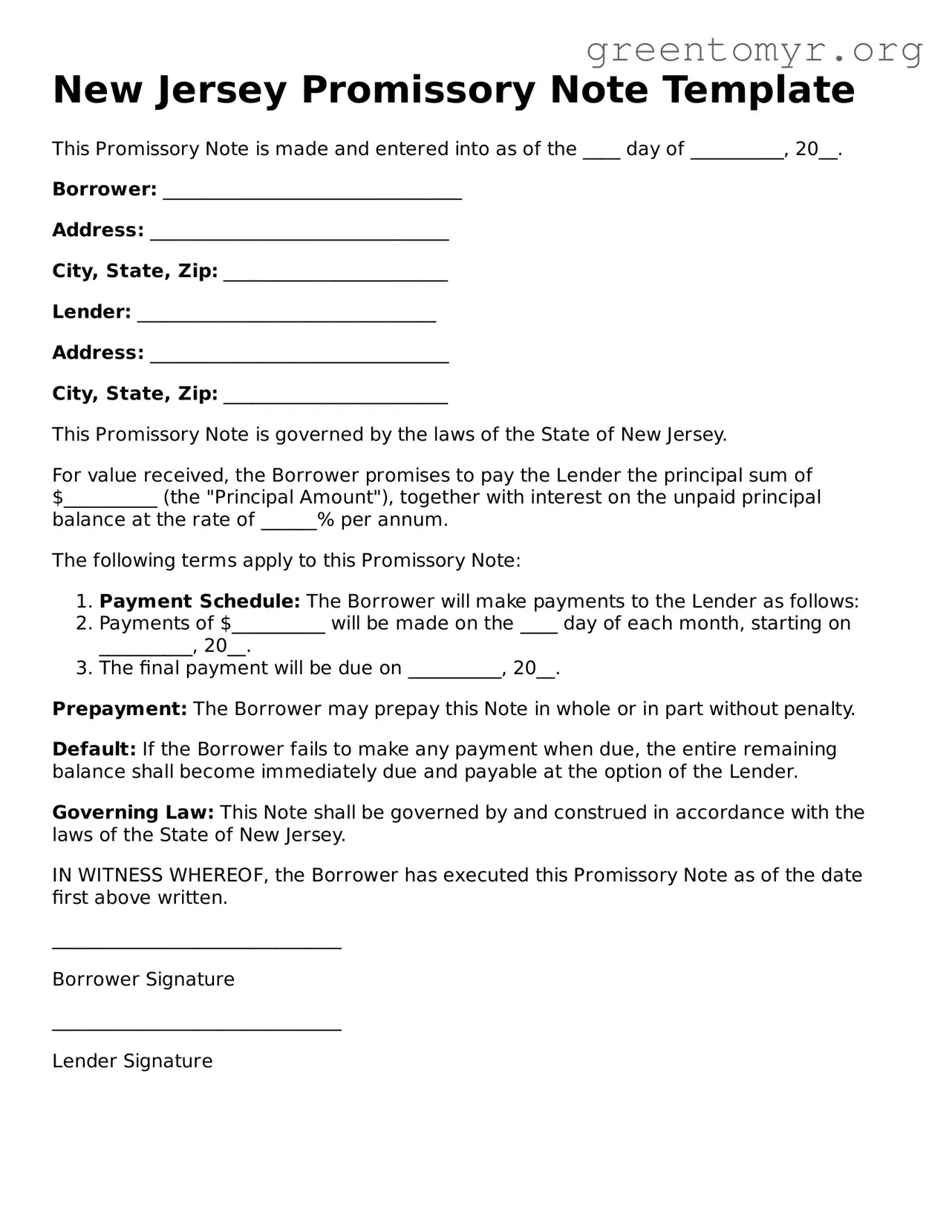
The New Jersey Promissory Note form serves as a vital financial document for individuals and businesses alike, facilitating the borrowing and lending of money in a clear and legally binding manner. This form outlines the key terms of the loan agreement, including the principal amount borrowed, the interest rate, repayment schedule, and any applicable fees. Additionally, it specifies the rights and obligations of both the lender and the borrower, ensuring that both parties understand their commitments. By detailing the consequences of default, such as late fees or legal action, the document provides a framework for resolving disputes should they arise. Furthermore, the New Jersey Promissory Note can be customized to suit various lending situations, whether for personal loans, business financing, or real estate transactions. Understanding this form is essential for anyone engaged in a lending agreement in New Jersey, as it not only protects the interests of the lender but also provides the borrower with clarity on their repayment responsibilities.
New Jersey Promissory Note Template
This Promissory Note is made and entered into as of the ____ day of __________, 20__.
Borrower: ________________________________
Address: ________________________________
City, State, Zip: ________________________
Lender: ________________________________
Address: ________________________________
City, State, Zip: ________________________
This Promissory Note is governed by the laws of the State of New Jersey.
For value received, the Borrower promises to pay the Lender the principal sum of $__________ (the "Principal Amount"), together with interest on the unpaid principal balance at the rate of ______% per annum.
The following terms apply to this Promissory Note:
Prepayment: The Borrower may prepay this Note in whole or in part without penalty.
Default: If the Borrower fails to make any payment when due, the entire remaining balance shall become immediately due and payable at the option of the Lender.
Governing Law: This Note shall be governed by and construed in accordance with the laws of the State of New Jersey.
IN WITNESS WHEREOF, the Borrower has executed this Promissory Note as of the date first above written.
_______________________________
Borrower Signature
_______________________________
Lender Signature
| Fact Name | Description |
|---|---|
| Definition | A promissory note is a written promise to pay a specified amount of money to a designated person or entity at a future date. |
| Governing Law | The New Jersey Uniform Commercial Code (UCC) governs promissory notes in New Jersey. |
| Parties Involved | The document typically involves two parties: the maker (borrower) and the payee (lender). |
| Interest Rate | Interest rates can be fixed or variable, and they should be clearly stated in the note. |
| Payment Terms | The payment schedule must be outlined, including due dates and amounts. |
| Default Clause | Many notes include a default clause, which outlines what happens if the borrower fails to make payments. |
| Signature Requirement | The note must be signed by the maker to be legally binding. |
| Enforceability | For a promissory note to be enforceable, it must meet certain legal criteria, including clarity and intent to create a binding obligation. |
After you have gathered the necessary information, you are ready to fill out the New Jersey Promissory Note form. This document outlines the terms of a loan agreement between a borrower and a lender. Completing this form accurately is important to ensure that both parties understand their obligations.
Once the form is completed and signed, keep copies for both parties. This ensures everyone has a record of the agreement.
A promissory note is a written promise to pay a specific amount of money to a designated person or entity at a specified time or on demand. In New Jersey, this document serves as a legal agreement between a borrower and a lender, outlining the terms of the loan, including the interest rate, repayment schedule, and any collateral involved.
Using a promissory note provides clarity and protection for both parties involved in a loan transaction. It establishes the expectations regarding repayment and can help prevent misunderstandings. Additionally, if a dispute arises, having a written document can serve as evidence in legal proceedings.
A typical promissory note in New Jersey includes the following key components:
Yes, a promissory note is legally binding once it is signed by both the borrower and the lender. This means that both parties are obligated to adhere to the terms outlined in the document. If either party fails to fulfill their obligations, the other party may seek legal recourse.
While it is not required to have a lawyer draft a promissory note, consulting with a legal professional can be beneficial. A lawyer can ensure that the document meets all legal requirements and adequately protects your interests. If the loan amount is significant or if complex terms are involved, legal assistance is highly recommended.
Yes, modifications can be made to a promissory note after it has been signed, but both parties must agree to the changes. It is best to document any modifications in writing and have both parties sign the revised note to avoid confusion in the future.
If the borrower defaults, meaning they fail to make the required payments, the lender has several options. They can pursue collection efforts, which may include contacting the borrower to negotiate a payment plan. If necessary, the lender can take legal action to recover the owed amount, potentially leading to court proceedings.
New Jersey does have specific laws that govern promissory notes, including regulations on interest rates and enforcement. For example, the state limits the maximum interest rate that can be charged on loans. It is important to be aware of these regulations to ensure compliance and avoid potential legal issues.
Filling out a Promissory Note in New Jersey can seem straightforward, but many people make common mistakes that could lead to confusion or legal issues. One frequent error is not including all necessary details. A Promissory Note should clearly state the amount borrowed, the interest rate, and the repayment schedule. Omitting any of this information can create misunderstandings later on.
Another mistake is failing to sign the document. Both the borrower and the lender must sign the Promissory Note for it to be legally binding. Without signatures, the document may not hold up in court if a dispute arises. It’s essential to double-check that all required signatures are present before finalizing the note.
Many people also overlook the importance of specifying the payment method. Whether payments will be made via check, bank transfer, or another method should be clearly stated in the note. Not doing so can lead to complications in how payments are processed and recorded.
In addition, some individuals make the mistake of not having a witness or notarization. While not always required, having a witness or getting the document notarized can add an extra layer of protection. This can be especially important if there is ever a disagreement about the terms of the loan.
Lastly, failing to keep a copy of the signed Promissory Note is a common oversight. Both parties should retain a copy for their records. This ensures that everyone has access to the agreed-upon terms and can refer back to them if needed. Keeping a record helps prevent disputes and provides clarity for both the borrower and the lender.
When entering into a financial agreement, especially one that involves a promissory note, several other documents may be necessary to ensure clarity and protection for all parties involved. These documents help outline the terms of the agreement, provide legal backing, and facilitate the enforcement of the note if needed. Below is a list of commonly used forms and documents that often accompany a New Jersey Promissory Note.
Understanding these documents can help both borrowers and lenders navigate the complexities of financial agreements. Proper documentation not only clarifies expectations but also protects the rights of all parties involved.
A Promissory Note is a financial document that outlines a promise to pay a specific amount of money to a designated party under agreed-upon terms. Several other documents share similarities with a Promissory Note, each serving unique purposes while maintaining the core concept of a promise or obligation. Here’s a look at nine documents that are similar to a Promissory Note:
Understanding these documents can help individuals navigate their financial obligations more effectively. Each serves a specific purpose but fundamentally revolves around the concept of a promise to pay.
When filling out the New Jersey Promissory Note form, it is important to approach the process carefully. Here are some key do's and don'ts to keep in mind:
By following these guidelines, you can ensure that your Promissory Note is completed correctly and serves its intended purpose effectively.
Understanding the New Jersey Promissory Note form can be tricky. Here are some common misconceptions that people often have:
Understanding these misconceptions can help you navigate the process of creating and using a promissory note in New Jersey more effectively.
Filling out and using the New Jersey Promissory Note form requires careful attention to detail. Here are some key takeaways to consider: