When renting a home in New Jersey, a Residential Lease Agreement is a crucial document that outlines the relationship between landlords and tenants. This form covers essential aspects such as the duration of the lease, monthly rent, and security deposit requirements. It also details the responsibilities of both parties, including maintenance obligations and rules regarding property use. Furthermore, the agreement specifies the conditions under which the lease can be terminated, ensuring that both landlords and tenants understand their rights and obligations. By having a clear and comprehensive lease agreement in place, both parties can avoid misunderstandings and foster a positive rental experience. Understanding the key elements of this form is vital for anyone involved in the rental process in New Jersey.
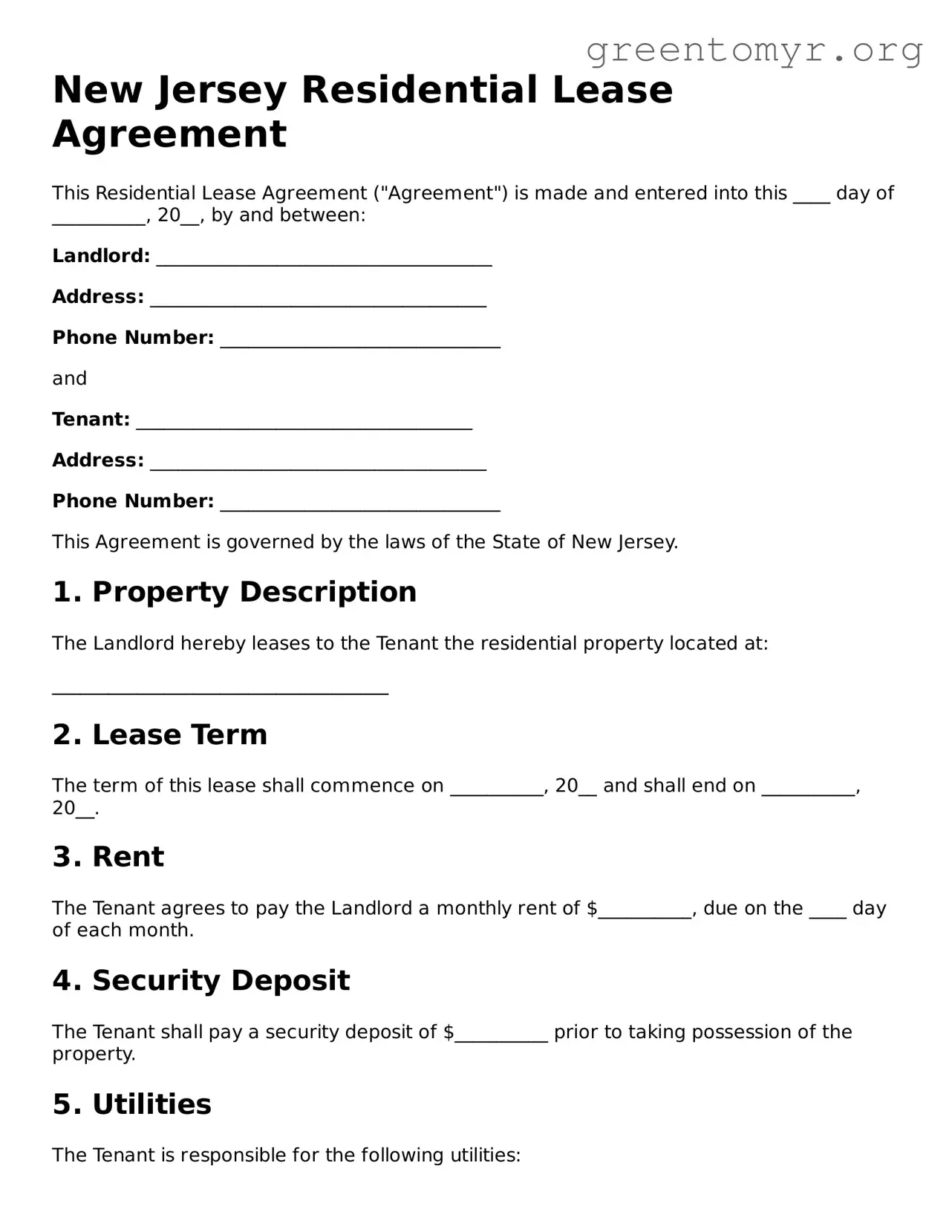
New Jersey Residential Lease Agreement
This Residential Lease Agreement ("Agreement") is made and entered into this ____ day of __________, 20__, by and between:
Landlord: ____________________________________
Address: ____________________________________
Phone Number: ______________________________
and
Tenant: ____________________________________
Address: ____________________________________
Phone Number: ______________________________
This Agreement is governed by the laws of the State of New Jersey.
1. Property Description
The Landlord hereby leases to the Tenant the residential property located at:
____________________________________
2. Lease Term
The term of this lease shall commence on __________, 20__ and shall end on __________, 20__.
3. Rent
The Tenant agrees to pay the Landlord a monthly rent of $__________, due on the ____ day of each month.
4. Security Deposit
The Tenant shall pay a security deposit of $__________ prior to taking possession of the property.
5. Utilities
The Tenant is responsible for the following utilities:
6. Maintenance and Repairs
The Tenant agrees to maintain the premises in good condition and report any needed repairs to the Landlord promptly.
7. Pets
Allowed: Yes / No (circle one)
8. Governing Law
This Agreement shall be governed by the laws of the State of New Jersey.
9. Signatures
By signing below, both parties agree to the terms of this Residential Lease Agreement.
Landlord Signature: ___________________________ Date: __________
Tenant Signature: ___________________________ Date: __________
| Fact Name | Details |
|---|---|
| Governing Law | The New Jersey Residential Lease Agreement is governed by the New Jersey Statutes, specifically Title 46A: Tenant and Landlord. |
| Duration of Lease | The lease can be for a fixed term, typically one year, or it can be month-to-month. |
| Security Deposit | Landlords may require a security deposit, which cannot exceed one and a half months' rent. |
| Notice Requirements | Both landlords and tenants must provide written notice for termination or non-renewal of the lease, typically 30 days in advance. |
| Habitability Standards | Landlords are required to maintain the property in a habitable condition, ensuring it meets health and safety standards. |
Filling out the New Jersey Residential Lease Agreement form is a straightforward process. This document outlines the terms between a landlord and a tenant for renting a property. Make sure to have all necessary information ready before you begin.
A New Jersey Residential Lease Agreement is a legally binding document between a landlord and tenant. This agreement outlines the terms and conditions under which a tenant can occupy a residential property. It typically includes details such as the duration of the lease, rent amount, security deposit, and responsibilities of both parties. This form is essential for protecting the rights of both landlords and tenants in New Jersey.
Several critical components should be included in a New Jersey Residential Lease Agreement. These components typically consist of:
In New Jersey, lease terms can vary widely based on the agreement between the landlord and tenant. Common lease terms include:
Regardless of the length, it is important that the lease clearly states the term to avoid any misunderstandings.
Generally, a landlord cannot increase the rent during the lease term unless the lease explicitly allows for such increases. If the lease is month-to-month, the landlord may increase the rent with proper notice, typically 30 days in New Jersey. It is crucial for tenants to review their lease agreement to understand the terms regarding rent increases.
If a tenant wishes to break the lease early, the consequences depend on the terms outlined in the lease agreement. Tenants may face penalties such as:
However, tenants may have options such as negotiating with the landlord or invoking specific clauses in the lease, like those related to job relocation or family emergencies. It is advisable to communicate openly with the landlord to explore potential solutions.
Completing the New Jersey Residential Lease Agreement form can be straightforward, but many individuals make common mistakes that can lead to complications. One frequent error is failing to include the full names of all tenants. It’s essential to list every adult who will be living in the rental unit. Omitting a name can create legal issues later, especially regarding liability and lease enforcement.
Another mistake often encountered is neglecting to specify the lease term. Whether it’s a month-to-month arrangement or a fixed-term lease, clarity is key. Without a clearly defined duration, disputes may arise regarding the end date and renewal processes.
Additionally, many people forget to outline the rent payment details. This includes the amount, due date, and acceptable payment methods. Incomplete payment terms can lead to confusion and potential late fees. Ensuring these details are clear protects both the landlord and tenant.
Another common oversight is failing to address security deposits. New Jersey has specific regulations regarding how much can be charged and how it should be handled. Not specifying the security deposit amount or the conditions for its return can lead to misunderstandings and disputes at the end of the lease.
It’s also crucial to include maintenance responsibilities. Many lease agreements lack clarity on who is responsible for repairs and maintenance. This can create tension between landlords and tenants if issues arise. Clearly defining these responsibilities upfront can prevent future conflicts.
Many individuals overlook the importance of including a clause regarding pets. If pets are allowed, the lease should specify any restrictions, such as breed or size limitations. Conversely, if pets are prohibited, this must be clearly stated to avoid misunderstandings.
Another mistake involves the failure to outline the consequences of lease violations. This can include late fees, eviction procedures, or other penalties. Clearly stating these terms helps both parties understand their rights and obligations, reducing the likelihood of disputes.
Furthermore, it is vital to ensure that all signatures are obtained. A lease agreement is not legally binding until it is signed by both parties. Failing to secure all necessary signatures can render the agreement void, leading to potential legal complications.
Lastly, many individuals neglect to read the entire lease agreement before signing. It is essential to review all terms and conditions carefully. Understanding every clause can prevent surprises and ensure that both parties are on the same page.
When entering into a rental agreement in New Jersey, several additional forms and documents may be required to ensure a smooth leasing process. These documents help clarify responsibilities, provide necessary disclosures, and protect both landlords and tenants. Below is a list of commonly used forms that complement the New Jersey Residential Lease Agreement.
These documents play a vital role in the rental process, ensuring that both landlords and tenants are informed and protected. It is important to have these forms completed and properly maintained throughout the duration of the lease agreement.
When filling out the New Jersey Residential Lease Agreement form, attention to detail is crucial. Here are some important dos and don'ts to keep in mind:
Understanding the New Jersey Residential Lease Agreement form can be challenging. Many people hold misconceptions that can lead to confusion. Here are eight common misconceptions, along with explanations to clarify them:
Many believe that all lease agreements in New Jersey are the same. In reality, each lease can be customized to meet the specific needs of the landlord and tenant, resulting in various terms and conditions.
Some tenants think that a verbal agreement is enough to establish a rental arrangement. However, written leases provide clear documentation of the terms and can protect both parties in case of disputes.
While landlords often think they are the only ones who need to sign, tenants must also sign the lease to make it legally binding. Both parties must agree to the terms.
While many terms can be negotiated, certain aspects, like security deposit limits and eviction laws, are governed by state law and cannot be altered.
Some tenants mistakenly believe that their lease will automatically renew. It’s essential to check the lease terms, as some agreements require notice to renew or terminate.
Many think landlords have unrestricted access to the rental unit. However, landlords must provide notice before entering, except in emergencies.
Some tenants assume that security deposits are always kept by the landlord. In reality, landlords must return the deposit, minus any legitimate deductions, after the lease ends.
People often think leases apply only to long-term rentals. However, lease agreements can also be used for short-term rentals, providing clarity on terms for both parties.
By addressing these misconceptions, tenants and landlords can better navigate the rental process in New Jersey.
When filling out and using the New Jersey Residential Lease Agreement form, there are several important points to keep in mind. Understanding these key takeaways can help ensure a smooth leasing process for both landlords and tenants.
By paying attention to these key elements, both landlords and tenants can foster a positive rental experience and minimize potential conflicts.