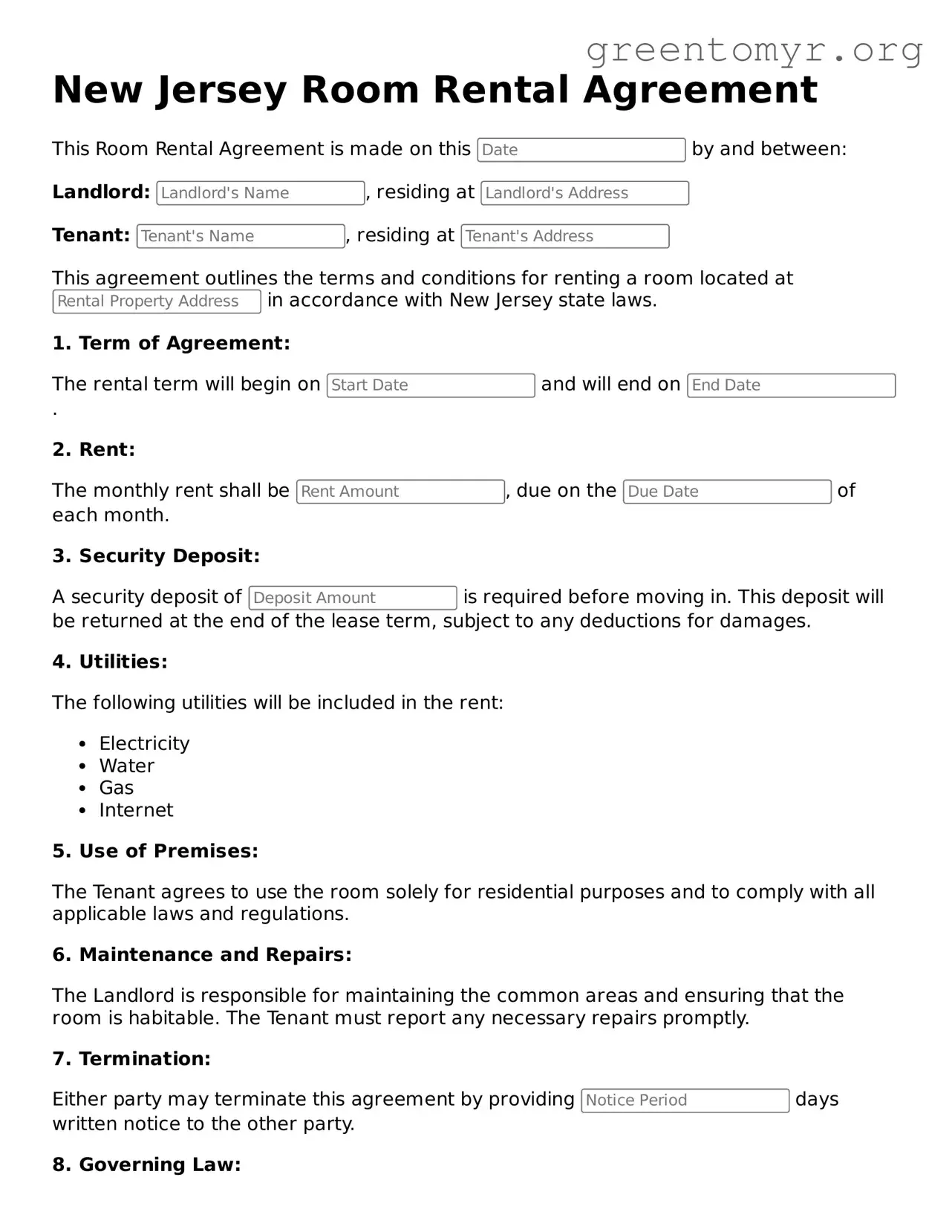
When renting a room in New Jersey, having a clear and comprehensive Room Rental Agreement is essential for both landlords and tenants. This document outlines the specific terms and conditions of the rental arrangement, ensuring that both parties understand their rights and responsibilities. Key aspects of the agreement typically include the duration of the rental period, the amount of rent due, and the payment schedule. It also addresses security deposits, maintenance responsibilities, and rules regarding the use of common areas. Additionally, the agreement may specify conditions for terminating the lease, providing a framework for resolving any disputes that may arise. By laying out these important details, the Room Rental Agreement helps to create a transparent and harmonious living situation, ultimately protecting the interests of everyone involved.
New Jersey Room Rental Agreement
This Room Rental Agreement is made on this by and between:
Landlord: , residing at
Tenant: , residing at
This agreement outlines the terms and conditions for renting a room located at in accordance with New Jersey state laws.
1. Term of Agreement:
The rental term will begin on and will end on .
2. Rent:
The monthly rent shall be , due on the of each month.
3. Security Deposit:
A security deposit of is required before moving in. This deposit will be returned at the end of the lease term, subject to any deductions for damages.
4. Utilities:
The following utilities will be included in the rent:
5. Use of Premises:
The Tenant agrees to use the room solely for residential purposes and to comply with all applicable laws and regulations.
6. Maintenance and Repairs:
The Landlord is responsible for maintaining the common areas and ensuring that the room is habitable. The Tenant must report any necessary repairs promptly.
7. Termination:
Either party may terminate this agreement by providing days written notice to the other party.
8. Governing Law:
This agreement shall be governed by the laws of the State of New Jersey.
By signing below, both parties agree to the terms outlined in this Room Rental Agreement.
Landlord Signature: ____________________________ Date: ______________
Tenant Signature: ____________________________ Date: ______________
| Fact Name | Description |
|---|---|
| Purpose | The New Jersey Room Rental Agreement form outlines the terms and conditions for renting a room in a residential property. |
| Governing Law | This agreement is governed by the New Jersey landlord-tenant laws, specifically the New Jersey Statutes Annotated (N.J.S.A.) 46:8-1 et seq. |
| Parties Involved | The agreement is between the landlord (property owner) and the tenant (room renter). |
| Duration | The rental period can be specified as either a fixed term or a month-to-month arrangement. |
| Security Deposit | The form allows for a security deposit, which is typically one and a half months' rent, in accordance with state law. |
| Rent Payment | The agreement specifies the amount of rent, due date, and acceptable payment methods. |
| Utilities | Responsibilities for utility payments, such as water, gas, and electricity, are outlined in the agreement. |
| Termination | Procedures for terminating the agreement, including notice requirements, are detailed within the form. |
| Maintenance Responsibilities | The form clarifies which party is responsible for maintenance and repairs of the rented room and common areas. |
| Legal Recourse | In case of disputes, the agreement may outline the process for mediation or legal action under New Jersey law. |
Filling out the New Jersey Room Rental Agreement form requires careful attention to detail. Each section of the form must be completed accurately to ensure that both parties are protected and understand their rights and responsibilities. Below are the steps to guide you through the process of filling out this form.
A New Jersey Room Rental Agreement is a legal document that outlines the terms and conditions between a landlord and a tenant for renting a room in a residential property. This agreement specifies the rights and responsibilities of both parties, including the rental amount, duration of the lease, and any rules regarding the use of shared spaces.
The Room Rental Agreement should contain several key elements to ensure clarity and legal protection. These include:
Yes, once both the landlord and tenant sign the Room Rental Agreement, it becomes a legally binding contract. This means that both parties are obligated to adhere to the terms outlined in the agreement. If either party fails to comply, the other may have grounds for legal action.
Disputes can arise for various reasons, such as failure to pay rent or violations of house rules. The Room Rental Agreement may include a clause outlining the process for resolving disputes. Common methods include:
Notarization is not typically required for a Room Rental Agreement in New Jersey. However, having the document notarized can provide an extra layer of protection and authenticity. It may be beneficial to consult with a legal professional to determine the best course of action for your specific situation.
Filling out the New Jersey Room Rental Agreement form can be a straightforward process, but many individuals make common mistakes that can lead to confusion or disputes later on. One significant error is failing to include all required information. Each party's name, contact details, and the address of the rental property must be accurately filled in. Omitting any of this information can render the agreement incomplete.
Another frequent mistake is neglecting to specify the rental term. Whether the arrangement is for a month-to-month rental or a fixed term, clarity is essential. If the rental period is not clearly defined, it can lead to misunderstandings about when the agreement begins and ends.
Many people also overlook the importance of detailing the rental amount and payment schedule. It is crucial to state the exact rent due, the due date, and acceptable payment methods. Without this information, tenants may find themselves uncertain about their obligations, leading to potential conflicts.
Additionally, individuals often fail to include security deposit terms. The agreement should clearly outline the amount of the security deposit, the conditions under which it may be withheld, and the timeline for its return. This omission can lead to disputes regarding the return of funds at the end of the rental period.
Another common error is not addressing maintenance responsibilities. Both landlords and tenants should understand their obligations regarding repairs and maintenance. If these responsibilities are not clearly defined in the agreement, it can result in frustration and disagreements.
People frequently neglect to include provisions for termination of the agreement. It is important to outline how either party can terminate the rental agreement, including any required notice periods. This clarity helps prevent unexpected evictions or misunderstandings.
Some individuals also forget to specify rules regarding pets. If a landlord has specific pet policies, these should be included in the agreement. Failing to do so can lead to conflicts if a tenant brings a pet that is not allowed.
Another mistake is not including clauses related to subletting. If a tenant wishes to sublet the room, the agreement should state whether this is permitted and under what conditions. This provision protects both parties and ensures clear communication.
Finally, individuals often neglect to sign and date the agreement. An unsigned document may not be enforceable in a dispute. Both parties must ensure they sign and date the agreement to validate the terms outlined within.
When entering into a room rental agreement in New Jersey, there are several other forms and documents that can be beneficial for both landlords and tenants. These documents help clarify terms, protect rights, and ensure a smooth rental experience. Here’s a brief overview of some commonly used forms alongside the Room Rental Agreement.
Utilizing these documents alongside the New Jersey Room Rental Agreement can enhance communication and understanding between landlords and tenants. This proactive approach contributes to a more harmonious rental experience for everyone involved.
The Room Rental Agreement is a crucial document for anyone looking to rent a space. It establishes the terms and conditions between the landlord and tenant. Several other documents serve similar purposes in the realm of rental agreements. Here are four documents that share similarities with the Room Rental Agreement:
When filling out the New Jersey Room Rental Agreement form, attention to detail is crucial. Here are some important dos and don’ts to keep in mind:
Following these guidelines can help ensure a smoother rental experience and protect your rights as a tenant.
Understanding the New Jersey Room Rental Agreement form is essential for both landlords and tenants. However, several misconceptions can lead to confusion. Here are seven common misconceptions:
While it is highly recommended to have a written agreement, oral agreements can also be legally binding in New Jersey. However, proving the terms of an oral agreement can be challenging.
Both landlords and tenants can propose terms for a rental agreement. It is a negotiation process where both parties can agree on the conditions.
New Jersey law allows landlords to charge a security deposit of up to one and a half times the monthly rent. This can lead to higher upfront costs for tenants.
Rental agreements can vary significantly based on individual circumstances. Terms such as duration, rent amount, and responsibilities can differ widely.
Even without a signed agreement, tenants have rights under New Jersey law. These rights include protection against unlawful eviction and the right to habitable living conditions.
Rental agreements can be modified if both parties agree to the changes. Any amendments should be documented in writing to avoid future disputes.
Landlords must provide reasonable notice before entering a tenant's property, except in emergencies. Typically, 24 hours' notice is considered reasonable.
Clarifying these misconceptions can help both landlords and tenants navigate their rights and responsibilities more effectively.
When filling out and using the New Jersey Room Rental Agreement form, it’s essential to understand its purpose and how to complete it correctly. Here are some key takeaways to keep in mind:
By following these takeaways, you can navigate the Room Rental Agreement process with confidence, ensuring a smooth rental experience for everyone involved.