The New Jersey Small Estate Affidavit form provides a streamlined process for settling the estates of deceased individuals when the total value of their assets is below a certain threshold. This form allows heirs to bypass the lengthy and often costly probate process, making it easier for them to claim the assets they are entitled to. Typically, the form is utilized when the estate's value does not exceed $50,000 for individuals who died on or after February 1, 2017, or $20,000 for those who passed away prior to that date. The affidavit must be signed by the heirs and includes essential information such as the deceased person's details, a list of assets, and the relationship of the heirs to the deceased. By completing this form, heirs can assert their right to the assets without court intervention, provided they meet the necessary criteria. It is important to ensure that all information is accurate and that the form is properly executed to avoid potential complications down the line.
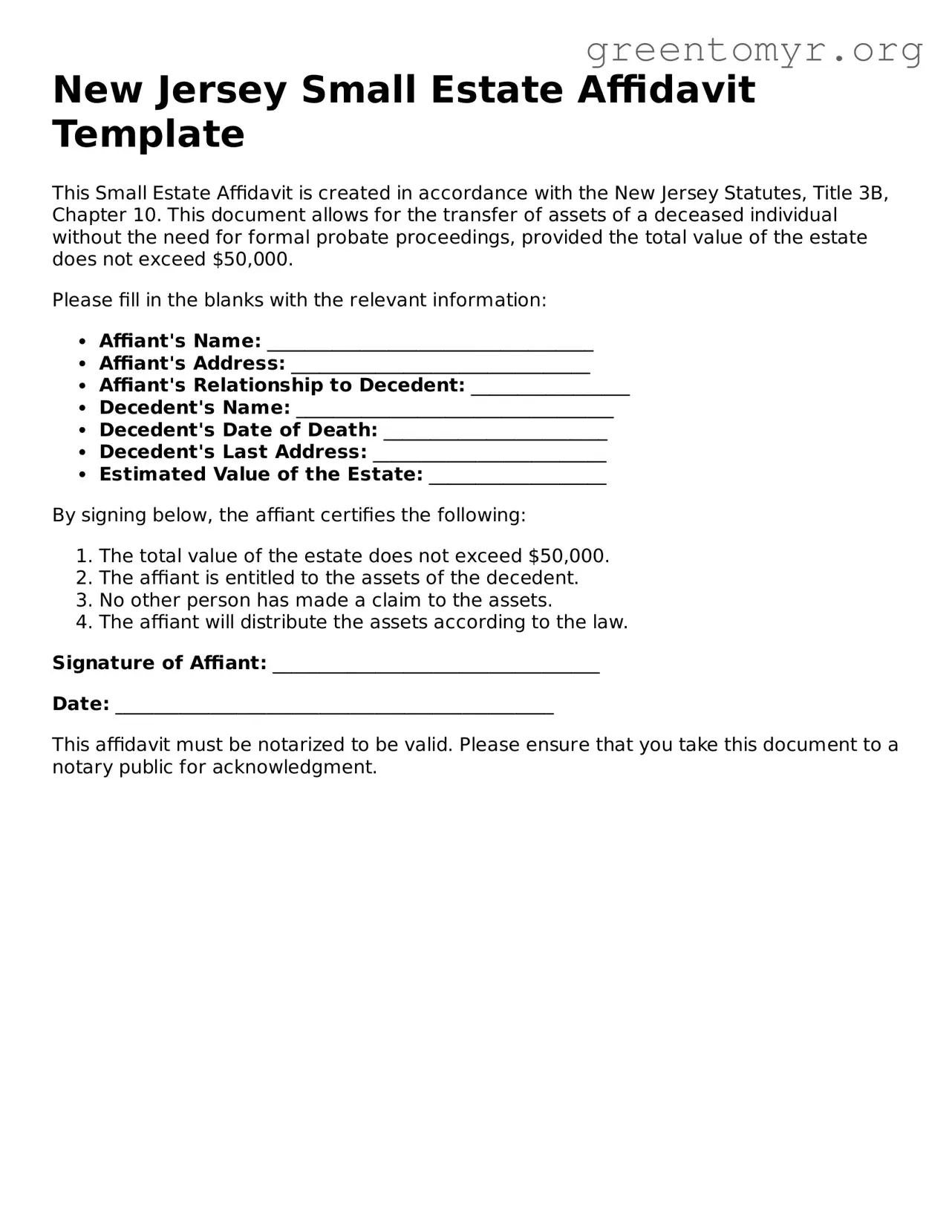
New Jersey Small Estate Affidavit Template
This Small Estate Affidavit is created in accordance with the New Jersey Statutes, Title 3B, Chapter 10. This document allows for the transfer of assets of a deceased individual without the need for formal probate proceedings, provided the total value of the estate does not exceed $50,000.
Please fill in the blanks with the relevant information:
By signing below, the affiant certifies the following:
Signature of Affiant: ___________________________________
Date: _______________________________________________
This affidavit must be notarized to be valid. Please ensure that you take this document to a notary public for acknowledgment.
| Fact Name | Description |
|---|---|
| Purpose | The New Jersey Small Estate Affidavit allows heirs to claim assets of a deceased person without going through probate if the estate's value is below a certain threshold. |
| Threshold Amount | As of October 2023, the estate must not exceed $50,000 in value for an individual or $100,000 for a married couple to qualify for the affidavit. |
| Governing Law | The Small Estate Affidavit is governed by New Jersey Statutes, specifically N.J.S.A. 3B:10-1 et seq. |
| Eligibility | Only heirs or beneficiaries of the deceased can use the Small Estate Affidavit to claim assets. |
| Required Information | The affidavit requires details such as the deceased's name, date of death, and a list of assets. |
| Signature Requirement | The affidavit must be signed by the person claiming the assets and may need notarization for validity. |
| Filing Process | The completed affidavit is typically submitted to the institution holding the deceased's assets, such as banks or financial institutions. |
| Limitations | This form cannot be used for real estate or assets that require formal probate proceedings. |
| Timeframe | Heirs should act promptly, as delays can complicate the process of asset recovery. |
| Alternative Options | If the estate exceeds the small estate threshold, formal probate proceedings must be initiated to settle the estate. |
After gathering the necessary information and documents, you are ready to fill out the New Jersey Small Estate Affidavit form. This process involves providing specific details about the deceased, their estate, and the individuals involved. Completing the form accurately is essential for a smooth transition of assets.
The New Jersey Small Estate Affidavit is a legal document that allows individuals to claim assets of a deceased person without going through the full probate process. This is particularly useful for estates that do not exceed a certain value, making it easier and quicker for heirs to access the deceased's property.
To be eligible, the total value of the deceased's estate must be below a specified threshold, which is currently $50,000 for personal property and $200,000 for real property. Additionally, the person filing the affidavit must be an heir or a beneficiary named in the will, or a person entitled to inherit under New Jersey intestacy laws.
To complete the Small Estate Affidavit, follow these steps:
No, you do not need to file the Small Estate Affidavit with the court. Instead, you present it to financial institutions, banks, or other entities holding the deceased's assets. They will typically require the affidavit along with other documentation, such as the death certificate, to release the assets to you.
Yes, the Small Estate Affidavit can be used to claim real estate, provided the total value of the estate falls within the limits set by New Jersey law. If the real estate is valued at or below $200,000, you can use the affidavit to transfer ownership without going through probate.
If the estate's value exceeds the small estate limits, you will need to go through the regular probate process. This involves filing a will with the court, appointing an executor, and settling any debts before distributing assets to heirs. The probate process can be more time-consuming and costly than using a Small Estate Affidavit.
There is no filing fee for the Small Estate Affidavit itself, as it is not submitted to the court. However, you may incur costs related to obtaining copies of the death certificate or notarizing the affidavit. Always check with the institutions holding the deceased’s assets for any specific fees they may charge.
Yes, multiple heirs can use the Small Estate Affidavit, but they must agree on how to divide the assets. Each heir may need to complete their own affidavit or one affidavit can be filed collectively, detailing the distribution of assets among the heirs.
If the deceased left a will, the Small Estate Affidavit can still be used if the estate qualifies as a small estate. However, the affidavit must include information about the will, including its date and the names of the beneficiaries. If there are disputes regarding the will, it may be necessary to proceed with probate.
For more information, you can visit the New Jersey Judiciary website or consult with an attorney who specializes in estate planning. They can provide guidance tailored to your specific situation and help you navigate the process effectively.
Filling out the New Jersey Small Estate Affidavit form can be straightforward, but many people encounter common pitfalls. One frequent mistake is failing to include all necessary information. The form requires specific details about the deceased, including their full name, date of death, and last known address. Omitting any of these details can lead to delays or rejection of the affidavit.
Another mistake is not properly identifying the assets. The affidavit must list all assets that fall under the small estate threshold, which is currently set at $50,000 for personal property. If you overlook any assets or misclassify them, it can complicate the process. It is essential to review the deceased's financial records thoroughly to ensure all relevant assets are included.
People often forget to sign the affidavit in the correct places. The form requires signatures from both the affiant and a witness. Not having these signatures can render the document invalid. Double-checking the signature section before submission can save time and frustration.
Another common error involves the notarization process. The Small Estate Affidavit must be notarized to be legally binding. Some individuals neglect this step, thinking that a simple signature will suffice. Without notarization, the affidavit may not be accepted by financial institutions or courts.
Inaccurate information can also lead to issues. Providing incorrect details about the deceased's estate can create legal complications. It is crucial to ensure that all information is accurate and matches official documents. Mismatched information can raise red flags and delay the process.
Many people do not understand the implications of submitting the affidavit. This form is not just a simple declaration; it has legal weight. Misunderstanding its purpose can lead to mistakes in how it is filled out or submitted. Being informed about the process can help avoid unnecessary errors.
Lastly, some individuals fail to keep copies of the submitted affidavit. It is important to retain a copy for personal records. This can be useful for future reference or in case any issues arise later. Keeping organized records is a key step in managing an estate effectively.
The New Jersey Small Estate Affidavit form is an important document used to settle the estate of a deceased individual without going through the full probate process. When using this form, several other documents may also be required to ensure a smooth and efficient process. Below is a list of common forms and documents that are often used in conjunction with the Small Estate Affidavit.
Having these documents prepared and organized will help facilitate the use of the New Jersey Small Estate Affidavit. This can lead to a more efficient resolution of the estate, ensuring that all parties involved can proceed without unnecessary delays.
The Small Estate Affidavit is a useful legal tool for settling estates that meet certain criteria. Several other documents serve similar purposes in estate management and probate processes. Here’s a list of nine documents that share similarities with the Small Estate Affidavit:
Filling out the New Jersey Small Estate Affidavit form can be a straightforward process if you keep certain guidelines in mind. Here are ten essential do's and don'ts to consider:
Understanding the New Jersey Small Estate Affidavit form can be challenging. Here are ten common misconceptions that people often have about this form:
Being informed about these misconceptions can help individuals navigate the Small Estate Affidavit process more effectively and ensure that they are making the best decisions for their situation.
When dealing with the New Jersey Small Estate Affidavit form, it's important to understand a few key points to ensure a smooth process.
Understanding these points can help you navigate the process more effectively and reduce potential complications.