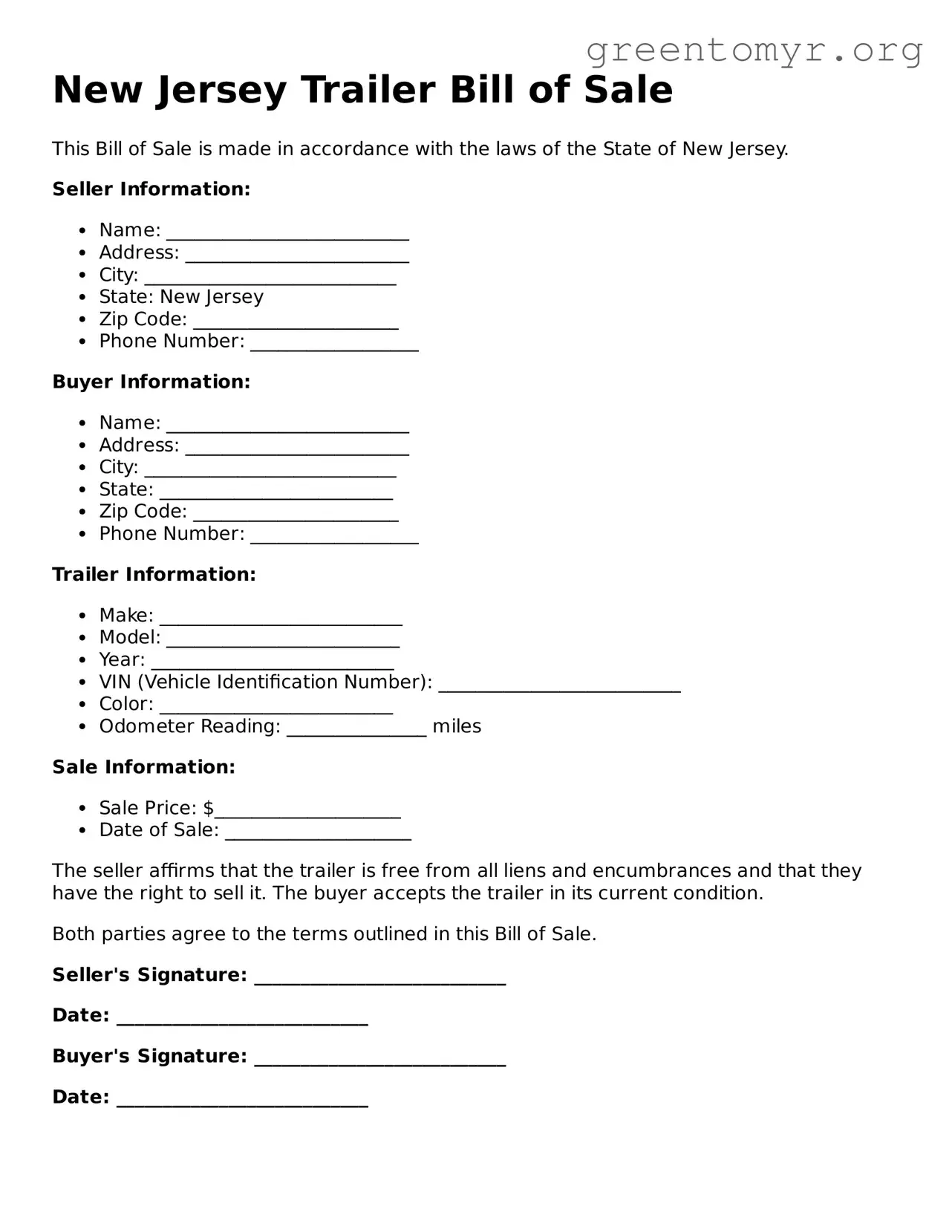
When purchasing or selling a trailer in New Jersey, having the right documentation is crucial to ensure a smooth transaction. The New Jersey Trailer Bill of Sale form serves as an essential legal document that records the transfer of ownership from one party to another. This form typically includes important details such as the names and addresses of both the buyer and the seller, a description of the trailer including its make, model, and Vehicle Identification Number (VIN), as well as the sale price. Additionally, it often requires the date of the transaction and may include spaces for signatures from both parties to validate the agreement. By utilizing this form, buyers and sellers can protect themselves against potential disputes and provide proof of ownership, making it a vital component in the trailer buying and selling process in the state.
New Jersey Trailer Bill of Sale
This Bill of Sale is made in accordance with the laws of the State of New Jersey.
Seller Information:
Buyer Information:
Trailer Information:
Sale Information:
The seller affirms that the trailer is free from all liens and encumbrances and that they have the right to sell it. The buyer accepts the trailer in its current condition.
Both parties agree to the terms outlined in this Bill of Sale.
Seller's Signature: ___________________________
Date: ___________________________
Buyer's Signature: ___________________________
Date: ___________________________
| Fact Name | Description |
|---|---|
| Purpose | The New Jersey Trailer Bill of Sale form is used to document the sale of a trailer between a buyer and a seller. |
| Governing Law | This form is governed by the New Jersey Statutes Annotated (N.J.S.A.) 39:10-1 et seq. |
| Required Information | Both parties must provide their names, addresses, and signatures on the form. |
| Trailer Details | The form requires specific details about the trailer, including make, model, year, and Vehicle Identification Number (VIN). |
| Notarization | Notarization is not mandatory but is highly recommended for added legal protection. |
| Transfer of Ownership | The bill of sale serves as proof of ownership transfer from the seller to the buyer. |
| Sales Tax | Sales tax may apply, and buyers should check with local authorities for specific rates and requirements. |
| Record Keeping | Both parties should retain a copy of the completed bill of sale for their records. |
Once you have the New Jersey Trailer Bill of Sale form in hand, you will need to provide specific information to ensure the transaction is properly documented. This form will serve as a record of the sale and can be crucial for both the buyer and seller in future dealings.
A New Jersey Trailer Bill of Sale form is a legal document used to record the sale of a trailer in the state of New Jersey. This form provides essential information about the transaction, including the buyer and seller's details, the trailer's description, and the sale price. It serves as proof of ownership transfer and can be used for registration purposes.
A Bill of Sale is important for several reasons:
The New Jersey Trailer Bill of Sale form typically requires the following information:
While a Bill of Sale is not legally required for every trailer sale in New Jersey, it is highly recommended. Having this document can simplify the registration process and provide protection in case of disputes. Additionally, the New Jersey Motor Vehicle Commission may require it for certain transactions.
Yes, you can create your own Bill of Sale form as long as it includes all necessary information. However, using a standardized form can help ensure that you do not miss any critical details. Various templates are available online, including those specifically designed for New Jersey trailer sales.
Notarization is not required for a Bill of Sale in New Jersey. However, having it notarized can add an extra layer of security and authenticity to the document, which may be beneficial in the event of a dispute.
After completing the Bill of Sale, both the buyer and seller should retain copies for their records. The buyer should then use the Bill of Sale to register the trailer with the New Jersey Motor Vehicle Commission. It may also be necessary to provide additional documents, such as proof of insurance or identification.
The Bill of Sale is a crucial document for registering a trailer in New Jersey. When registering, the buyer must present the Bill of Sale to the Motor Vehicle Commission along with any other required documentation. This process helps ensure that the trailer's ownership is officially recognized and that the buyer can legally operate the trailer on public roads.
You can obtain a New Jersey Trailer Bill of Sale form from various sources. Many online legal document preparation services offer downloadable templates. Additionally, the New Jersey Motor Vehicle Commission's website may provide a standard form. Always ensure that the form you use complies with New Jersey state laws.
Filling out the New Jersey Trailer Bill of Sale form requires attention to detail. One common mistake is failing to provide accurate identification information for both the buyer and seller. Each party must include their full name, address, and contact information. Incomplete or incorrect details can lead to delays in processing.
Another frequent error is neglecting to include the trailer's Vehicle Identification Number (VIN). The VIN is crucial for identifying the specific trailer being sold. Without it, the transaction may be questioned, and registration could be problematic.
Many individuals also overlook the importance of stating the sale price clearly. The form should reflect the agreed-upon amount in a straightforward manner. Ambiguities in pricing can lead to disputes or complications in future transactions.
Some people mistakenly assume that a signature is not necessary. Both the buyer and seller must sign the form to validate the sale. A missing signature can render the document ineffective and may lead to legal issues.
Another error involves the date of sale. Failing to record the correct date can create confusion regarding the timeline of ownership transfer. This information is essential for both parties to establish their rights and responsibilities.
Inaccurate descriptions of the trailer can also pose problems. The form should include details such as make, model, year, and condition. Omitting this information may lead to misunderstandings about the trailer's features and overall condition.
Some individuals forget to check for additional requirements that may apply. Depending on the circumstances, additional documentation or disclosures may be necessary. Being unaware of these requirements can complicate the sale process.
Additionally, people may fail to keep a copy of the completed form. Retaining a copy is important for both parties as it serves as proof of the transaction. Without it, resolving any future disputes could become challenging.
Another mistake is not verifying the payment method. Whether cash, check, or another form of payment, both parties should agree on and document this detail. This step helps prevent any misunderstandings about the transaction.
Lastly, some individuals may not seek assistance when needed. If unsure about any part of the form, consulting with a knowledgeable person can help avoid costly mistakes. Taking the time to ensure accuracy can lead to a smoother transaction.
When buying or selling a trailer in New Jersey, the Trailer Bill of Sale form is essential. However, there are several other documents that often accompany this form to ensure a smooth transaction and proper registration. Here’s a list of those documents, each playing a vital role in the process.
Understanding these documents can simplify the buying or selling process. Each plays a unique role in ensuring that the transaction is valid and that the new owner can enjoy their trailer without any legal complications. Always keep copies of all documents for your records, as they may be needed in the future.
The Trailer Bill of Sale form serves a specific purpose in the transfer of ownership for trailers. However, there are several other documents that share similarities in function and intent. Below is a list of six documents that are comparable to the Trailer Bill of Sale form:
Each of these documents plays a crucial role in ensuring that transactions are clear and legally binding, protecting both the buyer and seller in the process.
When filling out the New Jersey Trailer Bill of Sale form, it's essential to approach the task with care and attention to detail. Here’s a list of things you should and shouldn't do to ensure a smooth process.
By following these guidelines, you can help ensure that your Trailer Bill of Sale is completed correctly and efficiently.
There are several misconceptions surrounding the New Jersey Trailer Bill of Sale form. Understanding these misconceptions can help clarify its purpose and use.
This is incorrect. The form can be used for both new and used trailers. It serves as a record of the transaction regardless of the trailer's age.
In fact, the Trailer Bill of Sale is a legal document that can be used in court to prove ownership and the terms of the sale. It is important to complete it accurately.
While notarization is not always required, it is highly recommended. Having the document notarized can provide additional protection and validation of the transaction.
This is false. Regardless of the sale price, having a bill of sale is important for any trailer transaction. It helps ensure that both parties have a clear record of the sale.
When filling out and using the New Jersey Trailer Bill of Sale form, keep these key takeaways in mind:
Filling out the form correctly is crucial. It ensures a smooth transfer of ownership and avoids future complications.