The New Jersey Transfer-on-Death Deed (TOD) form provides a straightforward way for property owners to transfer real estate to beneficiaries upon their death, bypassing the often complex probate process. This legal instrument allows individuals to maintain control over their property during their lifetime while designating who will receive the property after they pass away. Importantly, the form must be executed and recorded in accordance with state regulations to ensure its validity. The TOD deed can cover various types of real estate, including residential homes and vacant land, making it a versatile option for estate planning. Additionally, it is crucial for property owners to understand that the transfer does not take effect until death occurs, meaning that the owner retains full rights to the property throughout their lifetime. By utilizing this deed, individuals can simplify the transfer of their assets, provide clarity for their beneficiaries, and potentially reduce the administrative burden on their loved ones during a difficult time.
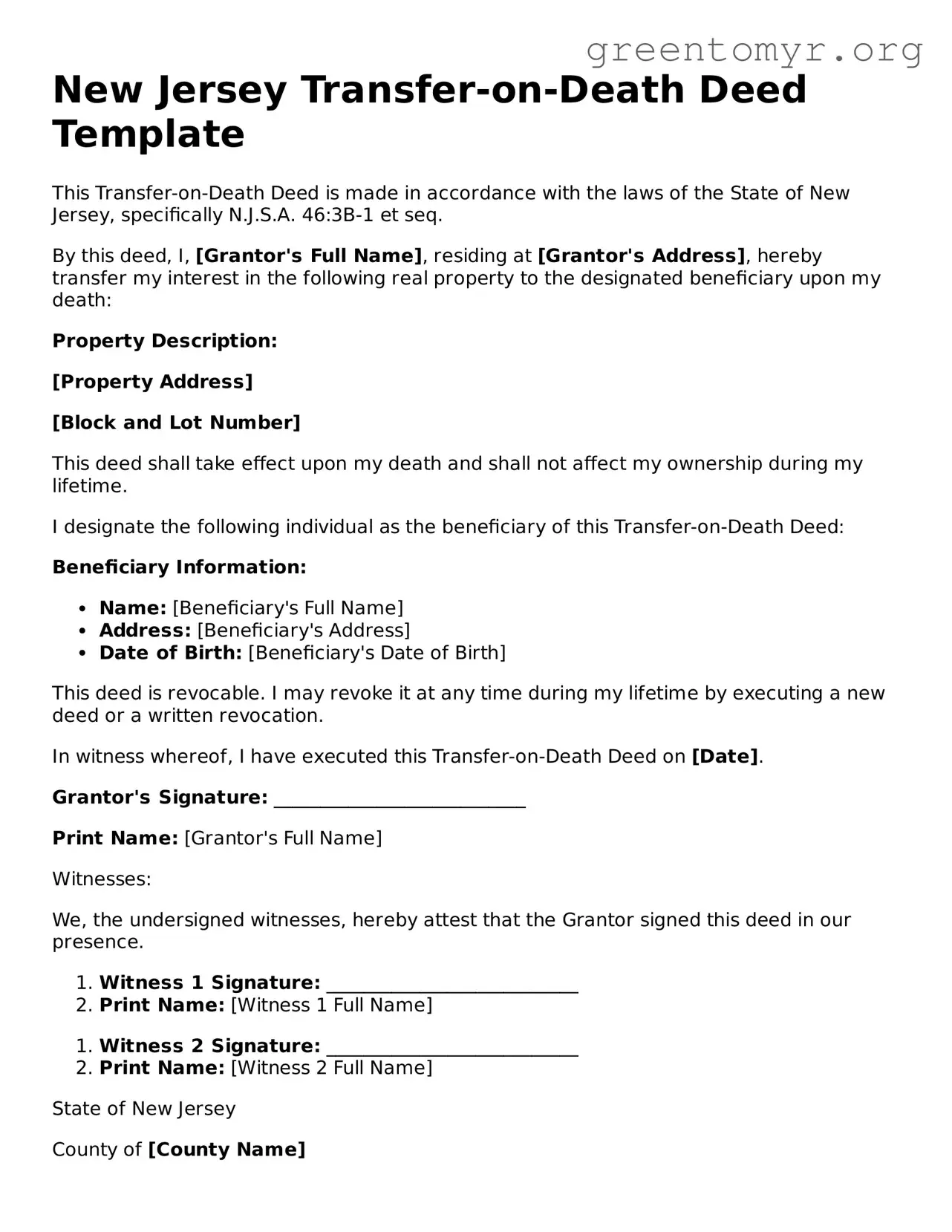
New Jersey Transfer-on-Death Deed Template
This Transfer-on-Death Deed is made in accordance with the laws of the State of New Jersey, specifically N.J.S.A. 46:3B-1 et seq.
By this deed, I, [Grantor's Full Name], residing at [Grantor's Address], hereby transfer my interest in the following real property to the designated beneficiary upon my death:
Property Description:
[Property Address]
[Block and Lot Number]
This deed shall take effect upon my death and shall not affect my ownership during my lifetime.
I designate the following individual as the beneficiary of this Transfer-on-Death Deed:
Beneficiary Information:
This deed is revocable. I may revoke it at any time during my lifetime by executing a new deed or a written revocation.
In witness whereof, I have executed this Transfer-on-Death Deed on [Date].
Grantor's Signature: ___________________________
Print Name: [Grantor's Full Name]
Witnesses:
We, the undersigned witnesses, hereby attest that the Grantor signed this deed in our presence.
State of New Jersey
County of [County Name]
Subscribed and sworn to before me this [Date].
Notary Public Signature: ___________________________
Print Name: [Notary Public Full Name]
My Commission Expires: [Expiration Date]
| Fact Name | Details |
|---|---|
| Definition | A Transfer-on-Death Deed allows an individual to transfer real estate to a beneficiary upon their death without going through probate. |
| Governing Law | The Transfer-on-Death Deed is governed by New Jersey Statutes, specifically N.J.S.A. 46:3B-1 et seq. |
| Eligibility | Any individual who owns real estate in New Jersey can create a Transfer-on-Death Deed. |
| Beneficiary Designation | The deed allows for one or more beneficiaries to be named, who will receive the property upon the owner's death. |
| Revocation | The owner can revoke the Transfer-on-Death Deed at any time during their lifetime, provided they follow the proper legal process. |
| Recording Requirement | The deed must be recorded with the county clerk in the county where the property is located to be effective. |
| Tax Implications | There may be tax implications for both the owner and the beneficiary, including potential estate taxes. |
| Legal Advice | It is advisable to seek legal counsel when creating a Transfer-on-Death Deed to ensure it meets all legal requirements. |
| Limitations | This deed cannot be used for transferring property held in a trust or for properties subject to a mortgage without further considerations. |
After obtaining the New Jersey Transfer-on-Death Deed form, you will need to fill it out carefully. This form allows you to designate a beneficiary for your property, which will transfer automatically upon your passing. Follow the steps below to complete the form correctly.
A Transfer-on-Death Deed (TODD) is a legal document that allows property owners in New Jersey to transfer real estate to a designated beneficiary upon their death. This deed allows the owner to maintain full control over the property during their lifetime, avoiding the lengthy probate process when the owner passes away.
Any individual who owns real property in New Jersey can use a Transfer-on-Death Deed. This includes single individuals, married couples, and joint owners. However, it is important to ensure that the property is not subject to any liens or other encumbrances that could complicate the transfer.
To create a Transfer-on-Death Deed, follow these steps:
The Transfer-on-Death Deed offers several advantages:
Yes, a Transfer-on-Death Deed can be revoked. The property owner must create a new deed that explicitly revokes the previous one or file a revocation form with the county clerk’s office. This ensures that the original beneficiary is no longer entitled to the property upon the owner's death.
If the designated beneficiary dies before the property owner, the Transfer-on-Death Deed becomes void. In this case, the property will be transferred according to the owner's will, or if there is no will, it will be distributed according to New Jersey's intestacy laws. It is advisable to name alternate beneficiaries to avoid complications.
Generally, there are no immediate tax implications when creating a Transfer-on-Death Deed. The property remains part of the owner’s estate until their death. However, the beneficiary may be subject to estate taxes based on the value of the property at the time of the owner's death. Consulting with a tax professional can provide clarity on specific situations.
While it is not legally required to have an attorney to create a Transfer-on-Death Deed, seeking legal assistance can be beneficial. An attorney can help ensure that the deed is filled out correctly, complies with state laws, and meets the property owner's specific needs. This can help avoid potential issues in the future.
Filling out a Transfer-on-Death Deed (TOD) form in New Jersey can be a straightforward process, but many individuals make common mistakes that can lead to complications down the line. Understanding these pitfalls can help ensure that your intentions are clearly conveyed and legally binding.
One frequent error is failing to include the full legal name of the beneficiary. It might seem simple, but omitting middle names or using nicknames can create confusion. A beneficiary's name should match the name on their legal identification to avoid disputes or delays in the transfer process.
Another common mistake is neglecting to provide a proper description of the property. The deed must include a clear and accurate description, typically found in the property’s deed or tax records. Vague descriptions can lead to misunderstandings about what property is being transferred, potentially resulting in legal challenges.
Some individuals overlook the importance of signing the deed in the presence of a notary public. New Jersey law requires that the deed be notarized to be valid. Without this step, the deed may not hold up in court, leaving your property transfer intentions unfulfilled.
Additionally, many people fail to record the deed with the county clerk’s office. After filling out and notarizing the TOD deed, it is crucial to file it with the appropriate local authority. If this step is skipped, the transfer may not be recognized, and the property could still be subject to probate.
Another mistake is not considering the implications of transferring property on death. Individuals often overlook how a TOD deed might affect their estate plan. It’s essential to evaluate how this transfer aligns with other estate planning documents, such as wills and trusts, to ensure that all elements work together harmoniously.
Furthermore, some people forget to communicate their intentions with the beneficiaries. It is advisable to discuss the transfer with those involved. Open communication can prevent misunderstandings and ensure that beneficiaries are prepared for the responsibilities they will inherit.
Lastly, individuals may not seek professional guidance when needed. While the form may appear straightforward, complexities can arise based on individual circumstances. Consulting with a legal expert can provide clarity and help navigate any potential issues, ensuring that the transfer aligns with your wishes.
When planning for the transfer of property in New Jersey, the Transfer-on-Death Deed is an important tool. However, it is often accompanied by other documents that can help streamline the process and ensure that all legal requirements are met. Below is a list of forms and documents commonly used alongside the Transfer-on-Death Deed.
Each of these documents plays a vital role in the overall estate planning process. By understanding their functions and how they relate to the Transfer-on-Death Deed, individuals can better prepare for the future and ensure their wishes are honored.
The Transfer-on-Death Deed form shares similarities with several other legal documents. Each serves a distinct purpose in estate planning and property transfer. Below is a list of documents that are comparable to the Transfer-on-Death Deed:
When filling out the New Jersey Transfer-on-Death Deed form, it’s essential to approach the process with care. Here’s a list of things to do and avoid to ensure your form is completed correctly.
By following these guidelines, you can help ensure that your Transfer-on-Death Deed is filled out correctly and serves its intended purpose.
Understanding the New Jersey Transfer-on-Death (TOD) Deed form can be challenging. Here are seven common misconceptions about this legal document:
This is not true. The TOD deed is available to anyone who owns real estate in New Jersey, regardless of their financial status.
While a TOD deed allows for the transfer of property outside of probate, it does not exempt the property from estate taxes or other potential taxes.
This is incorrect. The property owner can revoke or change the TOD deed at any time before their death.
This is misleading. The beneficiary will inherit the property only if the deed is valid and the owner has passed away.
This is false. The transfer of property rights only occurs after the death of the property owner.
Not all properties qualify. Only certain types of real estate can be transferred through a TOD deed in New Jersey.
This is incorrect. A TOD deed does not replace a will. It is advisable to have both to ensure all assets are managed according to your wishes.
When filling out and using the New Jersey Transfer-on-Death Deed form, keep the following key points in mind: