Content Navigation

In the realm of legal documentation, accuracy is paramount, and the New Mexico Affidavit of Correction form plays a crucial role in ensuring that public records reflect the true intent of the parties involved. This form is designed to rectify errors in previously filed documents, providing a streamlined process for individuals and entities to amend mistakes without the need for extensive legal proceedings. Commonly utilized for correcting inaccuracies in property deeds, marriage licenses, or other official records, the affidavit serves as a sworn statement affirming the need for correction. By clearly outlining the nature of the error and the desired correction, this form helps to maintain the integrity of public records. It is essential for anyone seeking to make amendments to understand the specific requirements and procedures associated with this form, as proper completion can prevent future legal complications. Timeliness is also critical; addressing errors promptly can safeguard against potential disputes or misunderstandings down the line. Thus, familiarity with the New Mexico Affidavit of Correction form is not just beneficial, but necessary for ensuring that one’s legal documents accurately reflect their intentions.

New Mexico Affidavit of Correction Example

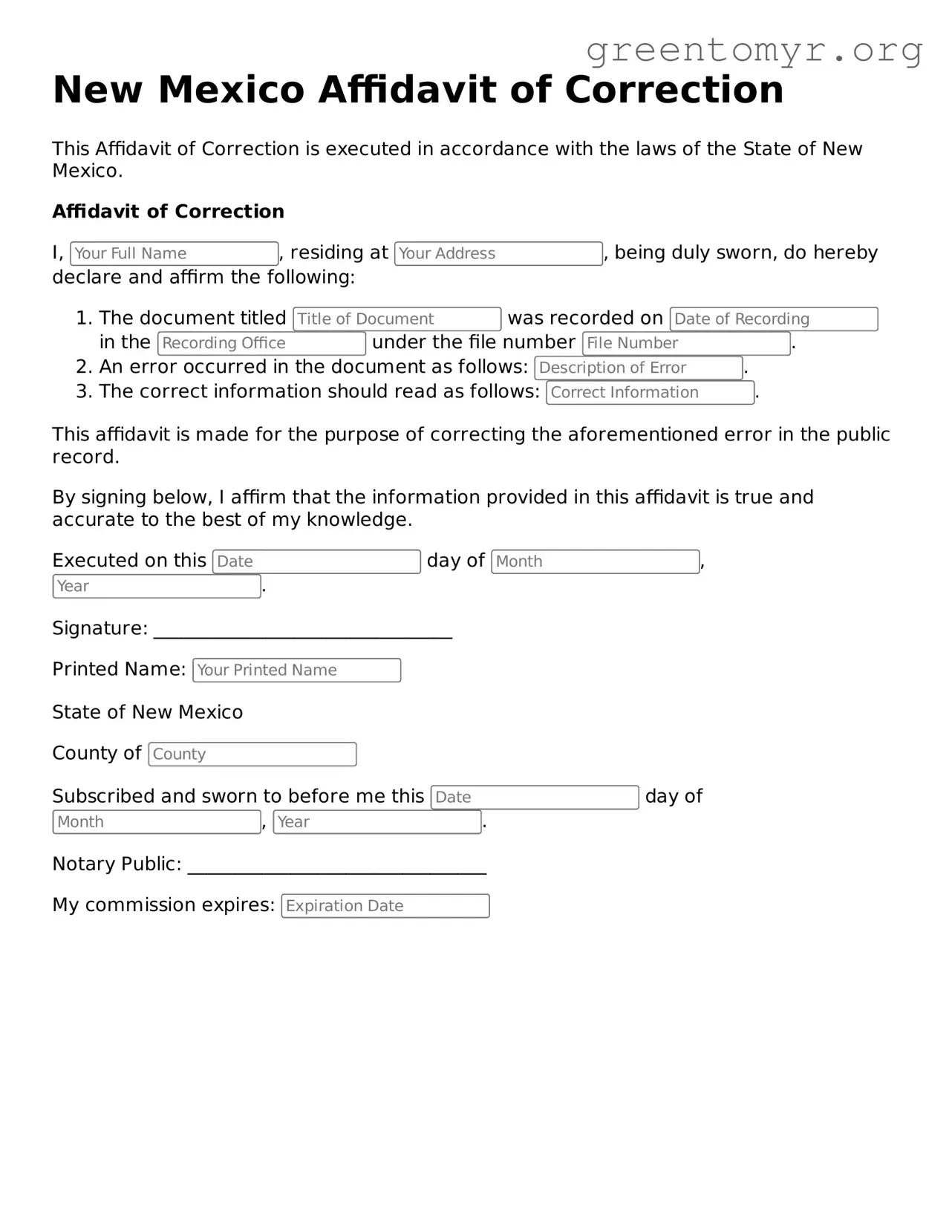
New Mexico Affidavit of Correction

This Affidavit of Correction is executed in accordance with the laws of the State of New Mexico.

Affidavit of Correction

I, , residing at , being duly sworn, do hereby declare and affirm the following:

  1. The document titled was recorded on in the under the file number .
  2. An error occurred in the document as follows: .
  3. The correct information should read as follows: .

This affidavit is made for the purpose of correcting the aforementioned error in the public record.

By signing below, I affirm that the information provided in this affidavit is true and accurate to the best of my knowledge.

Executed on this day of , .

Signature: ________________________________

Printed Name:

State of New Mexico

County of

Subscribed and sworn to before me this day of , .

Notary Public: ________________________________

My commission expires:

PDF Form Features

Fact Name Details
Purpose The New Mexico Affidavit of Correction is used to correct errors in public records, such as deeds or other legal documents.
Governing Law The form is governed by New Mexico Statutes, specifically NMSA 1978, § 14-4-1.
Eligibility Anyone who has filed a document with errors can use this form to make corrections.
Required Information It typically requires details about the original document, the nature of the error, and the correct information.
Signature Requirement The affidavit must be signed by the individual who filed the original document or their authorized representative.
Filing Process After completion, the affidavit should be filed with the same office where the original document was recorded.
Fee A filing fee may be required, which varies by county in New Mexico.
Public Access Once filed, the affidavit becomes a public record and can be accessed by anyone.
Impact on Original Document The affidavit serves to clarify the record, but it does not invalidate the original document.

Guide to Using New Mexico Affidavit of Correction

After you complete the New Mexico Affidavit of Correction form, you will need to submit it to the appropriate authority. Ensure that you follow any specific instructions provided by that authority for processing your affidavit.

  1. Obtain the New Mexico Affidavit of Correction form from the official state website or your local office.
  2. Read the form carefully to understand the information required.
  3. Fill in your name and contact information in the designated fields.
  4. Provide details about the document that needs correction, including the title and date of the original document.
  5. Clearly state the corrections that need to be made. Be specific and accurate.
  6. Sign the affidavit in the appropriate section. Ensure your signature matches the name provided.
  7. Have the affidavit notarized if required. This step may vary based on the specific requirements of your local authority.
  8. Make copies of the completed affidavit for your records.
  9. Submit the original affidavit to the appropriate office or authority as instructed.

Get Answers on New Mexico Affidavit of Correction

What is the New Mexico Affidavit of Correction form?

The New Mexico Affidavit of Correction form is a legal document used to correct errors in public records, such as property deeds or vital records. This form allows individuals to formally address mistakes that may have occurred during the recording process. Common errors include misspellings, incorrect dates, or inaccurate descriptions. By submitting this affidavit, the individual can ensure that the public record accurately reflects the intended information.

Who can file an Affidavit of Correction in New Mexico?

Any individual or entity that is affected by an error in a public record can file an Affidavit of Correction. This includes property owners, beneficiaries, or any party with a legal interest in the document being corrected. It is essential that the person filing the affidavit has the authority to do so and that they provide accurate information to support the correction.

What information is required to complete the Affidavit of Correction?

To complete the Affidavit of Correction, the following information is typically required:

  1. The name and contact information of the person filing the affidavit.
  2. A clear description of the record that contains the error.
  3. The specific nature of the error that needs correction.
  4. The correct information that should replace the erroneous data.
  5. Any supporting documentation that verifies the accuracy of the correction.

It is crucial to ensure that all information is accurate and complete to avoid further complications.

Where do I submit the Affidavit of Correction?

The completed Affidavit of Correction should be submitted to the appropriate county clerk's office where the original document was recorded. Each county may have its own submission procedures, so it is advisable to check with the specific office for any additional requirements. Some counties may also allow electronic submissions, while others may require in-person filing.

Common mistakes

Filling out the New Mexico Affidavit of Correction form can be straightforward, but many individuals make common mistakes that can lead to delays or rejections. One frequent error is failing to provide accurate personal information. It is essential to ensure that names, addresses, and contact details match exactly with the original documents. Any discrepancies can raise questions and complicate the correction process.

Another mistake often seen is neglecting to include all required signatures. The form typically requires the signatures of all parties involved in the original document. Omitting a signature can render the affidavit incomplete, forcing the individual to start the process over again. Always double-check that every necessary party has signed before submitting.

People also frequently overlook the importance of clear and concise explanations of the corrections being made. The affidavit should clearly state what the error was and how it should be corrected. Vague descriptions can lead to confusion and may result in the form being rejected. Providing specific details helps ensure that the correction is processed smoothly.

Lastly, individuals often forget to include supporting documentation. Depending on the nature of the correction, additional documents may be required to substantiate the claims made in the affidavit. Without these documents, the affidavit may not be accepted. Always review the requirements carefully and attach any necessary paperwork to avoid unnecessary complications.

Documents used along the form

The New Mexico Affidavit of Correction form is often used in various legal and administrative processes to rectify errors in official documents. Along with this form, several other documents may be necessary to ensure proper handling of corrections. Below is a list of commonly used forms and documents that accompany the Affidavit of Correction.

  • Certificate of Correction: This document officially records the changes made to a previously filed document. It serves as a public record that reflects the corrected information.
  • Notarized Statement: A notarized statement may be required to verify the identity of the person making the correction. This adds an extra layer of authenticity to the affidavit.
  • Original Document: The original document that contains the error is often required for reference. This helps to clearly identify what needs to be corrected.
  • Cover Letter: A cover letter may accompany the Affidavit of Correction to explain the purpose of the submission and outline the corrections being made.
  • Proof of Identification: A government-issued ID may be necessary to confirm the identity of the individual submitting the affidavit. This ensures that the corrections are authorized.

Each of these documents plays a crucial role in the correction process, helping to maintain the integrity of official records. Properly completing and submitting these forms can facilitate a smoother correction experience.

Similar forms

  • Affidavit of Identity: This document serves to verify a person's identity, often used in legal proceedings. Like the Affidavit of Correction, it is sworn under oath and can help clarify discrepancies in personal information.
  • Affidavit of Support: Used primarily in immigration cases, this affidavit confirms that a sponsor can financially support an immigrant. Both documents require a sworn statement to affirm the truth of the information provided.
  • Affidavit of Residence: This form is often utilized to confirm a person's address for legal purposes. Similar to the Affidavit of Correction, it aims to rectify or confirm specific details that may be in question.
  • Affidavit of Heirship: This document establishes the heirs of a deceased individual. It shares the same sworn nature as the Affidavit of Correction, helping to clarify ownership and rights to property.
  • Affidavit of Service: This document certifies that legal documents were delivered to a party. It, too, is sworn under oath, ensuring that the service of process is acknowledged and documented correctly.
  • Affidavit of Marriage: This form is used to verify the existence of a marriage, often required for legal proceedings. Like the Affidavit of Correction, it requires a sworn statement to confirm the validity of the information.
  • Affidavit of Debt: This document asserts the existence of a debt owed to a creditor. Both it and the Affidavit of Correction serve to clarify financial obligations and rectify misunderstandings.
  • Affidavit of Non-Ownership: Often used in legal matters to declare that an individual does not own a specific property or asset. It shares the same purpose of clarifying information as the Affidavit of Correction.
  • Affidavit of Change of Name: This document is used when an individual wishes to legally change their name. Like the Affidavit of Correction, it involves a sworn declaration to rectify or confirm personal details.
  • Affidavit of Truth: This form is used to affirm the truth of certain statements in various legal contexts. Similar to the Affidavit of Correction, it emphasizes the importance of accuracy and honesty in legal documentation.

Dos and Don'ts

When filling out the New Mexico Affidavit of Correction form, it is important to approach the task with care. Here are some helpful guidelines to ensure the process goes smoothly.

  • Do read the instructions carefully before starting. Understanding what is required can save time and prevent mistakes.
  • Do provide accurate information. Double-check names, dates, and any other details to ensure correctness.
  • Do sign the form in the designated area. Your signature is essential for the document to be valid.
  • Do keep a copy of the completed form for your records. This can be useful for future reference.
  • Don't leave any sections blank unless instructed. Incomplete forms may be rejected or delayed.
  • Don't use correction fluid or tape on the form. This can lead to complications and may invalidate the document.

By following these simple dos and don’ts, you can help ensure that your Affidavit of Correction is processed efficiently and accurately.

Misconceptions

Many people have misunderstandings about the New Mexico Affidavit of Correction form. Here are nine common misconceptions, along with clarifications to help you better understand this important document.

  1. It can be used for any type of correction. The Affidavit of Correction is specifically designed for correcting clerical errors in public records, such as typographical mistakes. It cannot be used for substantive changes to the information.
  2. Anyone can file an Affidavit of Correction. Only individuals who are directly affected by the error or have a legal interest in the document can file this affidavit.
  3. Filing the affidavit guarantees the correction will be made. While the affidavit is a formal request for correction, it does not guarantee that the relevant authority will approve the change. They will review the affidavit and make a decision based on their criteria.
  4. It is the same as a legal amendment. An Affidavit of Correction is not a legal amendment. It is a way to address minor errors rather than changing the substance of the document.
  5. There is no fee associated with filing. Some jurisdictions may charge a fee for processing the Affidavit of Correction. Always check with the local office to confirm any potential costs.
  6. The form must be notarized. While it is often recommended to have the affidavit notarized to enhance its credibility, notarization may not be a strict requirement in all cases.
  7. It can be filed at any time. There may be time limits for filing an Affidavit of Correction, especially if the error relates to a legal document. It’s important to act promptly.
  8. Only one affidavit is needed for multiple corrections. If there are multiple errors, separate affidavits may be required for each correction. Each error should be addressed individually to avoid confusion.
  9. It is a complicated process. While the process may seem daunting, it is generally straightforward. Clear instructions are usually provided, making it accessible for most individuals.

Understanding these misconceptions can help you navigate the process more effectively. If you have further questions, consider reaching out to a legal professional for guidance.

Key takeaways

Filling out and using the New Mexico Affidavit of Correction form can be straightforward if you keep a few key points in mind. Here are some essential takeaways:

  • Understand the Purpose: This form is used to correct errors in public records, such as deeds or other legal documents.
  • Eligibility: Anyone can file an affidavit of correction, but it must pertain to a document that you are authorized to amend.
  • Gather Required Information: Before you start, collect all necessary details about the original document, including the date, the parties involved, and the specific errors that need correction.
  • Be Clear and Concise: When describing the correction, use straightforward language. Clearly state what the error was and what the correct information should be.
  • Signatures Matter: Ensure that all relevant parties sign the affidavit. This includes anyone who was involved in the original document.
  • Notarization: The affidavit must be notarized. A notary public will verify your identity and witness your signature.
  • File with the Right Office: After completing the form, file it with the appropriate county clerk's office where the original document is recorded.
  • Keep Copies: Always keep a copy of the completed affidavit for your records. This can be helpful for future reference.

By following these takeaways, you can navigate the process of correcting public records more confidently. Remember, clarity and accuracy are key.