When starting a business in New Mexico, one of the first steps is to complete the Articles of Incorporation form. This essential document serves as the foundation for your corporation, outlining key information such as the corporation's name, purpose, and duration. It requires details about the registered agent, who will receive legal documents on behalf of the corporation, as well as the names and addresses of the initial directors. Additionally, the form addresses the structure of stock, including the number of shares the corporation is authorized to issue. Filing this form with the New Mexico Secretary of State is a crucial step in establishing your business as a legal entity, providing the necessary protections and benefits of incorporation. Understanding these components will help ensure a smooth filing process and set your business on the right path.
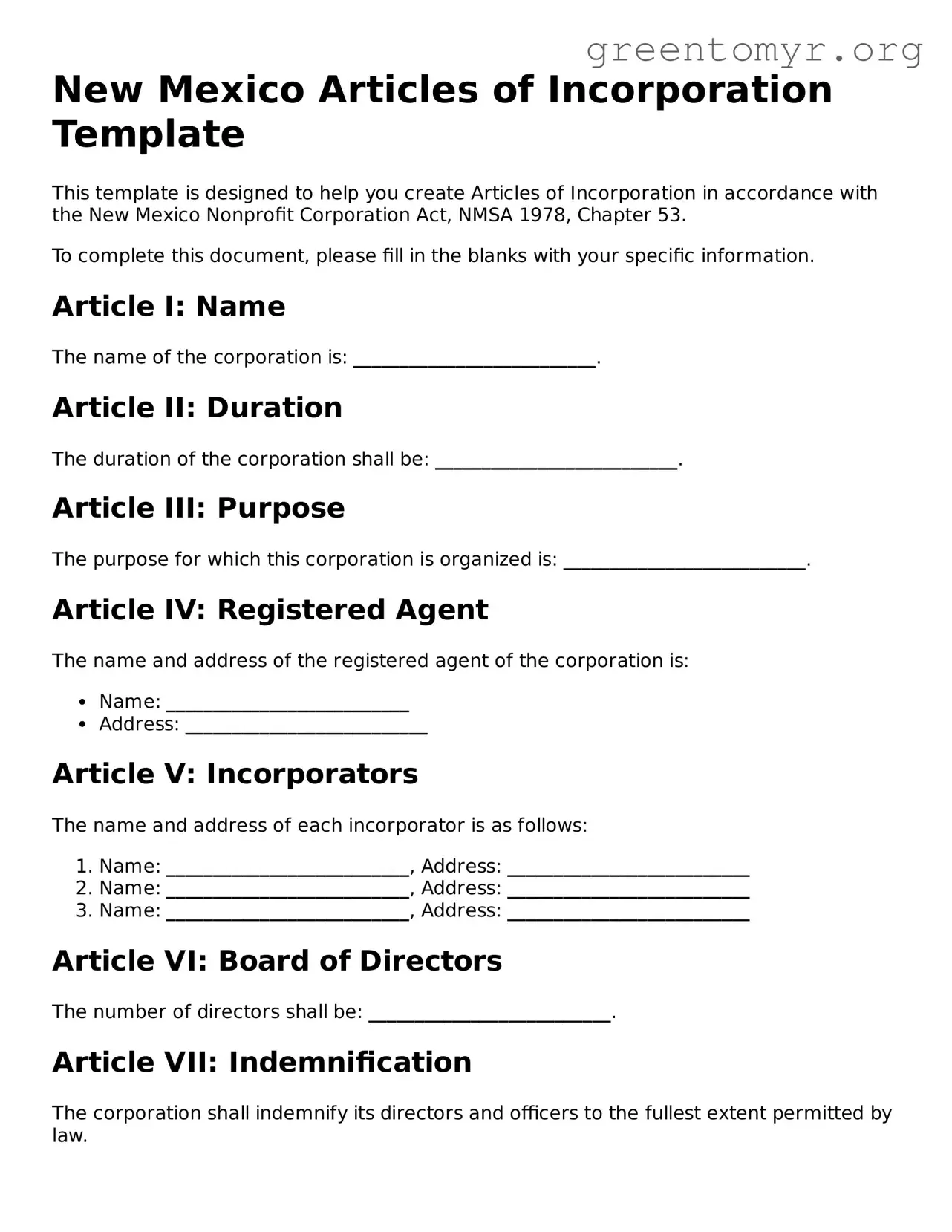
New Mexico Articles of Incorporation Template
This template is designed to help you create Articles of Incorporation in accordance with the New Mexico Nonprofit Corporation Act, NMSA 1978, Chapter 53.
To complete this document, please fill in the blanks with your specific information.
Article I: Name
The name of the corporation is: __________________________.
Article II: Duration
The duration of the corporation shall be: __________________________.
Article III: Purpose
The purpose for which this corporation is organized is: __________________________.
Article IV: Registered Agent
The name and address of the registered agent of the corporation is:
Article V: Incorporators
The name and address of each incorporator is as follows:
Article VI: Board of Directors
The number of directors shall be: __________________________.
Article VII: Indemnification
The corporation shall indemnify its directors and officers to the fullest extent permitted by law.
Article VIII: Amendments
These Articles of Incorporation may be amended in accordance with the provisions of the New Mexico Nonprofit Corporation Act.
Signature
Incorporator Signature: __________________________
Date: __________________________
Once completed, please file these Articles of Incorporation with the New Mexico Secretary of State.
| Fact Name | Details |
|---|---|
| Governing Law | The New Mexico Articles of Incorporation are governed by the New Mexico Business Corporation Act. |
| Filing Requirement | Filing the Articles of Incorporation with the New Mexico Secretary of State is mandatory to legally form a corporation. |
| Information Required | The form requires the corporation's name, duration, registered agent, and the number of shares authorized. |
| Registered Agent | A registered agent must be designated in the Articles of Incorporation to receive legal documents on behalf of the corporation. |
| Filing Fee | A filing fee is required when submitting the Articles of Incorporation, which may vary based on the type of corporation. |
| Effective Date | The Articles of Incorporation can specify an effective date, which may be the date of filing or a future date. |
| Amendments | Changes to the Articles of Incorporation can be made by filing an amendment with the Secretary of State. |
| Public Record | Once filed, the Articles of Incorporation become part of the public record and can be accessed by the public. |
After you have gathered all the necessary information, you are ready to fill out the New Mexico Articles of Incorporation form. This form is essential for officially establishing your business as a corporation in the state. Once completed, you will submit it to the New Mexico Secretary of State along with any required fees.
Once you have filled out the form, review it for accuracy. Then, submit it along with the required filing fee to the New Mexico Secretary of State. Your corporation will be on its way to becoming a legal entity!
The Articles of Incorporation is a legal document that establishes a corporation in New Mexico. This form outlines essential information about the corporation, including its name, purpose, registered agent, and duration. By filing this document with the New Mexico Secretary of State, you formally create a corporation, which provides limited liability protection to its owners.
When filling out the Articles of Incorporation, you will need to provide specific details, including:
To file the Articles of Incorporation, follow these steps:
Once approved, your corporation will be officially recognized, allowing you to operate legally in New Mexico.
Incorporating in New Mexico offers several advantages:
These benefits can significantly contribute to the long-term success and stability of your business.
Filling out the New Mexico Articles of Incorporation form can be a straightforward process, but many people make common mistakes that can delay or complicate the incorporation of their business. One frequent error is failing to provide a clear and accurate name for the corporation. The name must be unique and not too similar to existing businesses. It's essential to check the New Mexico Secretary of State’s database to avoid potential conflicts.
Another mistake involves the designation of the registered agent. A registered agent is required to receive legal documents on behalf of the corporation. Many individuals either forget to include this information or choose someone who does not meet the state’s requirements. It’s important to select a reliable individual or business entity that is authorized to conduct business in New Mexico.
Many applicants overlook the importance of specifying the purpose of the corporation. The Articles of Incorporation require a statement of purpose, which should be clear and concise. A vague purpose can lead to confusion and may even result in rejection of the application. It’s advisable to be specific about what the corporation intends to do.
Another common error is not including the appropriate number of shares the corporation is authorized to issue. This section should be filled out carefully, as it can affect ownership and control of the business. Failing to specify the number of shares or including an incorrect amount can lead to complications down the line.
Some people neglect to provide the correct information about the incorporators. The form requires the names and addresses of the individuals who are forming the corporation. Missing or incorrect information can cause delays in processing the application. It’s essential to double-check this information before submission.
In addition, many applicants forget to sign the form. The Articles of Incorporation must be signed by at least one incorporator. Without a signature, the form is incomplete and cannot be processed. This is a simple oversight, but it can lead to significant delays.
Another mistake involves not paying the required filing fee. Each state has its own fee structure, and New Mexico is no different. Failing to include the correct payment can result in rejection of the application. It’s crucial to verify the fee amount and include it with the submission.
Some individuals also fail to keep a copy of the completed Articles of Incorporation. Having a copy for your records is essential for future reference. This document serves as a foundational piece of your business, and it’s wise to maintain it in an accessible location.
Lastly, individuals often underestimate the importance of following up after submission. After filing the Articles of Incorporation, it’s important to confirm that the state has processed the application and that the corporation is officially recognized. This step can prevent future legal issues and ensure that the business is compliant with state regulations.
When forming a corporation in New Mexico, the Articles of Incorporation is just one of several essential documents required. These documents serve various purposes, from establishing the corporation’s structure to ensuring compliance with state laws. Below is a list of other forms and documents that are commonly used alongside the Articles of Incorporation.
Understanding these documents is crucial for anyone looking to establish a corporation in New Mexico. Each plays a vital role in ensuring that the corporation operates smoothly and remains compliant with state and federal laws. Properly managing these documents can help lay a strong foundation for future success.
When filling out the New Mexico Articles of Incorporation form, it is essential to approach the process with care and attention to detail. Below are some important dos and don'ts to consider.
By following these guidelines, individuals can help ensure a smoother incorporation process in New Mexico.
When it comes to the New Mexico Articles of Incorporation form, several misconceptions can lead to confusion for those looking to start a business. Understanding the truth behind these myths can help streamline the incorporation process.
This is not true. While the Articles of Incorporation are essential for establishing your corporation, other documents may also be required, such as bylaws, initial reports, and various permits depending on your business type and location.
Filing the Articles is just the first step in a long process. Success depends on many factors, including your business plan, market conditions, and effective management.
This is incorrect. While you need a registered agent with a physical address in New Mexico, you do not have to maintain an office in the state yourself.
Different types of corporations may require different information. For instance, a nonprofit corporation has distinct requirements compared to a for-profit corporation, so it’s essential to ensure you are using the correct form.
Filling out and using the New Mexico Articles of Incorporation form is an essential step for establishing a corporation in the state. Here are some key takeaways to consider: