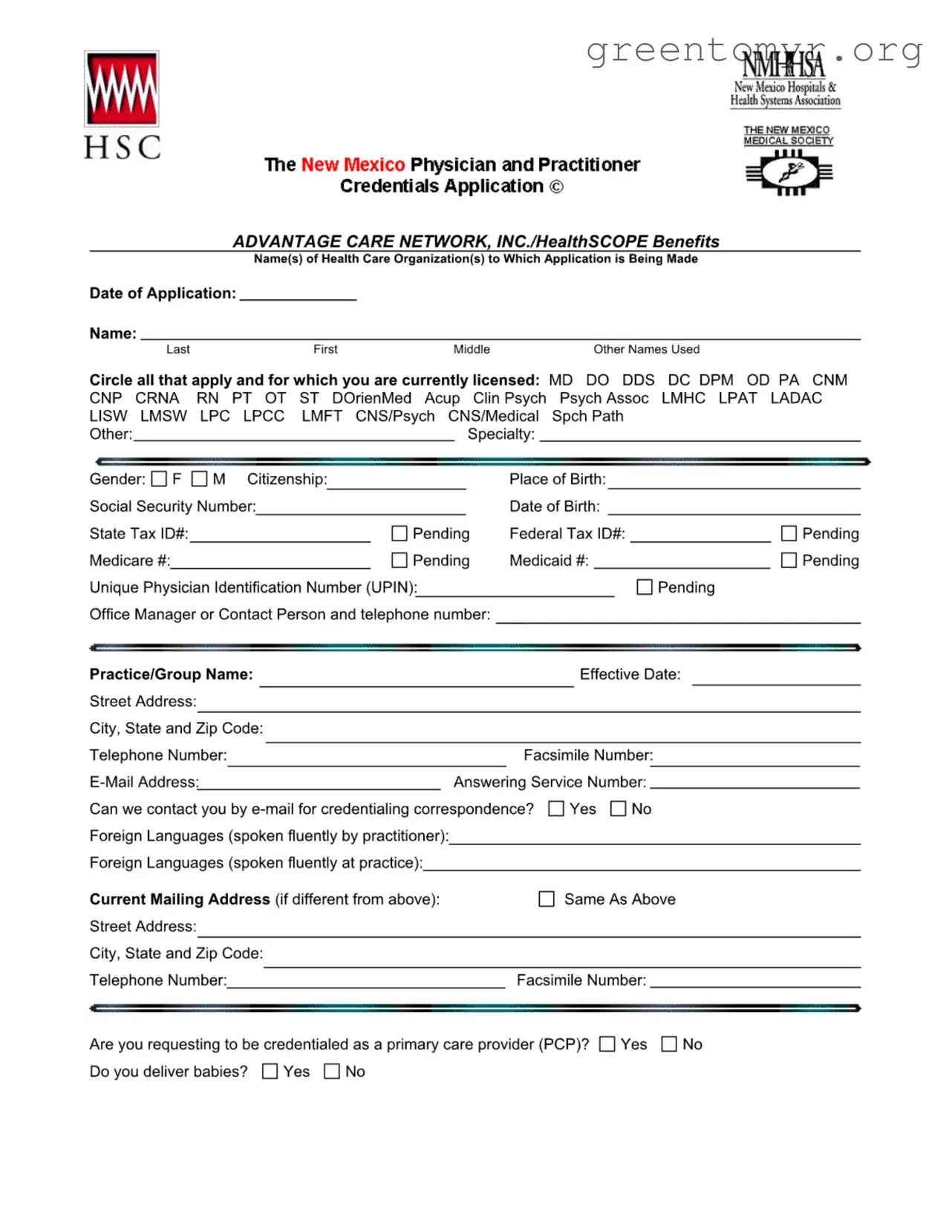
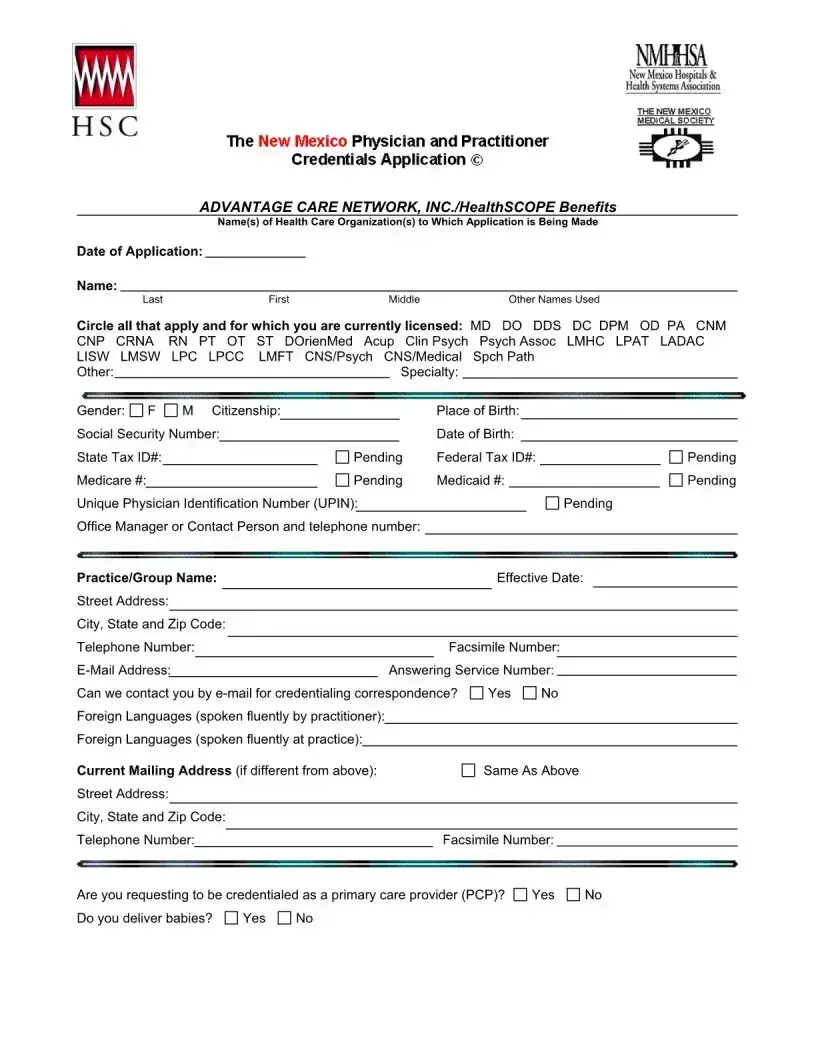
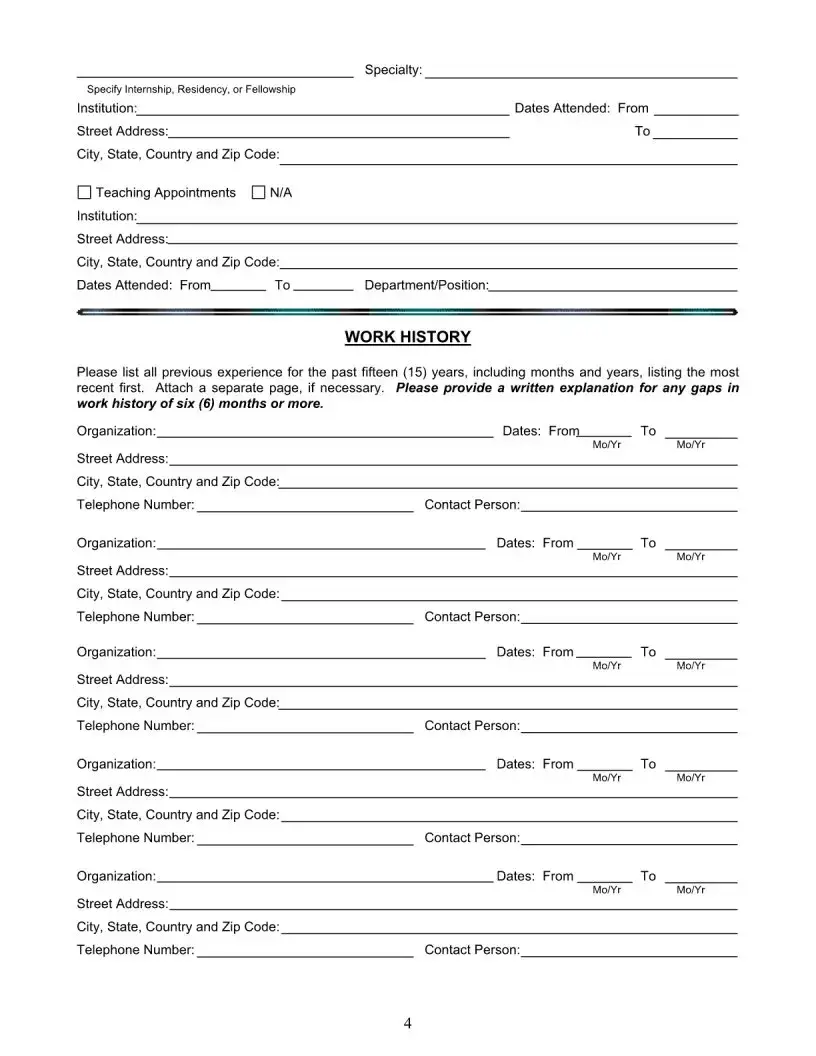
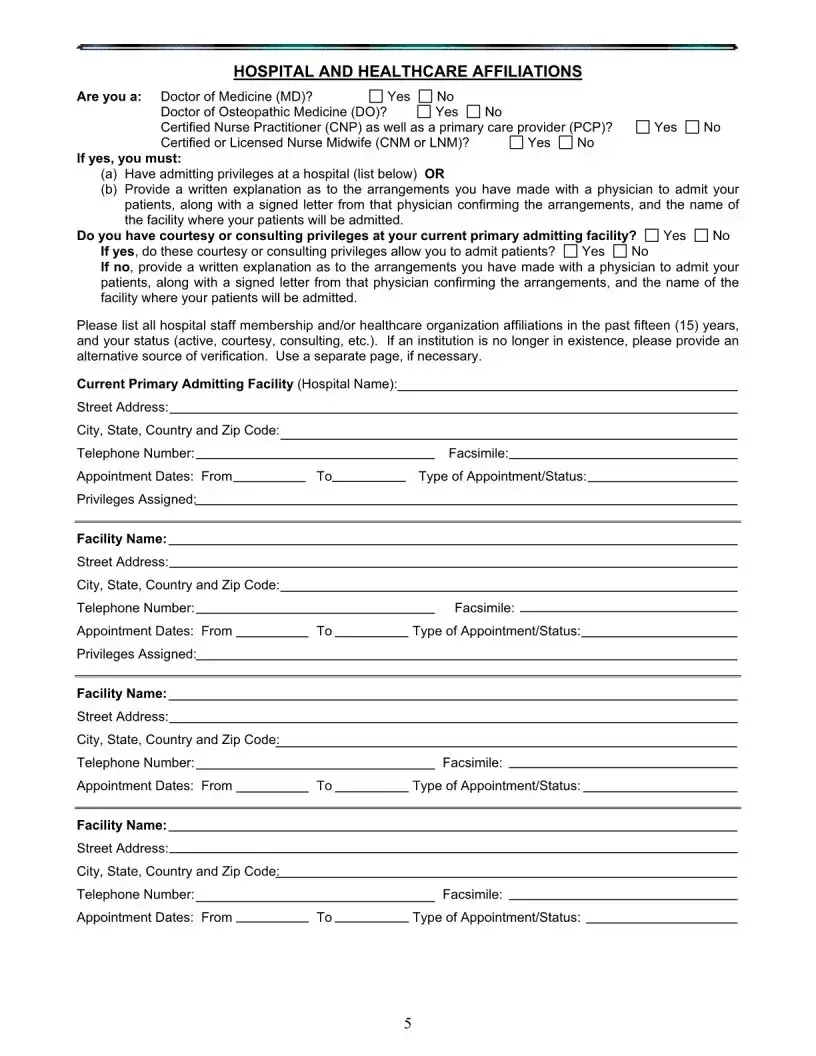
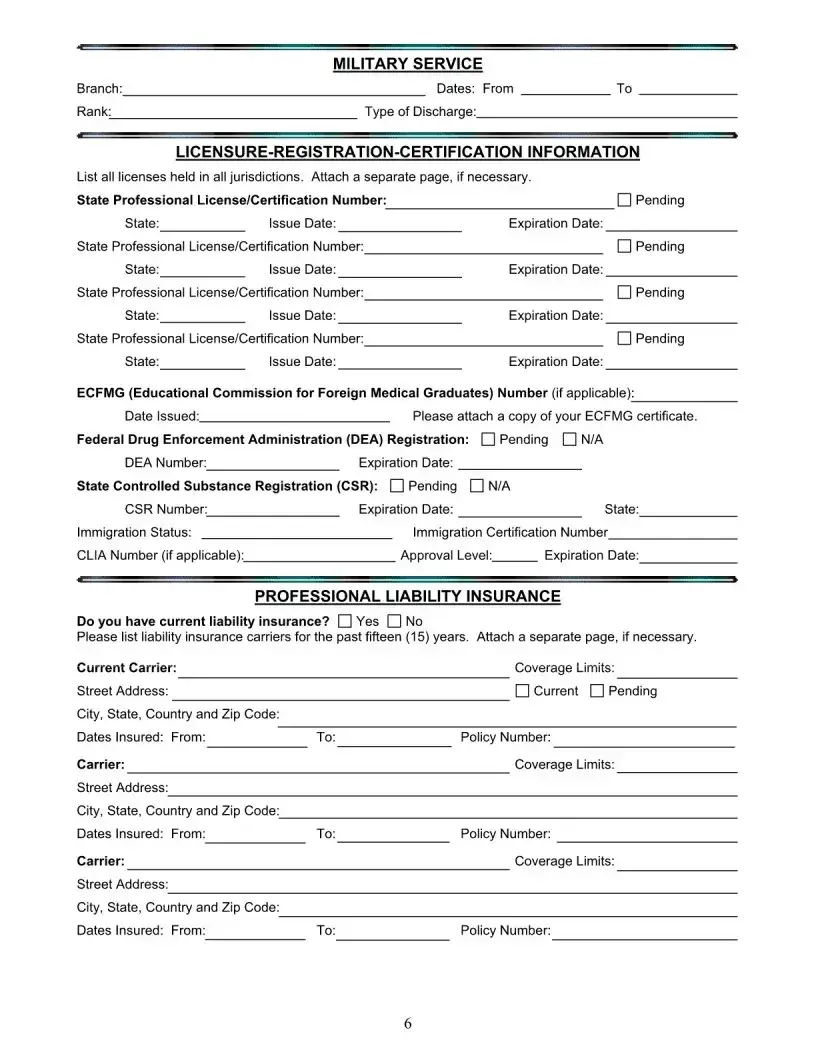
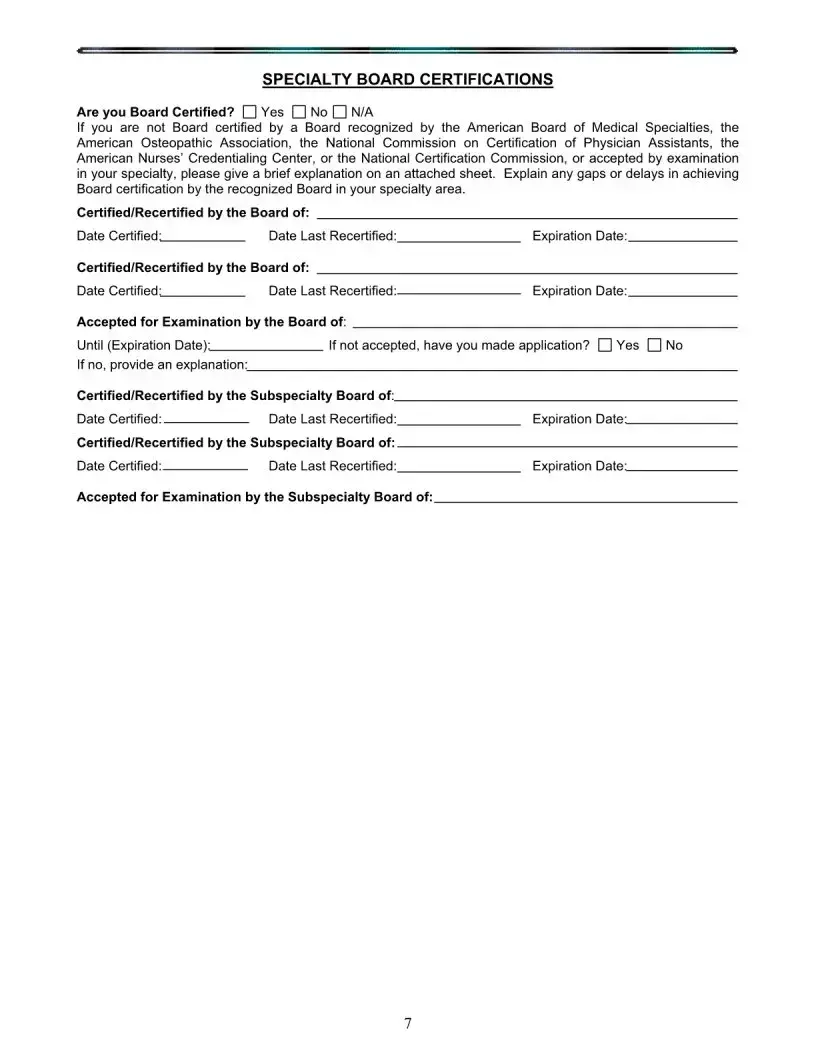
The New Mexico Credentialing Application form serves as a vital tool for healthcare professionals seeking to establish their credentials within the state's medical community. This comprehensive document collects essential information about the applicant, including their name, contact details, and various licenses held, such as MD, DO, or RN, among others. It requires applicants to disclose their specialties, citizenship status, and social security numbers, ensuring that all necessary identification is accurately captured. The form also includes sections for practice locations, office hours, and after-hours provisions, which are crucial for understanding the applicant's availability and service offerings. In addition, the application mandates the listing of professional references, allowing for a thorough evaluation of the applicant's performance and qualifications. With clear instructions and structured sections, the New Mexico Credentialing Application form aims to streamline the credentialing process while ensuring that all relevant information is gathered efficiently.
| Fact Name | Description |
|---|---|
| Governing Organizations | The New Mexico Credentialing Application form is associated with the New Mexico Hospitals & Health Systems Association and the New Mexico Medical Society. |
| Application Purpose | This form is designed for healthcare professionals seeking to obtain credentials to practice in New Mexico. |
| Required Information | Applicants must provide personal details, including their name, date of birth, and social security number, along with professional credentials. |
| Primary Care Provider Status | The application includes a question regarding whether the applicant is requesting to be credentialed as a primary care provider (PCP). |
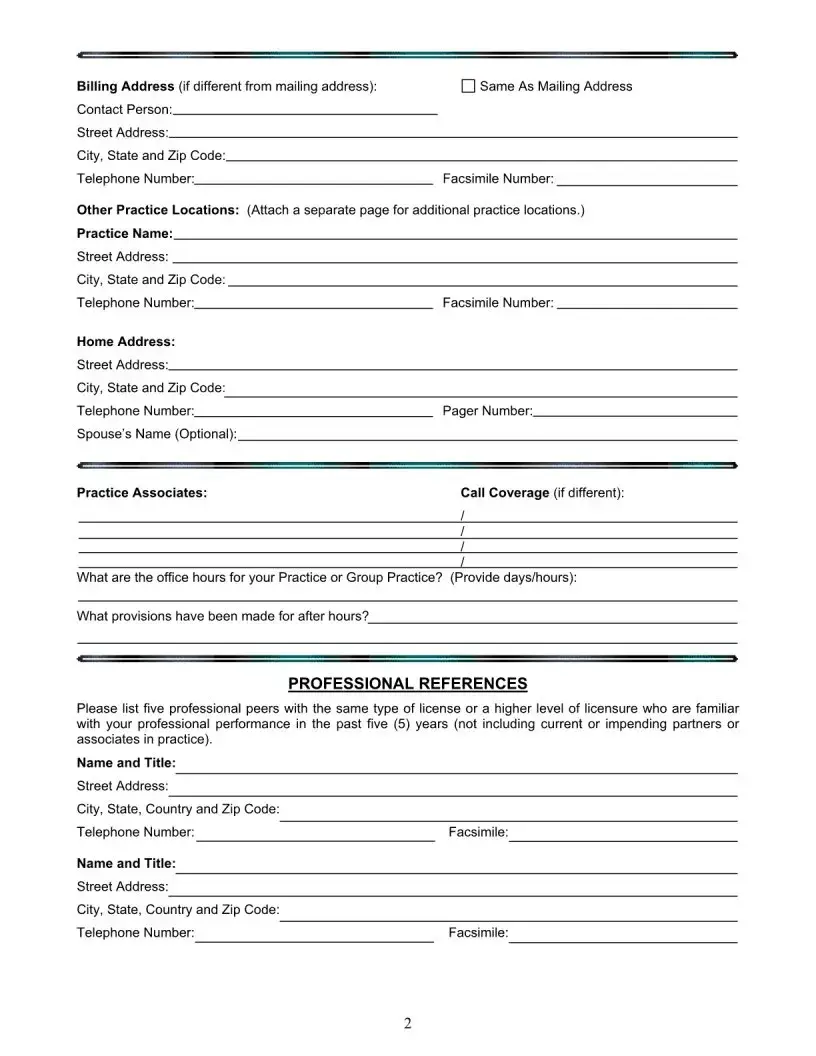
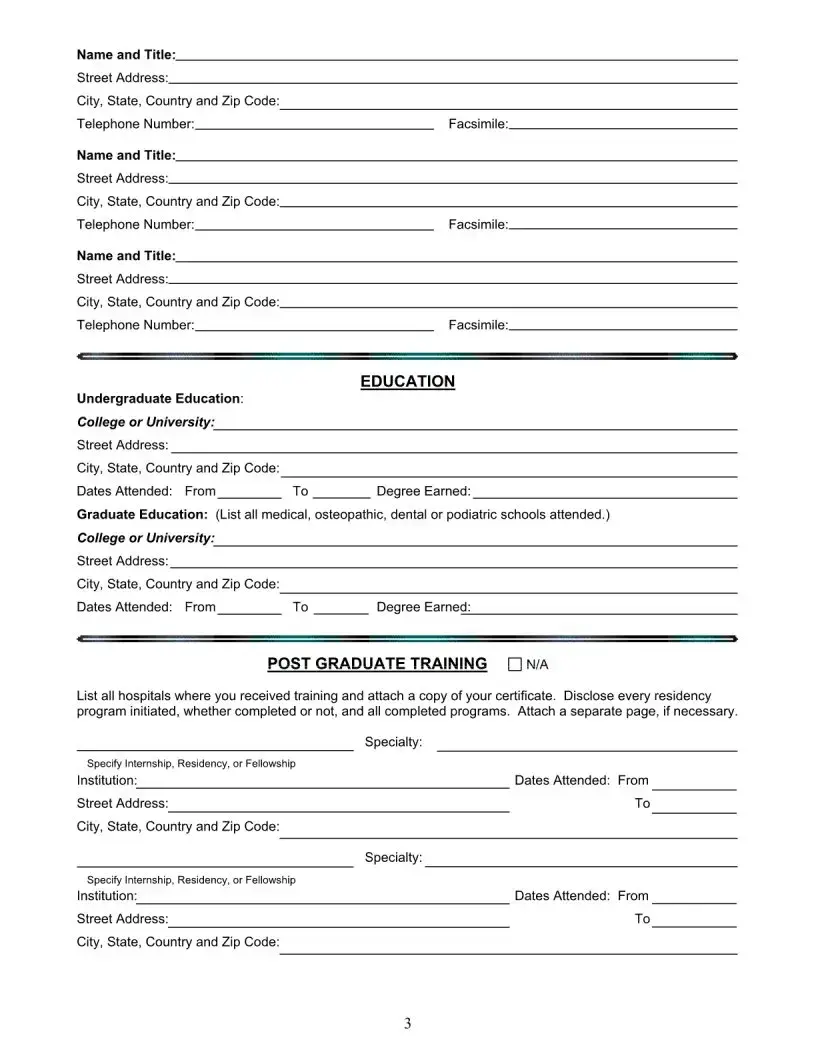
| Professional References | Applicants are required to list five professional peers who can attest to their performance over the last five years. |
| Governing Laws | The credentialing process in New Mexico is governed by various state laws, including the New Mexico Medical Practice Act. |
Completing the New Mexico Credentialing Application form requires careful attention to detail. Each section of the form gathers important information about your professional background, qualifications, and practice details. After filling out the form, you will submit it for review, which will help ensure that you meet the necessary standards for credentialing in New Mexico.
The New Mexico Credentialing Application form is a document used by healthcare professionals to apply for credentialing with various health care organizations in New Mexico. It collects essential information about the applicant's qualifications, licensure, and practice details.
This application is required for healthcare providers such as physicians, nurse practitioners, physician assistants, and other licensed practitioners seeking to be credentialed by hospitals or health systems in New Mexico.
The application requires personal details, including:
Additionally, you may need to provide your Social Security Number, state tax ID, and Medicare number.
Currently, the application must be completed and submitted in a paper format. Be sure to check with the specific healthcare organization for their submission guidelines.
The credentialing process can vary depending on the organization. Generally, it may take anywhere from a few weeks to several months. It is advisable to follow up with the organization for updates on your application status.
If you need to update your application after submission, contact the healthcare organization directly. They will provide guidance on how to amend your application or submit additional information.
Some healthcare organizations may charge a fee for processing your credentialing application. It is important to verify any potential fees with the organization to which you are applying.
Having a criminal history does not automatically disqualify you from credentialing. However, it is essential to disclose any relevant information on your application. Each organization has its own policies regarding criminal history, and they will assess your application on a case-by-case basis.
When filling out the application, you will need to provide your practice's office hours. This includes the days and times your practice is open to patients. Ensure this information is accurate, as it helps organizations understand your availability.
Yes, the application includes a section where you can indicate whether you are requesting to be credentialed as a primary care provider (PCP). Be sure to answer this question accurately, as it may affect your application review.
Completing the New Mexico Credentialing Application form can be a straightforward process, but several common mistakes often lead to delays or complications. Awareness of these pitfalls can help ensure a smoother experience.
One frequent error is neglecting to provide all required personal information. Many applicants overlook sections such as place of birth or social security number. Each detail is crucial for the verification process. Missing information can lead to unnecessary delays in credentialing.
Another mistake involves inaccurate or incomplete contact information. It’s essential to list current phone numbers and email addresses. If the credentialing body cannot reach you, it may stall your application. Ensure that all contact details are correct and up-to-date.
Some applicants fail to indicate their specialty or areas of practice clearly. This information is vital for determining eligibility and for the appropriate assignment of credentials. Be specific about your specialty and any additional qualifications you hold.
Inconsistencies in naming can also create issues. For example, if an applicant uses different names in various sections, it can raise questions during the verification process. Consistency is key. Use the same name format throughout the application.
Additionally, many people forget to answer the questions about credentialing as a primary care provider or whether they deliver babies. These responses are not merely formalities; they significantly impact your application’s assessment. Be sure to respond to all questions thoroughly.
Providing outdated references is another common error. The application requires references from the past five years. Listing older references can lead to complications. Ensure your references are current and familiar with your recent professional performance.
Another mistake is failing to include additional practice locations if applicable. If you practice in multiple locations, list them clearly on a separate page. Omitting this information can lead to misunderstandings about your practice scope.
Finally, some applicants neglect to specify their office hours or after-hours provisions. This information is essential for understanding your availability and how you manage patient care. Be precise about your office hours and any arrangements for after-hours care.
By avoiding these common mistakes, applicants can facilitate a more efficient credentialing process. Attention to detail is crucial, and taking the time to ensure accuracy can save significant time and effort in the long run.
The New Mexico Credentialing Application form is a crucial document for healthcare professionals seeking to establish their credentials in the state. Along with this application, several other forms and documents are typically required to ensure a comprehensive review of the applicant's qualifications. Below is a list of these accompanying documents, each serving a specific purpose in the credentialing process.
Each of these documents plays a vital role in the credentialing process, helping to ensure that healthcare professionals meet the necessary standards for practice. Collectively, they contribute to a thorough evaluation, promoting patient safety and quality care within the healthcare system.
When filling out the New Mexico Credentialing Application form, it is essential to approach the task with care and attention to detail. Below are some recommendations on what to do and what to avoid during this process.
By following these guidelines, you can help ensure a smoother credentialing process in New Mexico. Attention to detail and accuracy are crucial in presenting your qualifications effectively.
Misconception 1: The application is only for physicians.
This form is not limited to physicians. It is designed for a variety of healthcare professionals, including nurse practitioners, physician assistants, and other licensed practitioners. All eligible healthcare providers can use this application to seek credentialing.
Misconception 2: The application process is the same for all healthcare organizations.
Each healthcare organization may have different requirements and processes for credentialing. While the application form provides a standard format, individual organizations may request additional documentation or have specific guidelines that applicants must follow.
Misconception 3: Once submitted, the application cannot be modified.
Applicants can make changes to their application before it is processed. If an applicant realizes they need to update information after submission, they should contact the credentialing office of the organization to discuss how to proceed.
Misconception 4: The application guarantees credentialing approval.
Completing the application does not ensure that credentialing will be granted. Approval is contingent upon a review of the applicant's qualifications, experience, and compliance with the specific criteria set by the healthcare organization.
When filling out the New Mexico Credentialing Application form, keep the following key takeaways in mind: