Content Navigation

In the state of New Mexico, the Do Not Resuscitate (DNR) Order form serves as a crucial document for individuals who wish to express their preferences regarding medical interventions during a critical health crisis. This form is particularly important for patients facing terminal illnesses or those who may not wish to undergo resuscitation efforts in the event of cardiac arrest or respiratory failure. By completing the DNR Order, individuals can ensure that their wishes are respected by healthcare providers, allowing for a more peaceful end-of-life experience. The form requires specific information, including the patient's name, date of birth, and signature, along with the signatures of witnesses or a healthcare provider to validate the document. Additionally, it is vital for individuals to discuss their decisions with family members and medical professionals to ensure clarity and understanding. Understanding the implications of this form can help individuals make informed choices about their healthcare preferences, ultimately providing peace of mind in difficult times.

New Mexico Do Not Resuscitate Order Example

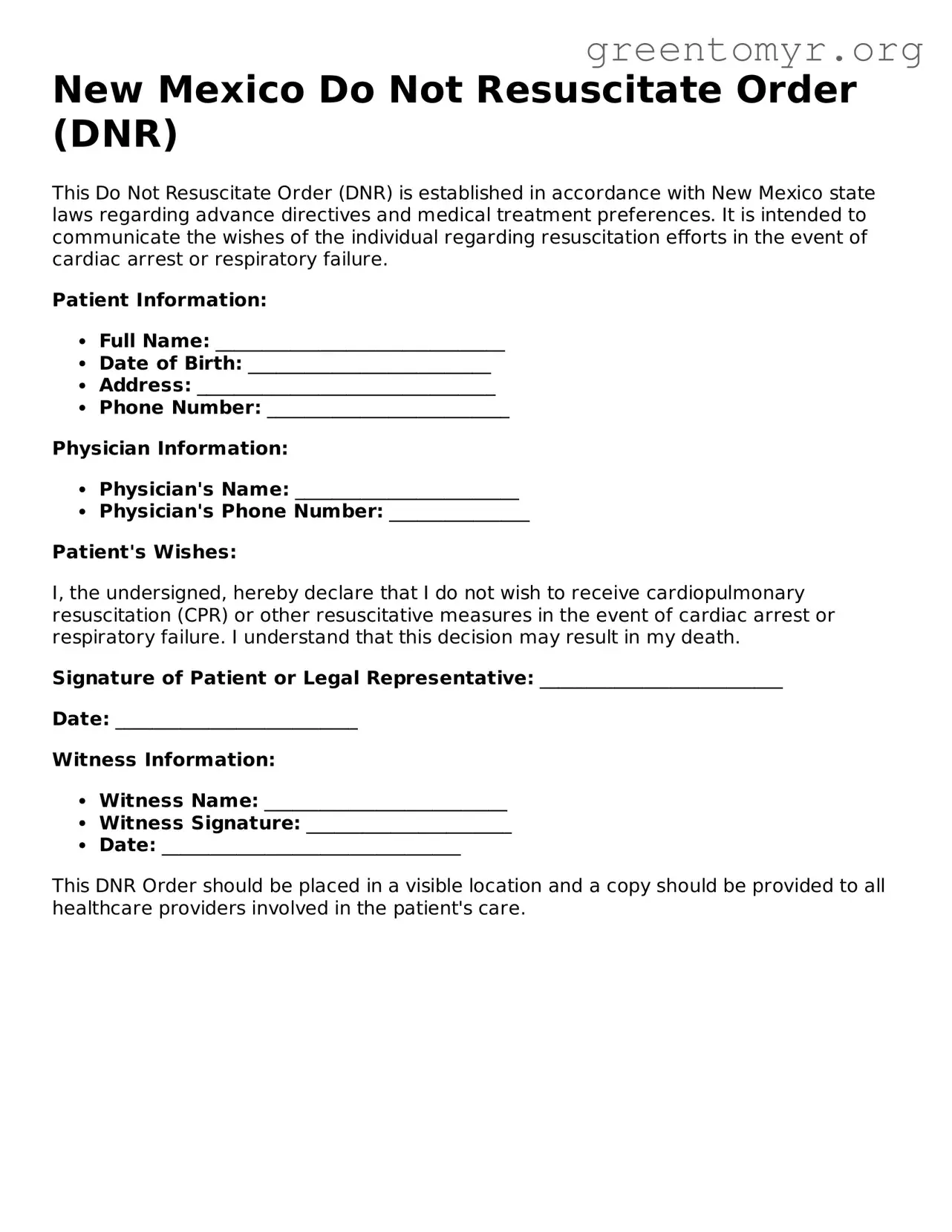
New Mexico Do Not Resuscitate Order (DNR)

This Do Not Resuscitate Order (DNR) is established in accordance with New Mexico state laws regarding advance directives and medical treatment preferences. It is intended to communicate the wishes of the individual regarding resuscitation efforts in the event of cardiac arrest or respiratory failure.

Patient Information:

  • Full Name: _______________________________
  • Date of Birth: __________________________
  • Address: ________________________________
  • Phone Number: __________________________

Physician Information:

  • Physician's Name: ________________________
  • Physician's Phone Number: _______________

Patient's Wishes:

I, the undersigned, hereby declare that I do not wish to receive cardiopulmonary resuscitation (CPR) or other resuscitative measures in the event of cardiac arrest or respiratory failure. I understand that this decision may result in my death.

Signature of Patient or Legal Representative: __________________________

Date: __________________________

Witness Information:

  • Witness Name: __________________________
  • Witness Signature: ______________________
  • Date: ________________________________

This DNR Order should be placed in a visible location and a copy should be provided to all healthcare providers involved in the patient's care.

PDF Form Features

Fact Name Description
Governing Law The New Mexico Do Not Resuscitate Order is governed by the New Mexico Statutes, specifically NMSA 1978, § 24-10B-1 et seq.
Purpose This form allows individuals to express their wishes regarding resuscitation in the event of a medical emergency.
Eligibility Any adult who is competent to make medical decisions can complete a Do Not Resuscitate Order.
Signature Requirement The form must be signed by the individual or their legal representative and a physician must also sign to validate the order.
Recognition The order is recognized by healthcare providers across New Mexico, ensuring that the patient's wishes are honored in emergency situations.

Guide to Using New Mexico Do Not Resuscitate Order

Filling out the New Mexico Do Not Resuscitate Order form is an important step in ensuring your healthcare wishes are respected. Once completed, this form should be shared with your healthcare provider and kept in an easily accessible location.

  1. Obtain the New Mexico Do Not Resuscitate Order form. You can find it online or request it from your healthcare provider.
  2. Fill in your full name, date of birth, and address at the top of the form.
  3. Indicate whether you are completing this form as a patient or as a legal representative.
  4. Provide the name and contact information of your healthcare provider.
  5. Sign and date the form in the designated area. If you are a legal representative, include your relationship to the patient.
  6. Have the form witnessed by two individuals who are not related to you and do not stand to benefit from your estate.
  7. Make copies of the signed form for your records and for your healthcare provider.

After completing the form, ensure that it is stored in a safe place and inform your family members and healthcare team about its location. This will help guarantee that your wishes are honored in a medical emergency.

Get Answers on New Mexico Do Not Resuscitate Order

What is a Do Not Resuscitate (DNR) Order in New Mexico?

A Do Not Resuscitate Order is a medical order that tells healthcare providers not to perform cardiopulmonary resuscitation (CPR) if a person's heart stops beating or if they stop breathing. In New Mexico, this order is particularly important for individuals who have serious health conditions and wish to avoid aggressive medical interventions at the end of life.

Who can request a DNR Order in New Mexico?

In New Mexico, a DNR Order can be requested by the patient themselves if they are capable of making their own healthcare decisions. If the patient is unable to make decisions, a legally authorized representative, such as a family member or a designated healthcare proxy, may request the order on their behalf. It is essential that the person requesting the DNR understands the implications of the order and that it aligns with the patient's wishes.

How is a DNR Order completed in New Mexico?

To complete a DNR Order in New Mexico, the following steps should be taken:

  1. Obtain the official New Mexico DNR Order form, which can be found online or through healthcare providers.
  2. Fill out the form, ensuring that all required information is accurately provided.
  3. Have the form signed by the patient or their authorized representative, as well as by a physician.
  4. Make copies of the signed DNR Order and provide them to all relevant healthcare providers, including hospitals and emergency services.

What should I do if I change my mind about the DNR Order?

If you decide to revoke or change your DNR Order, it is crucial to communicate this decision clearly. You can do this by:

  • Destroying the existing DNR Order form.
  • Informing your healthcare providers about your decision.
  • Completing a new DNR Order form if you wish to establish a different set of instructions.

Always ensure that your wishes are documented and shared with those involved in your care.

Will a DNR Order affect the level of care I receive?

No, having a DNR Order does not mean that you will receive less care. Healthcare providers are still obligated to provide appropriate medical treatment and comfort measures. The DNR Order specifically addresses resuscitation efforts in the event of cardiac arrest or respiratory failure. Other forms of treatment, such as pain management and supportive care, will continue regardless of the DNR status.

Common mistakes

When individuals fill out the New Mexico Do Not Resuscitate (DNR) Order form, several common mistakes can occur. One frequent error is failing to provide complete information. The form requires specific details, such as the patient’s name, date of birth, and signature. Omitting any of these crucial elements can render the form invalid, leading to complications during a medical emergency.

Another mistake involves misunderstanding the scope of the DNR order. Some individuals may assume that a DNR order applies to all medical situations. In reality, a DNR specifically addresses resuscitation efforts in the event of cardiac or respiratory arrest. It does not prevent other forms of medical treatment or care. Therefore, it is important to clarify the intent behind the order to avoid confusion among healthcare providers.

Additionally, individuals sometimes neglect to discuss their wishes with family members or healthcare providers before completing the form. Open communication is essential. Without discussing the DNR order, family members may be caught off guard during a medical crisis, leading to potential disputes about the patient’s wishes. Ensuring that everyone involved understands the decision can help honor the patient’s preferences.

Lastly, individuals may forget to review and update the DNR order regularly. Life circumstances can change, and so can a person’s wishes regarding resuscitation. It is advisable to revisit the order periodically, especially after significant life events or changes in health status. Keeping the document current ensures that it accurately reflects the individual’s intentions and can provide peace of mind for both the patient and their loved ones.

Documents used along the form

In New Mexico, the Do Not Resuscitate (DNR) Order form is an important document for individuals who wish to express their preferences regarding medical treatment in emergencies. However, there are several other forms and documents that can complement a DNR order, ensuring that a person's wishes are clearly communicated and respected. Below are four commonly used forms that often accompany a DNR order.

  • Advance Healthcare Directive: This document allows individuals to specify their healthcare preferences in advance, including appointing a healthcare proxy to make decisions on their behalf if they become unable to do so. It provides a broader context for medical decisions beyond resuscitation.
  • Durable Power of Attorney for Healthcare: This form designates a specific person to make healthcare decisions for someone if they are incapacitated. It is crucial for ensuring that someone trusted is making choices that align with the individual’s values and wishes.
  • POLST (Physician Orders for Life-Sustaining Treatment): This is a medical order that outlines a patient’s preferences for treatment in emergency situations. Unlike a DNR, a POLST form can address a wider range of medical interventions and is intended for individuals with serious health conditions.
  • Living Will: A living will details specific medical treatments a person does or does not want in situations where they cannot communicate their wishes. It serves as a guide for healthcare providers and loved ones, ensuring that the individual’s desires are honored.

These documents work together to create a comprehensive approach to healthcare decision-making. By understanding and utilizing these forms, individuals can ensure that their medical preferences are clearly articulated and respected, especially in critical situations.

Similar forms

  • Advance Directive: This document outlines an individual's preferences for medical treatment in situations where they are unable to communicate their wishes. Like a Do Not Resuscitate Order (DNR), it ensures that healthcare providers honor the patient's desires regarding life-sustaining measures.
  • Living Will: A living will specifies the types of medical treatment a person wishes to receive or avoid in the event of a terminal illness or incapacitation. Similar to a DNR, it provides guidance to healthcare professionals and family members about the individual's preferences.
  • Durable Power of Attorney for Health Care: This legal document designates a person to make healthcare decisions on behalf of another individual when they are unable to do so. It can encompass decisions related to resuscitation and aligns closely with the intentions of a DNR.
  • Physician Orders for Life-Sustaining Treatment (POLST): POLST forms provide specific medical orders regarding treatment preferences for seriously ill patients. Like a DNR, it conveys the patient's wishes in a clear and actionable manner to emergency medical personnel.
  • Medical Power of Attorney: This document allows a person to appoint someone to make medical decisions for them if they become incapacitated. It complements a DNR by ensuring that the appointed individual understands and respects the patient’s wishes regarding resuscitation.
  • Do Not Intubate Order: This order specifically instructs healthcare providers not to perform intubation in case of respiratory failure. It shares similarities with a DNR by focusing on limiting invasive life-sustaining interventions.
  • Comfort Care Order: A comfort care order emphasizes the provision of comfort and pain relief rather than aggressive treatment. It aligns with the intentions of a DNR by prioritizing the quality of life over prolonged medical interventions.
  • Emergency Medical Services (EMS) Directive: This directive communicates a patient's treatment preferences to emergency responders. It functions similarly to a DNR by ensuring that emergency personnel are aware of the individual's wishes regarding resuscitation efforts.
  • End-of-Life Care Plan: An end-of-life care plan outlines a patient’s goals and preferences for care during their final days. Like a DNR, it aims to ensure that healthcare providers respect the patient’s choices about life-sustaining treatments.
  • Patient’s Bill of Rights: While not a direct equivalent, a Patient's Bill of Rights affirms a patient's right to make decisions about their medical care, including the right to refuse resuscitation. It supports the principles underlying a DNR by advocating for patient autonomy.

Dos and Don'ts

When filling out the New Mexico Do Not Resuscitate Order form, it's important to follow certain guidelines. Here are some things to keep in mind:

  • Do discuss your wishes with your healthcare provider.
  • Do ensure that the form is signed by you and your physician.
  • Do keep a copy of the completed form in an easily accessible place.
  • Do inform family members about your decision.
  • Don't fill out the form if you are unsure about your wishes.
  • Don't forget to update the form if your preferences change.
  • Don't assume that medical staff will know your wishes without the form.
  • Don't leave the form unsigned or incomplete.
  • Don't ignore the importance of discussing this with loved ones.

Taking these steps can help ensure that your wishes are respected in a medical emergency.

Misconceptions

Understanding the New Mexico Do Not Resuscitate (DNR) Order form is crucial for patients and their families. However, several misconceptions can lead to confusion and anxiety. Here are eight common misconceptions explained:

  1. A DNR order means no medical treatment at all. Many people think that having a DNR means a patient will not receive any medical care. In reality, a DNR only applies to resuscitation efforts like CPR or intubation. Other treatments, including pain management and comfort care, will still be provided.
  2. DNR orders are only for terminally ill patients. While DNR orders are often associated with end-of-life situations, they can be appropriate for anyone with a serious medical condition. It’s a personal choice based on individual values and preferences.
  3. A DNR order is permanent and cannot be changed. Many believe that once a DNR is in place, it cannot be altered. However, patients or their healthcare proxies can revoke or modify the order at any time, reflecting their changing wishes.
  4. All healthcare providers must honor a DNR order. Some individuals think that all medical professionals are required to follow a DNR order. While most do, it’s important to ensure that the DNR is documented properly and recognized by the specific healthcare facility or provider.
  5. You need a lawyer to create a DNR order. Some people assume that a DNR order must be drafted by a lawyer. In New Mexico, you can fill out the official DNR form without legal assistance, as long as it is signed by the patient and a physician.
  6. A DNR order is the same as an advance directive. While both documents express a patient’s wishes regarding medical treatment, they serve different purposes. An advance directive covers a broader range of healthcare decisions, while a DNR specifically addresses resuscitation efforts.
  7. Having a DNR order means giving up hope. Many fear that choosing a DNR signifies a lack of hope for recovery. In truth, it reflects a thoughtful decision about the type of care a patient desires, emphasizing quality of life over aggressive interventions.
  8. Family members can make a DNR decision without the patient's consent. It’s a common misconception that family members can decide on a DNR order if the patient is unable to communicate. In New Mexico, a DNR must be signed by the patient or their legally designated healthcare proxy.

By clarifying these misconceptions, individuals can make more informed decisions regarding their healthcare preferences. Understanding the specifics of the DNR order can empower patients and their families to advocate for the care that aligns with their values.

Key takeaways

Here are key takeaways regarding the New Mexico Do Not Resuscitate Order form:

  • The form is intended for individuals who wish to refuse resuscitation efforts in case of cardiac or respiratory arrest.
  • It must be signed by a licensed physician to be valid.
  • Patients or their legal representatives should complete the form with clear instructions.
  • Ensure that the form is easily accessible to healthcare providers, especially in emergency situations.
  • It is important to discuss your wishes with family members and healthcare providers before completing the form.
  • The order remains effective until revoked or modified by the patient or their representative.
  • Keep copies of the signed form in multiple locations, such as with your primary care physician and at home.
  • Review the form regularly to ensure it reflects your current wishes.
  • Understand that the Do Not Resuscitate Order does not affect other medical treatments or care.