The New Mexico Durable Power of Attorney form serves as a vital legal document that empowers individuals to designate a trusted person to make decisions on their behalf in the event they become incapacitated. This form is particularly significant because it remains effective even if the principal, the person granting the authority, loses the ability to make sound decisions due to illness or injury. By completing this document, individuals can outline specific powers granted to their agent, ranging from financial matters to healthcare decisions. The process involves careful consideration of whom to appoint, as this person will have the authority to act in the principal's best interests. Additionally, the form must be signed in the presence of a notary public to ensure its validity, providing an extra layer of protection and authenticity. Understanding the implications of this document is crucial, as it not only safeguards personal interests but also alleviates potential burdens on family members during challenging times.
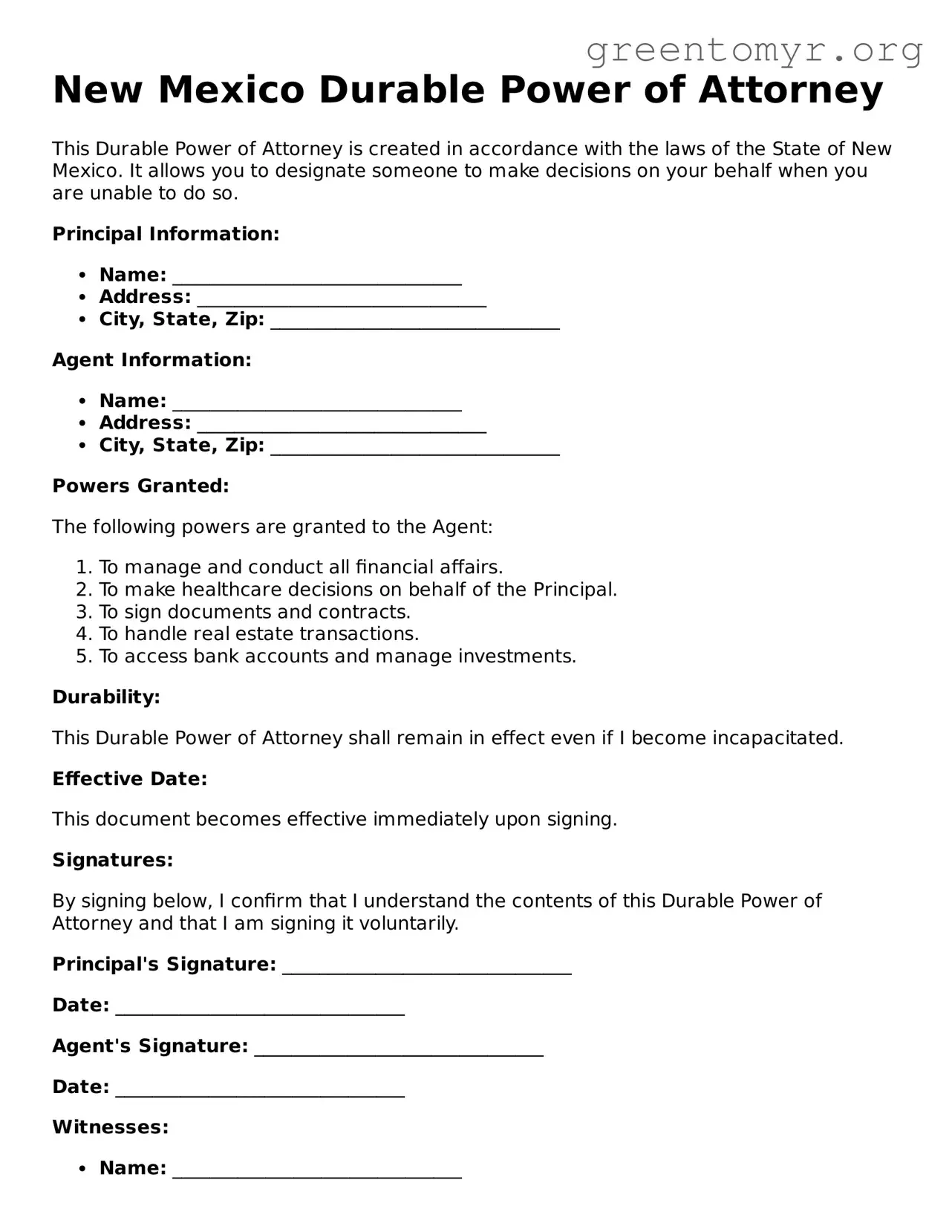
New Mexico Durable Power of Attorney
This Durable Power of Attorney is created in accordance with the laws of the State of New Mexico. It allows you to designate someone to make decisions on your behalf when you are unable to do so.
Principal Information:
Agent Information:
Powers Granted:
The following powers are granted to the Agent:
Durability:
This Durable Power of Attorney shall remain in effect even if I become incapacitated.
Effective Date:
This document becomes effective immediately upon signing.
Signatures:
By signing below, I confirm that I understand the contents of this Durable Power of Attorney and that I am signing it voluntarily.
Principal's Signature: _______________________________
Date: _______________________________
Agent's Signature: _______________________________
Date: _______________________________
Witnesses:
This document should be notarized for added validity.
| Fact Name | Description |
|---|---|
| Definition | A Durable Power of Attorney allows an individual to designate another person to make financial or legal decisions on their behalf. |
| Durability | This form remains effective even if the principal becomes incapacitated. |
| Governing Law | The New Mexico Durable Power of Attorney is governed by the New Mexico Uniform Power of Attorney Act. |
| Principal | The person who creates the Durable Power of Attorney is referred to as the principal. |
| Agent | The individual designated to act on behalf of the principal is known as the agent or attorney-in-fact. |
| Signing Requirements | The form must be signed by the principal and acknowledged by a notary public. |
| Revocation | The principal can revoke the Durable Power of Attorney at any time, as long as they are competent. |
| Scope of Authority | The form can grant broad or limited powers, depending on the principal's preferences. |
| Filing | No filing is required with the state; however, it should be kept in a safe place and shared with relevant parties. |
| Important Considerations | Choosing a trustworthy agent is crucial, as they will have significant control over financial and legal matters. |
Filling out the New Mexico Durable Power of Attorney form is an important step in ensuring your financial and legal affairs are managed according to your wishes. Once completed, the form allows you to designate someone you trust to act on your behalf in various matters. Here’s how to fill it out correctly.
By following these steps, you will have a properly filled out Durable Power of Attorney form that reflects your intentions and can be used when needed.
A Durable Power of Attorney (DPOA) is a legal document that allows an individual (the principal) to appoint another person (the agent) to make decisions on their behalf. This authority remains in effect even if the principal becomes incapacitated. In New Mexico, the DPOA can cover financial matters, healthcare decisions, or both, depending on how it is structured.
To create a DPOA in New Mexico, the principal must:
It is recommended to consult with an attorney to ensure the document meets all legal requirements and accurately reflects the principal's wishes.
The principal can grant a wide range of powers to the agent, including but not limited to:
The principal should clearly specify the powers in the DPOA to avoid any ambiguity.
Yes, a principal can revoke a DPOA at any time, as long as they are mentally competent. To revoke the DPOA, the principal must provide a written notice to the agent and any relevant third parties. It is advisable to destroy any copies of the original DPOA to prevent confusion.
If the principal becomes incapacitated, the Durable Power of Attorney remains effective. The agent can then act on behalf of the principal, making decisions in their best interest. This is one of the key features that distinguishes a DPOA from a standard power of attorney, which typically becomes invalid if the principal loses capacity.
A Durable Power of Attorney created in New Mexico is generally valid in other states, but specific laws may vary. It is advisable to check the laws of the other state to ensure compliance. Some states may require additional forms or notarization for the DPOA to be recognized.
If a person becomes incapacitated without a DPOA, family members may need to go through a court process to obtain guardianship or conservatorship. This process can be lengthy and costly. Having a DPOA in place can help avoid this situation and ensure that decisions are made according to the principal's wishes.
Yes, a principal can designate multiple agents in a Durable Power of Attorney. They can choose to have the agents act jointly, meaning they must make decisions together, or they can allow them to act separately. It is important to clearly outline how the agents are to operate within the DPOA to prevent conflicts.
When filling out the New Mexico Durable Power of Attorney form, individuals often make several common mistakes that can lead to confusion or even invalidate the document. One of the most frequent errors is failing to specify the powers granted to the agent clearly. Without clear instructions, the agent may not understand the extent of their authority, which can create complications when decisions need to be made.
Another mistake is neglecting to date the form. A date is crucial as it establishes when the powers begin. If the document is undated, questions may arise about its validity, especially if it is challenged later. Additionally, people sometimes forget to sign the form or have it witnessed as required by New Mexico law. A missing signature can render the entire document ineffective.
It's also common for individuals to choose an agent who is not reliable or trustworthy. This decision can have serious consequences, especially if the agent is expected to make significant financial or medical decisions on behalf of the principal. Selecting someone who understands the responsibilities and can act in the principal’s best interest is essential.
Some people mistakenly believe that a Durable Power of Attorney automatically covers all situations. In reality, specific powers must be listed for the agent to act. This oversight can lead to limitations when urgent decisions need to be made. Furthermore, failing to review the form thoroughly before submission can result in errors that could have been easily corrected.
Another common pitfall is not discussing the Durable Power of Attorney with the appointed agent. Without a conversation, the agent may not be aware of the principal's wishes or the reasons behind certain decisions. This lack of communication can lead to misunderstandings during critical moments.
In addition, individuals sometimes use outdated forms or templates that do not comply with current laws. Using the most recent version of the Durable Power of Attorney form is vital to ensure that it meets all legal requirements. This mistake can lead to complications if the form is challenged in court.
People may also overlook the importance of revoking previous powers of attorney. If a new Durable Power of Attorney is created without formally revoking the old one, confusion can arise about which document is valid. It is important to ensure that all previous documents are properly canceled to avoid potential conflicts.
Finally, some individuals do not keep copies of the completed form. Keeping a copy is essential for both the principal and the agent. If questions arise about the authority granted, having a copy readily available can help clarify the situation and prevent misunderstandings.
By being aware of these common mistakes, individuals can take the necessary steps to complete the New Mexico Durable Power of Attorney form accurately and effectively. This proactive approach can provide peace of mind, knowing that their wishes will be honored when it matters most.
When creating a New Mexico Durable Power of Attorney, there are several other important forms and documents that may be used in conjunction with it. Each of these documents serves a specific purpose and can help ensure that your wishes are clearly communicated and legally recognized. Here’s a list of commonly used forms that complement the Durable Power of Attorney.
Each of these documents plays a crucial role in ensuring that your wishes are respected and that your loved ones are prepared to make decisions on your behalf. It’s always advisable to consult with a legal professional to ensure that all documents are completed correctly and reflect your intentions accurately.
When filling out the New Mexico Durable Power of Attorney form, it’s essential to approach the task with care and attention. Below are some important dos and don’ts to keep in mind.
By following these guidelines, you can help ensure that your Durable Power of Attorney form is filled out correctly and meets your needs. Taking the time to do it right can save you and your loved ones a lot of trouble down the road.
Understanding the New Mexico Durable Power of Attorney (DPOA) form can be challenging. Here are ten common misconceptions that people often have about this important legal document:
By clarifying these misconceptions, individuals can better understand the significance of a New Mexico Durable Power of Attorney and make informed decisions about their legal and financial planning.
Filling out and using a Durable Power of Attorney (DPOA) form in New Mexico is a significant step in planning for the future. Here are some key takeaways to consider:
By following these guidelines, individuals can ensure that their Durable Power of Attorney is effective and aligns with their wishes.