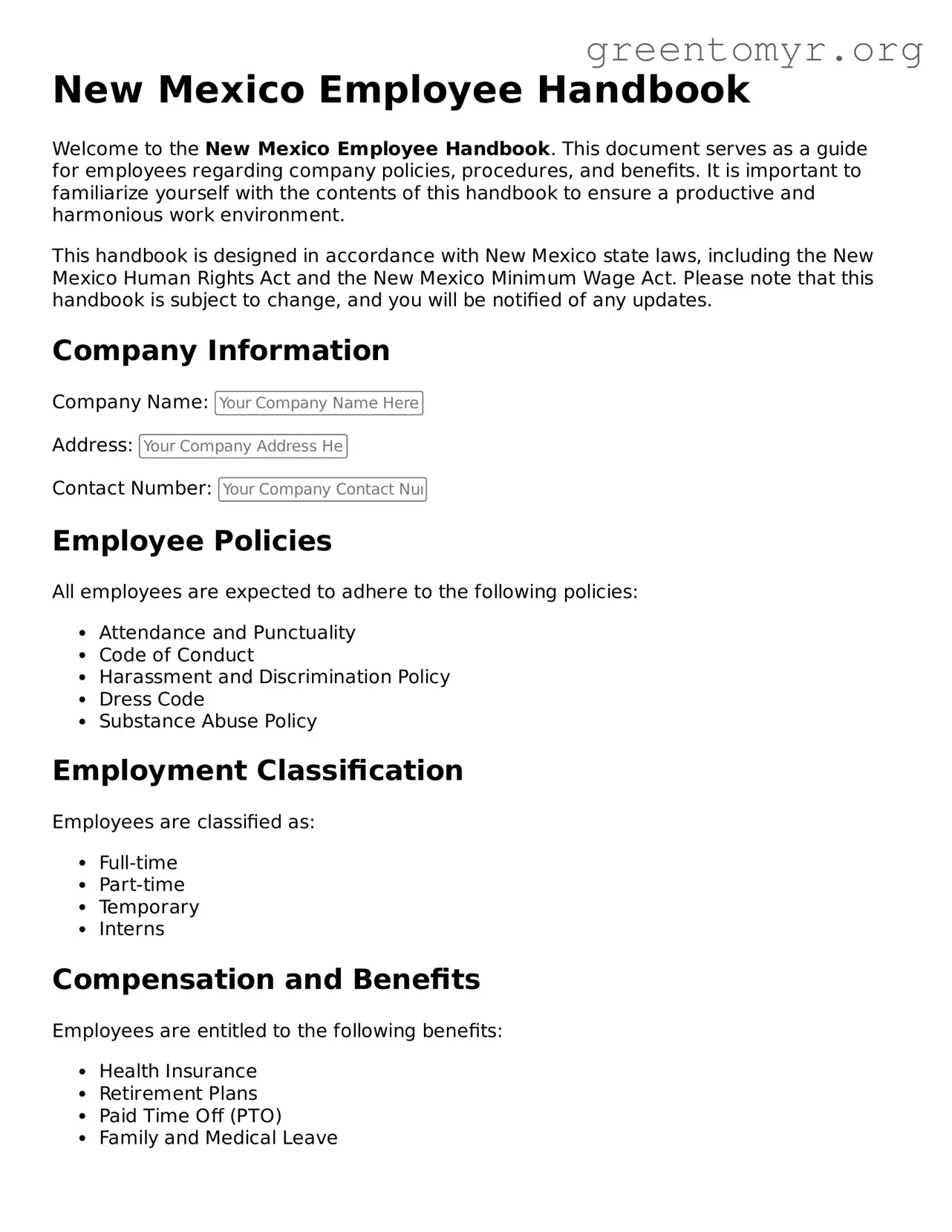
The New Mexico Employee Handbook form serves as a crucial resource for employers and employees alike, outlining essential workplace policies and procedures. This document typically includes guidelines on employee rights, workplace conduct, and company expectations. It addresses critical topics such as anti-discrimination policies, harassment prevention, and disciplinary procedures. Additionally, the form often details benefits, including leave entitlements, health insurance options, and retirement plans. By providing clear communication on these matters, the handbook helps foster a positive work environment while ensuring compliance with state and federal regulations. Employers can customize the handbook to reflect their unique culture and operational needs, making it a vital tool for both onboarding new hires and reinforcing existing policies among current staff.
New Mexico Employee Handbook
Welcome to the New Mexico Employee Handbook. This document serves as a guide for employees regarding company policies, procedures, and benefits. It is important to familiarize yourself with the contents of this handbook to ensure a productive and harmonious work environment.
This handbook is designed in accordance with New Mexico state laws, including the New Mexico Human Rights Act and the New Mexico Minimum Wage Act. Please note that this handbook is subject to change, and you will be notified of any updates.
Company Information
Company Name:
Address:
Contact Number:
Employee Policies
All employees are expected to adhere to the following policies:
Employment Classification
Employees are classified as:
Compensation and Benefits
Employees are entitled to the following benefits:
Workplace Safety
Safety is a top priority. Employees are encouraged to:
Employee Acknowledgment
I, , acknowledge that I have received and read the New Mexico Employee Handbook. I understand the policies and procedures outlined herein.
Employee Signature: ____________________
Date: ____________________
| Fact Name | Description |
|---|---|
| Purpose | The New Mexico Employee Handbook serves as a guide for employees regarding company policies and procedures. |
| Governing Law | The handbook is governed by New Mexico state employment laws, including the New Mexico Human Rights Act. |
| Mandatory Policies | |
| At-Will Employment | The handbook should clarify that employment is at-will, meaning either party can terminate the employment relationship at any time. |
| Employee Rights | It must inform employees of their rights under state and federal law, including wage and hour laws. |
| Updates | Employers should regularly update the handbook to reflect changes in laws and company policies. |
| Distribution | The handbook should be distributed to all employees upon hiring and made accessible thereafter. |
| Acknowledgment | Employees may be required to sign an acknowledgment form confirming they have received and understood the handbook. |
| Review Process | Employers should periodically review the handbook to ensure compliance with legal requirements and organizational standards. |
| Legal Disclaimer | A disclaimer stating that the handbook is not a contract of employment should be included to prevent misunderstandings. |
Filling out the New Mexico Employee Handbook form is an important step in ensuring that you understand your rights and responsibilities as an employee. Once you have completed the form, it will be reviewed by your employer, and you will receive further instructions on any next steps.
The New Mexico Employee Handbook form is a document that outlines the policies, procedures, and expectations of an employer for their employees. It serves as a guide to help employees understand their rights and responsibilities within the workplace. This form can cover various topics, including workplace conduct, benefits, and disciplinary procedures. It is essential for both employers and employees to have a clear understanding of the contents of the handbook.
An Employee Handbook is crucial for several reasons:
The Employee Handbook should be distributed to employees in a manner that ensures they receive and understand its contents. Common methods include:
Employers should also require employees to sign an acknowledgment form confirming they have received and read the handbook.
Regular updates to the Employee Handbook are essential to reflect changes in laws, company policies, or industry standards. It is advisable to review the handbook at least annually. Significant changes in legislation or company structure may necessitate immediate revisions. Keeping the handbook current helps ensure that employees have access to the most accurate and relevant information.
Filling out the New Mexico Employee Handbook form can be straightforward, but many people make common mistakes that can lead to confusion later. One frequent error is not reading the instructions carefully. Each section of the form has specific requirements. Skipping over these can result in incomplete or incorrect submissions.
Another mistake is failing to provide accurate personal information. It’s essential to double-check names, addresses, and contact numbers. Mistakes in this area can lead to issues with communication or benefits down the line.
Some individuals neglect to update their information when circumstances change. For example, if you move or change your phone number, it’s crucial to inform your employer promptly. Outdated information can hinder important notifications or updates.
Many people also forget to sign and date the form. An unsigned form may not be considered valid, which can create complications. Always remember to provide your signature and the date before submitting.
Another common error is not asking questions when something is unclear. If a section of the form is confusing, seeking clarification is important. Ignoring confusion can lead to mistakes that could have been easily avoided.
Some individuals may overlook the importance of reviewing the entire form before submission. Taking a moment to go through each section can catch errors and ensure that everything is accurate. This step can save time and prevent future problems.
Another mistake is submitting the form without keeping a copy for personal records. Having a copy can be useful for future reference or if any issues arise later. It’s always a good idea to keep track of important documents.
People sometimes fail to check for deadlines. Each employer may have specific timelines for submitting the Employee Handbook form. Missing these deadlines can lead to complications or delays in your employment process.
Lastly, some individuals may not take the time to understand the policies outlined in the Employee Handbook. It’s crucial to familiarize yourself with these policies, as they provide important information about your rights and responsibilities as an employee.
The New Mexico Employee Handbook is an essential document for any business. It outlines company policies, procedures, and expectations for employees. Along with this handbook, several other forms and documents are often utilized to ensure compliance and clarity in the workplace. Below is a list of related documents that can enhance employee understanding and company operations.
Utilizing these documents alongside the New Mexico Employee Handbook can foster a clearer understanding of employee roles and responsibilities. Ensuring all forms are in place and properly managed is crucial for maintaining a professional work environment.
Company Policies Manual: This document outlines the rules and regulations that govern employee behavior and expectations within the workplace, similar to the Employee Handbook, which serves a similar purpose.
Onboarding Guide: This guide provides new employees with essential information about the company culture, procedures, and resources, much like the Employee Handbook, which also aims to orient new hires.
Code of Conduct: This document specifies the ethical standards and professional behavior expected from employees, paralleling the Employee Handbook's focus on workplace conduct.
Safety Manual: This manual details safety protocols and emergency procedures, akin to the Employee Handbook, which may include sections on workplace safety and health.
Benefits Guide: This document explains employee benefits and compensation packages, similar to how the Employee Handbook addresses benefits available to staff.
Performance Review Guidelines: These guidelines outline the performance evaluation process, much like the Employee Handbook, which may describe how employee performance is assessed.
Leave of Absence Policy: This policy details the procedures and eligibility for taking leave, resembling the Employee Handbook's section on time off and leave policies.
Grievance Procedure Document: This document outlines the steps employees should take to report issues or concerns, similar to the Employee Handbook, which often includes grievance procedures.
Training Manual: This manual provides information on employee training programs and development opportunities, reflecting the Employee Handbook's emphasis on employee growth and training.
When filling out the New Mexico Employee Handbook form, it is important to follow specific guidelines to ensure accuracy and compliance. Here is a list of what to do and what to avoid:
When it comes to the New Mexico Employee Handbook form, there are several misconceptions that can lead to confusion. Understanding these misconceptions can help employees and employers alike navigate the handbook more effectively.
Many believe that creating an employee handbook is not necessary. However, having a handbook is crucial for outlining workplace policies and expectations. It serves as a reference point for both employees and management.
Some think that employee handbooks can be one-size-fits-all. In reality, each handbook should be tailored to the specific needs of the organization, considering industry standards and state laws.
There is a common belief that the handbook constitutes a contract between the employer and employee. While it provides guidelines, it typically includes disclaimers stating that employment is at-will, meaning either party can terminate the employment relationship at any time.
Some employees may feel that reading the handbook is unnecessary. However, it is important for employees to familiarize themselves with the policies and procedures outlined in the handbook to understand their rights and responsibilities.
Many assume that once a handbook is created, it does not need to be updated. In truth, regular reviews and updates are essential to ensure compliance with changing laws and to reflect new company policies.
Filling out and using the New Mexico Employee Handbook form is an important step for both employers and employees. Here are some key takeaways to keep in mind:
By keeping these points in mind, you can effectively fill out and utilize the New Mexico Employee Handbook form, ensuring a smoother workplace experience for everyone involved.