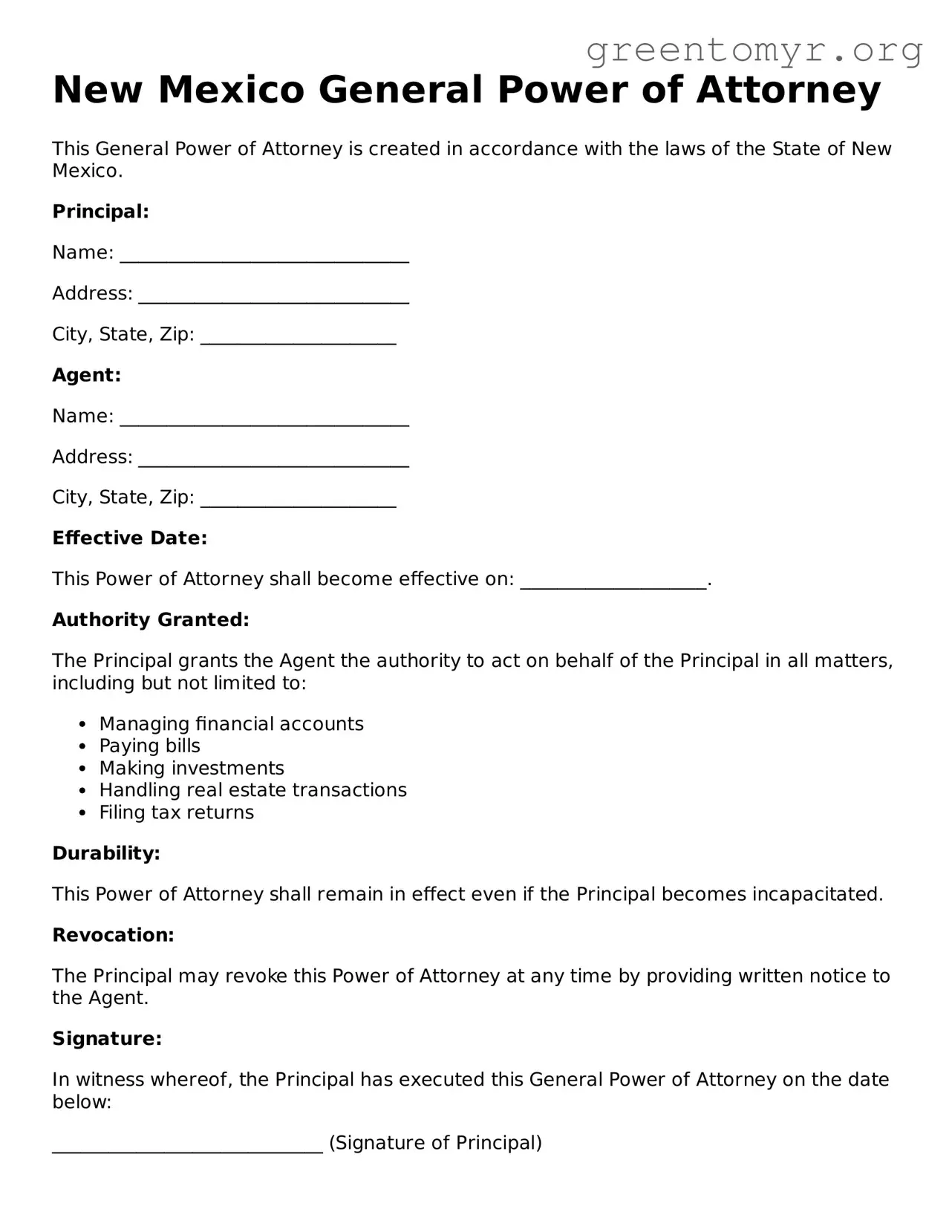
The New Mexico General Power of Attorney form is a vital legal document that allows individuals to appoint someone they trust to manage their financial and legal affairs. This form grants broad authority to the designated agent, enabling them to make decisions regarding property transactions, banking, and other financial matters on behalf of the principal. It is important to note that the powers granted can be customized, allowing the principal to specify which powers the agent will have. The form also includes provisions for revocation, ensuring that the principal can terminate the agent's authority at any time, should circumstances change. Additionally, the General Power of Attorney can remain effective even if the principal becomes incapacitated, making it a crucial tool for long-term planning. Understanding the implications of this form is essential for anyone considering delegating their decision-making authority to another individual.
New Mexico General Power of Attorney
This General Power of Attorney is created in accordance with the laws of the State of New Mexico.
Principal:
Name: _______________________________
Address: _____________________________
City, State, Zip: _____________________
Agent:
Name: _______________________________
Address: _____________________________
City, State, Zip: _____________________
Effective Date:
This Power of Attorney shall become effective on: ____________________.
Authority Granted:
The Principal grants the Agent the authority to act on behalf of the Principal in all matters, including but not limited to:
Durability:
This Power of Attorney shall remain in effect even if the Principal becomes incapacitated.
Revocation:
The Principal may revoke this Power of Attorney at any time by providing written notice to the Agent.
Signature:
In witness whereof, the Principal has executed this General Power of Attorney on the date below:
_____________________________ (Signature of Principal)
Date: ______________________
Witnesses:
Notary Public:
State of New Mexico
County of ______________________
Subscribed and sworn to before me this _____ day of __________, 20__.
_____________________________ (Notary Public Signature)
My Commission Expires: ____________
| Fact Name | Description |
|---|---|
| Definition | A New Mexico General Power of Attorney form allows an individual (the principal) to designate another person (the agent) to make decisions on their behalf. |
| Governing Law | This form is governed by the New Mexico Uniform Power of Attorney Act, specifically NMSA 1978, Chapter 46B. |
| Durability | The power of attorney can be durable, meaning it remains effective even if the principal becomes incapacitated, unless specified otherwise. |
| Agent's Authority | The agent can be granted broad or limited powers, depending on the principal’s preferences outlined in the document. |
| Revocation | The principal can revoke the power of attorney at any time, provided they are mentally competent to do so. |
| Witness Requirement | The form must be signed in the presence of a notary public, ensuring the authenticity of the principal's signature. |
| Financial Decisions | Agents can manage financial matters, including banking, property transactions, and tax filings, if given such authority. |
| Healthcare Decisions | While primarily for financial matters, a separate healthcare power of attorney is recommended for medical decisions. |
| Filing Requirements | No filing is required with the court for the general power of attorney; however, it should be kept in a safe place and shared with relevant parties. |
Once you have your New Mexico General Power of Attorney form ready, you will need to fill it out accurately to ensure it serves its intended purpose. This form allows you to designate someone to act on your behalf in various matters. Follow the steps below to complete the form correctly.
Completing the New Mexico General Power of Attorney form is a straightforward process when you follow these steps. Ensure that all information is accurate and that you understand the powers you are granting. This careful approach will help avoid any complications in the future.
A General Power of Attorney (GPOA) in New Mexico is a legal document that allows one person, known as the principal, to appoint another person, called the agent, to act on their behalf. This authority can encompass a wide range of financial and legal decisions, enabling the agent to manage the principal's affairs when they are unable to do so themselves.
The powers granted in a General Power of Attorney can include, but are not limited to:
It is essential for the principal to clearly outline the specific powers they wish to grant to the agent in the document.
To create a General Power of Attorney in New Mexico, the principal must follow these steps:
Yes, in New Mexico, the General Power of Attorney must be signed in front of a notary public to be considered valid. This notarization serves to verify the identity of the principal and confirms that they are signing the document willingly.
Yes, a General Power of Attorney can be revoked at any time by the principal as long as they are mentally competent. To revoke the document, the principal should create a written notice of revocation and provide it to the agent and any relevant institutions. It is advisable to also destroy any copies of the original document to prevent confusion.
If the principal becomes incapacitated, the General Power of Attorney remains in effect unless it is specifically stated that it becomes invalid upon incapacity. This means the agent can continue to act on behalf of the principal. However, for healthcare decisions, a separate document, such as an advance directive, may be necessary.
Yes, the principal can impose limitations on the powers granted in the General Power of Attorney. For example, they may restrict the agent from selling certain assets or limit the authority to specific transactions. It is important to clearly outline these limitations in the document to avoid any misunderstandings.
No, a General Power of Attorney and a Durable Power of Attorney are not the same. A Durable Power of Attorney remains effective even if the principal becomes incapacitated, while a General Power of Attorney may become invalid in such circumstances unless specified otherwise. It is crucial for individuals to understand the differences when deciding which document to create.
When filling out the New Mexico General Power of Attorney form, individuals often overlook critical details that can lead to complications down the line. One common mistake is failing to specify the powers granted to the agent. It’s essential to clearly outline what decisions your agent can make on your behalf. Without this clarity, there may be confusion or disputes regarding the agent's authority.
Another frequent error is not signing the document correctly. In New Mexico, the principal must sign the form in the presence of a notary public. If the signature is missing or improperly witnessed, the document may not be considered valid. Always double-check that all required signatures are in place before finalizing the form.
People also tend to neglect to date the document. A missing date can create uncertainty about when the power of attorney takes effect. This oversight can complicate matters, especially if there are questions about the principal's capacity or the timing of decisions made by the agent.
Some individuals mistakenly believe that a power of attorney remains valid indefinitely. In reality, it can be revoked or become invalid under certain circumstances, such as the principal's death or if the principal becomes incapacitated without a durable provision. It’s important to understand these limitations to avoid potential issues.
Additionally, failing to communicate with the designated agent is a common pitfall. It’s crucial to discuss your wishes and expectations with the person you choose to act on your behalf. Without this conversation, the agent may not fully understand your intentions, leading to decisions that do not align with your wishes.
Lastly, many people forget to keep copies of the completed form. Retaining copies ensures that both the principal and the agent have access to the document when needed. This can prevent misunderstandings and help facilitate smoother transactions when the power of attorney is invoked.
The New Mexico General Power of Attorney form is an essential legal document that allows one person to grant another the authority to act on their behalf in various matters. However, it is often accompanied by other forms and documents that further clarify or enhance the powers granted. Below is a list of several important documents that may be used in conjunction with the General Power of Attorney.
Understanding these accompanying documents is crucial for anyone considering a General Power of Attorney in New Mexico. Each form plays a unique role in ensuring that an individual’s wishes are honored and that their affairs are managed effectively. Careful planning and the right documentation can provide significant peace of mind for both the principal and their loved ones.
When filling out the New Mexico General Power of Attorney form, it is important to follow specific guidelines to ensure the document is valid and meets your needs. Below is a list of things you should and shouldn't do during this process.
Many people have misunderstandings about the New Mexico General Power of Attorney form. Here are some common misconceptions:
While the General Power of Attorney is often associated with financial decisions, it can also cover health care and other personal matters if specified. The scope depends on what the principal chooses to include.
This is not always true. A General Power of Attorney can be made durable, meaning it remains in effect even if the principal becomes incapacitated. If durability is not specified, it will end upon incapacity.
While you can choose anyone you trust as your agent, they must be an adult and legally capable of making decisions. It is advisable to select someone who understands your wishes and can act in your best interest.
A General Power of Attorney can be revoked at any time by the principal, as long as they are competent. This allows for flexibility in changing agents or decisions as circumstances evolve.
While it is wise to specify certain powers, the form often includes general language that grants broad authority. However, listing specific powers can help clarify the agent's responsibilities.
People of all ages can benefit from having a General Power of Attorney. Unexpected events can happen at any age, making it important to have a plan in place for decision-making.
A General Power of Attorney and a Will serve different purposes. The former allows someone to make decisions on your behalf while you are alive, whereas a Will dictates how your assets will be distributed after your death.
When considering the New Mexico General Power of Attorney form, there are several important points to keep in mind. Here are key takeaways to help you navigate the process effectively:
By keeping these points in mind, you can ensure that your General Power of Attorney serves your needs effectively and provides peace of mind for you and your loved ones.