The New Mexico Hold Harmless Agreement form serves as an important legal document that outlines the responsibilities and liabilities between parties involved in various activities or transactions. This form is particularly relevant in situations where one party agrees to protect another from potential legal claims or damages that may arise during the execution of a specific task or event. By signing this agreement, individuals or organizations commit to assuming the risk associated with their actions, thereby shielding the other party from financial loss or legal repercussions. Key aspects of the form include clear definitions of the parties involved, a detailed description of the activities covered, and the extent of liability that is being waived. Additionally, the agreement often includes provisions regarding indemnification, which means that one party agrees to compensate the other for any losses incurred. Understanding the implications of this form is essential for anyone looking to engage in activities that may carry inherent risks, as it establishes a framework for accountability and protection for all parties involved.
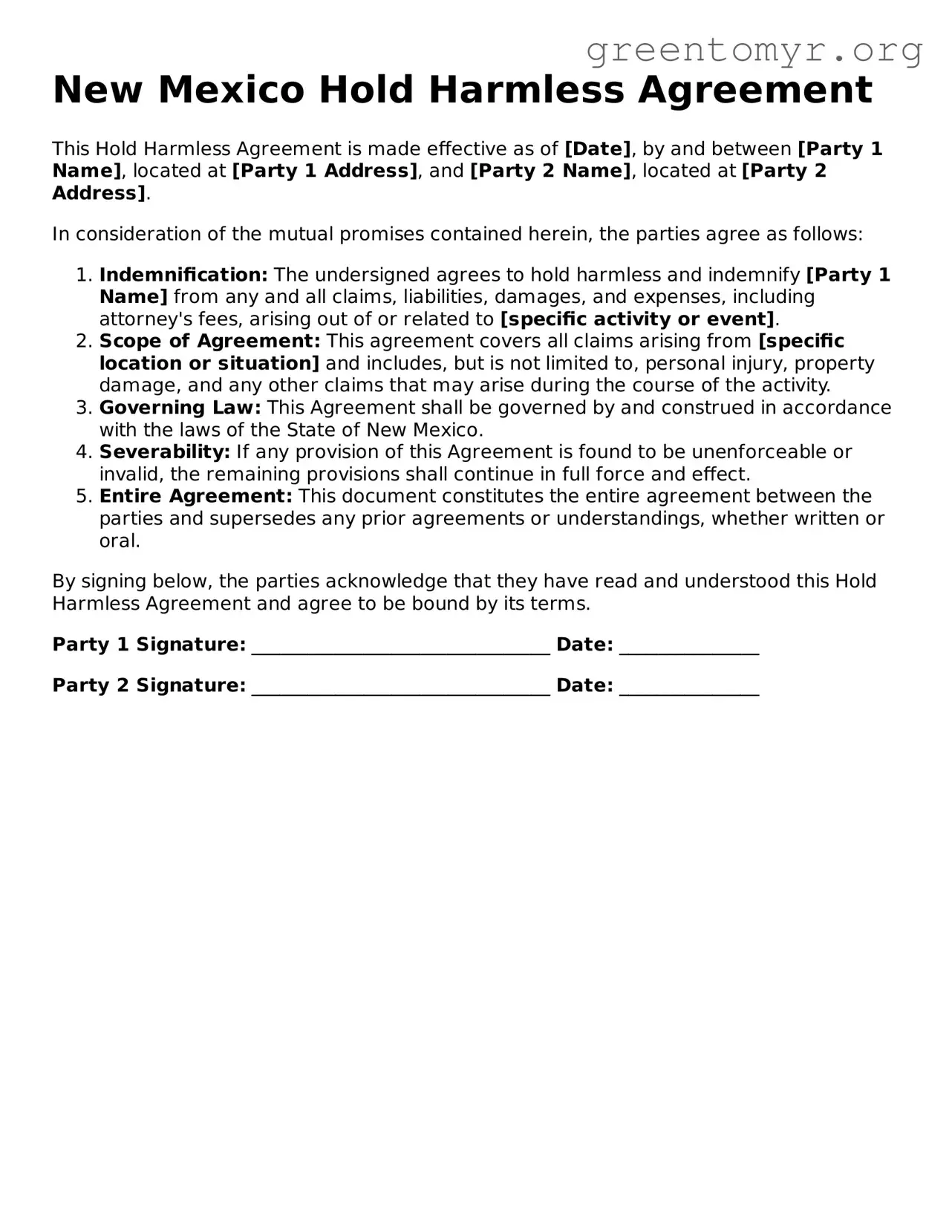
New Mexico Hold Harmless Agreement
This Hold Harmless Agreement is made effective as of [Date], by and between [Party 1 Name], located at [Party 1 Address], and [Party 2 Name], located at [Party 2 Address].
In consideration of the mutual promises contained herein, the parties agree as follows:
By signing below, the parties acknowledge that they have read and understood this Hold Harmless Agreement and agree to be bound by its terms.
Party 1 Signature: ________________________________ Date: _______________
Party 2 Signature: ________________________________ Date: _______________
| Fact Name | Description |
|---|---|
| Purpose | The New Mexico Hold Harmless Agreement is designed to protect parties from liability for injuries or damages that may occur during certain activities. |
| Governing Law | This agreement is governed by the laws of the State of New Mexico. |
| Parties Involved | Typically, this agreement involves at least two parties: the indemnitor (the party providing protection) and the indemnitee (the party being protected). |
| Common Uses | It is often used in situations involving events, property use, or activities where there is a risk of injury. |
| Legal Enforceability | When properly executed, the agreement is generally enforceable in a court of law, provided it meets specific legal requirements. |
| Clarity of Terms | Clear and specific language is essential in the agreement to ensure all parties understand their rights and obligations. |
| Limitations | The agreement may not protect against gross negligence or willful misconduct, depending on state laws. |
| Written Form | A written agreement is recommended to provide clear evidence of the terms agreed upon by both parties. |
| Signature Requirement | Both parties should sign the agreement for it to be valid and enforceable. |
| Review by Legal Counsel | It is advisable for parties to seek legal counsel before signing to ensure the agreement meets their needs and complies with state law. |
Completing the New Mexico Hold Harmless Agreement form is a straightforward process. After filling out the form, ensure that all information is accurate and that it is signed appropriately. This agreement may be required for various activities, so it’s important to follow the instructions carefully.
A Hold Harmless Agreement is a legal document that protects one party from liability for certain actions or events. In New Mexico, these agreements are often used in various contexts, such as construction projects, events, or property rentals. By signing this agreement, one party agrees not to hold the other responsible for any damages or injuries that may occur during the specified activity.
Using a Hold Harmless Agreement can provide peace of mind. It clarifies the responsibilities of each party involved and helps prevent legal disputes. For instance, if an injury occurs at an event, the agreement can protect the event organizer from being held liable, provided the terms are clear and reasonable.
Typically, both parties involved in a transaction or activity should sign the agreement. This often includes the party providing a service or hosting an event and the party participating in that service or event. It ensures that both sides understand their rights and responsibilities.
Yes, Hold Harmless Agreements are generally enforceable in New Mexico, provided they meet certain legal criteria. The agreement must be clear, specific, and not overly broad. Courts may not enforce agreements that attempt to waive liability for gross negligence or willful misconduct.
A well-drafted Hold Harmless Agreement should include the following elements:
Yes, you can modify a Hold Harmless Agreement as long as both parties agree to the changes. It’s important to document any modifications in writing and have both parties sign the revised agreement. This helps ensure clarity and mutual understanding of the terms.
No, a Hold Harmless Agreement is not the same as liability insurance. While the agreement limits liability between parties, liability insurance provides financial protection against claims. Both tools can be used together to enhance protection against potential risks.
Enforcement typically involves demonstrating that the agreement was validly executed and that the parties understood its terms. If a dispute arises, you may need to seek legal advice or pursue a resolution through mediation or court, depending on the situation.
If one party refuses to sign, it may indicate a lack of trust or concerns about the agreement's terms. Open communication can often resolve these issues. If necessary, consider revising the terms to address any concerns. If an agreement cannot be reached, you may need to reconsider proceeding with the activity or seek alternative arrangements.
Templates for Hold Harmless Agreements can often be found online through legal websites, local government resources, or legal aid organizations. However, it is advisable to consult with a legal professional to ensure that the template meets your specific needs and complies with New Mexico laws.
Filling out the New Mexico Hold Harmless Agreement form can be a straightforward task, yet many individuals encounter pitfalls that can lead to misunderstandings or legal complications. One common mistake is failing to read the entire document thoroughly before signing. This oversight can result in a lack of understanding regarding the rights and responsibilities outlined in the agreement.
Another frequent error involves incorrect or incomplete information. Individuals may neglect to provide essential details, such as names, addresses, or dates. Inaccurate information can render the agreement unenforceable or lead to disputes about the terms agreed upon.
People often overlook the importance of specifying the scope of the agreement. Without clearly defining what activities or situations the Hold Harmless Agreement covers, parties may find themselves exposed to liability in areas not initially intended. Clarity in this regard is crucial for ensuring that all parties understand the extent of the protection being offered.
Furthermore, individuals sometimes fail to include necessary signatures. A Hold Harmless Agreement is not valid unless it is signed by all parties involved. Omitting a signature can invalidate the agreement, leaving one or more parties unprotected.
Another mistake involves misunderstanding the legal implications of the agreement. Some individuals may assume that signing a Hold Harmless Agreement absolves them of all liability, which is not always the case. It is important to recognize that while the agreement can provide significant protection, it does not eliminate all legal responsibilities.
Additionally, individuals may neglect to consult with a legal professional before completing the form. Legal advice can be invaluable in ensuring that the agreement is comprehensive and tailored to specific needs. Without such guidance, individuals may inadvertently create gaps in protection.
Moreover, failing to update the agreement when circumstances change is a common oversight. As situations evolve, the terms of the Hold Harmless Agreement may need to be revised to reflect new realities. Ignoring this can lead to outdated protections that no longer apply.
Finally, individuals sometimes rush through the process without considering the implications of the agreement. Taking the time to understand the potential consequences of signing can prevent future disputes and misunderstandings. A thoughtful approach to completing the New Mexico Hold Harmless Agreement form is essential for ensuring that all parties are adequately protected.
When engaging in agreements that involve liability, it is essential to consider various forms and documents that complement the New Mexico Hold Harmless Agreement. These documents help clarify responsibilities, protect parties involved, and ensure that all legal bases are covered. Below is a list of some commonly used forms that often accompany a Hold Harmless Agreement.
Understanding these documents and their roles can significantly enhance the effectiveness of a Hold Harmless Agreement. Each form serves a unique purpose, ensuring that all parties are adequately protected and informed throughout their interactions.
A Hold Harmless Agreement is a legal document that protects one party from liability or claims arising from another party's actions. Several other documents serve similar purposes. Here’s a list of nine documents that share similarities with the Hold Harmless Agreement:
Understanding these documents can help individuals and businesses navigate their legal responsibilities and protections more effectively.
When filling out the New Mexico Hold Harmless Agreement form, it is essential to approach the process with care. Below are some key dos and don'ts to consider.
By following these guidelines, individuals can help ensure that the Hold Harmless Agreement serves its intended purpose effectively.
The New Mexico Hold Harmless Agreement form often leads to confusion. Here are six common misconceptions about this document:
The New Mexico Hold Harmless Agreement form is a legal document that outlines the responsibilities and liabilities of parties involved in a transaction or activity. Understanding its key components is essential for effective use. Here are several important takeaways:
By understanding these key aspects, individuals and organizations can better navigate the complexities of the Hold Harmless Agreement in New Mexico.