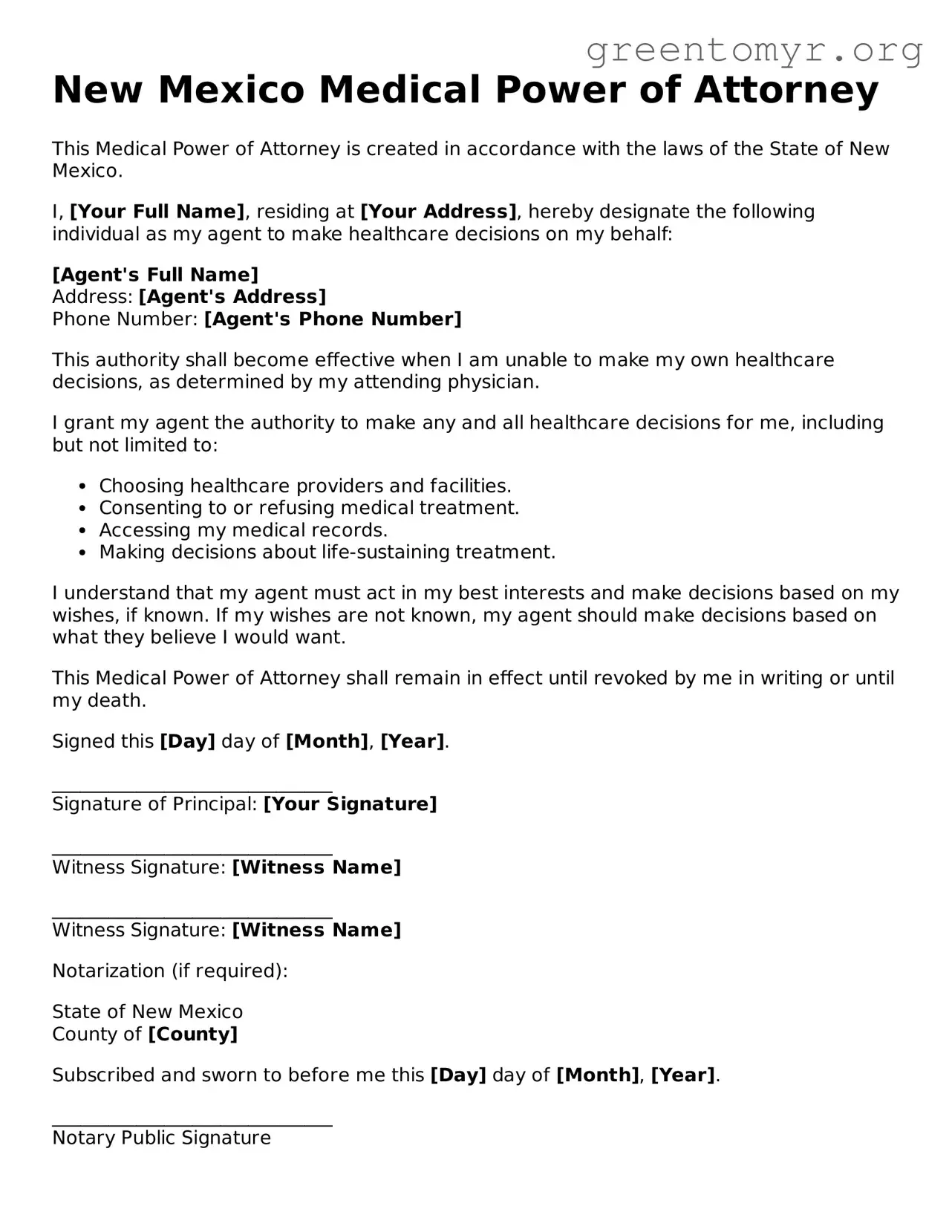
The New Mexico Medical Power of Attorney form is a crucial legal document that allows individuals to designate someone they trust to make medical decisions on their behalf in the event they become incapacitated. This form empowers the appointed agent to communicate with healthcare providers, access medical records, and make choices regarding treatment options, ensuring that the individual's healthcare preferences are honored. It is essential for individuals to consider their values and wishes when selecting an agent, as this person will play a significant role in guiding medical care during critical moments. The form must be completed, signed, and witnessed to be valid, and it can be revoked at any time as long as the individual is still capable of making decisions. Understanding the implications of this document is vital, as it not only facilitates medical decision-making but also provides peace of mind for both the individual and their loved ones. In New Mexico, specific requirements and provisions govern the execution of this form, making it important to adhere to state laws to ensure that the document holds legal weight when needed.
New Mexico Medical Power of Attorney
This Medical Power of Attorney is created in accordance with the laws of the State of New Mexico.
I, [Your Full Name], residing at [Your Address], hereby designate the following individual as my agent to make healthcare decisions on my behalf:
[Agent's Full Name]
Address: [Agent's Address]
Phone Number: [Agent's Phone Number]
This authority shall become effective when I am unable to make my own healthcare decisions, as determined by my attending physician.
I grant my agent the authority to make any and all healthcare decisions for me, including but not limited to:
I understand that my agent must act in my best interests and make decisions based on my wishes, if known. If my wishes are not known, my agent should make decisions based on what they believe I would want.
This Medical Power of Attorney shall remain in effect until revoked by me in writing or until my death.
Signed this [Day] day of [Month], [Year].
______________________________
Signature of Principal: [Your Signature]
______________________________
Witness Signature: [Witness Name]
______________________________
Witness Signature: [Witness Name]
Notarization (if required):
State of New Mexico
County of [County]
Subscribed and sworn to before me this [Day] day of [Month], [Year].
______________________________
Notary Public Signature
My commission expires: [Date]
| Fact Name | Description |
|---|---|
| Purpose | The New Mexico Medical Power of Attorney form allows individuals to designate someone to make healthcare decisions on their behalf if they become unable to do so. |
| Governing Law | This form is governed by the New Mexico Uniform Health Care Decisions Act, specifically NMSA 1978, Sections 24-7A-1 to 24-7A-18. |
| Eligibility | Any adult resident of New Mexico can create a Medical Power of Attorney. The principal must be of sound mind when signing the document. |
| Witness Requirements | The form must be signed in the presence of at least two adult witnesses, who cannot be related to the principal or be involved in the principal's healthcare. |
| Revocation | The Medical Power of Attorney can be revoked at any time by the principal, provided they communicate their decision clearly, either verbally or in writing. |
Filling out the New Mexico Medical Power of Attorney form is an important step in ensuring that your healthcare decisions are made according to your wishes. Once completed, the form will allow you to designate someone you trust to make medical decisions on your behalf if you are unable to do so. Here are the steps to fill out the form properly.
Once the form is completed, make copies for yourself, your agent, and any healthcare providers involved in your care. Store the original in a safe place where it can be easily accessed when needed.
A Medical Power of Attorney is a legal document that allows an individual to designate another person to make medical decisions on their behalf in case they become unable to do so. This document is crucial for ensuring that your healthcare preferences are respected, especially in emergencies or situations where you cannot communicate your wishes.
In New Mexico, you can choose any competent adult to act as your agent. This could be a family member, friend, or trusted advisor. However, it is important to select someone who understands your values and wishes regarding medical treatment. Additionally, your agent should be willing to take on this responsibility and be available to make decisions when needed.
Creating a Medical Power of Attorney in New Mexico involves several steps:
Yes, you can change or revoke your Medical Power of Attorney at any time as long as you are mentally competent. To revoke it, you may simply inform your agent and healthcare providers that you no longer wish for them to act on your behalf. It is advisable to create a new document if you wish to appoint a different agent or update your wishes.
If you do not have a Medical Power of Attorney and become unable to make your own medical decisions, your healthcare providers may need to rely on state laws to determine who can make decisions for you. This could lead to delays in treatment or decisions being made by individuals who may not fully understand your wishes.
While your agent can make a wide range of medical decisions, there are some limitations. For instance, your agent cannot make decisions regarding certain types of mental health treatment or refuse life-sustaining treatment if you have explicitly stated otherwise in your document. It is essential to clearly outline your preferences in the Medical Power of Attorney form to avoid confusion.
No, a Medical Power of Attorney and a Living Will serve different purposes. A Medical Power of Attorney appoints someone to make decisions on your behalf, while a Living Will outlines your preferences for medical treatment in specific situations, such as end-of-life care. Both documents can work together to ensure your healthcare wishes are honored.
Filling out the New Mexico Medical Power of Attorney form can be a daunting task. Many individuals make mistakes that can lead to complications later on. One common error is failing to choose the right agent. It is crucial to select someone who understands your wishes and can act in your best interest. This person should be trustworthy and capable of making difficult decisions under pressure.
Another mistake often made is not being specific about the medical decisions the agent can make. The form should clearly outline the types of medical treatments you do or do not want. Vague language can lead to confusion and may result in decisions that do not align with your values. Take the time to communicate your preferences clearly.
Additionally, individuals sometimes overlook the importance of signatures and witnesses. In New Mexico, the form must be signed and dated by you, the principal, and it requires the signatures of two witnesses or a notary. Failing to include these signatures can render the document invalid. Always double-check that all necessary signatures are present before submitting the form.
Finally, many people neglect to review and update their Medical Power of Attorney as circumstances change. Life events such as marriage, divorce, or the death of an agent can impact your choices. Regularly revisiting and revising the document ensures that it reflects your current wishes and that your agent is still the right choice for you.
When creating a New Mexico Medical Power of Attorney, it is beneficial to consider other related documents that can complement your healthcare planning. These documents help ensure that your medical preferences are respected and that your loved ones are well-informed about your wishes. Below are five important forms and documents often used alongside a Medical Power of Attorney.
Incorporating these documents into your healthcare planning can provide clarity and peace of mind for both you and your loved ones. By preparing ahead of time, you can ensure that your healthcare preferences are honored and that your family understands your wishes during challenging times.
The Medical Power of Attorney form shares similarities with several other legal documents that grant authority over personal and health-related decisions. Below are five documents that are comparable:
When filling out the New Mexico Medical Power of Attorney form, it is crucial to approach the process with care. Here are some key dos and don'ts to consider:
The New Mexico Medical Power of Attorney (MPOA) form is an important legal document that allows individuals to appoint someone to make healthcare decisions on their behalf if they become unable to do so. However, several misconceptions exist about this form. Here are nine common misunderstandings:
Understanding these misconceptions can help individuals make informed decisions about their healthcare planning and ensure their preferences are respected.
Filling out and utilizing the New Mexico Medical Power of Attorney form is a crucial step in ensuring your healthcare preferences are honored. Here are some key takeaways to keep in mind: