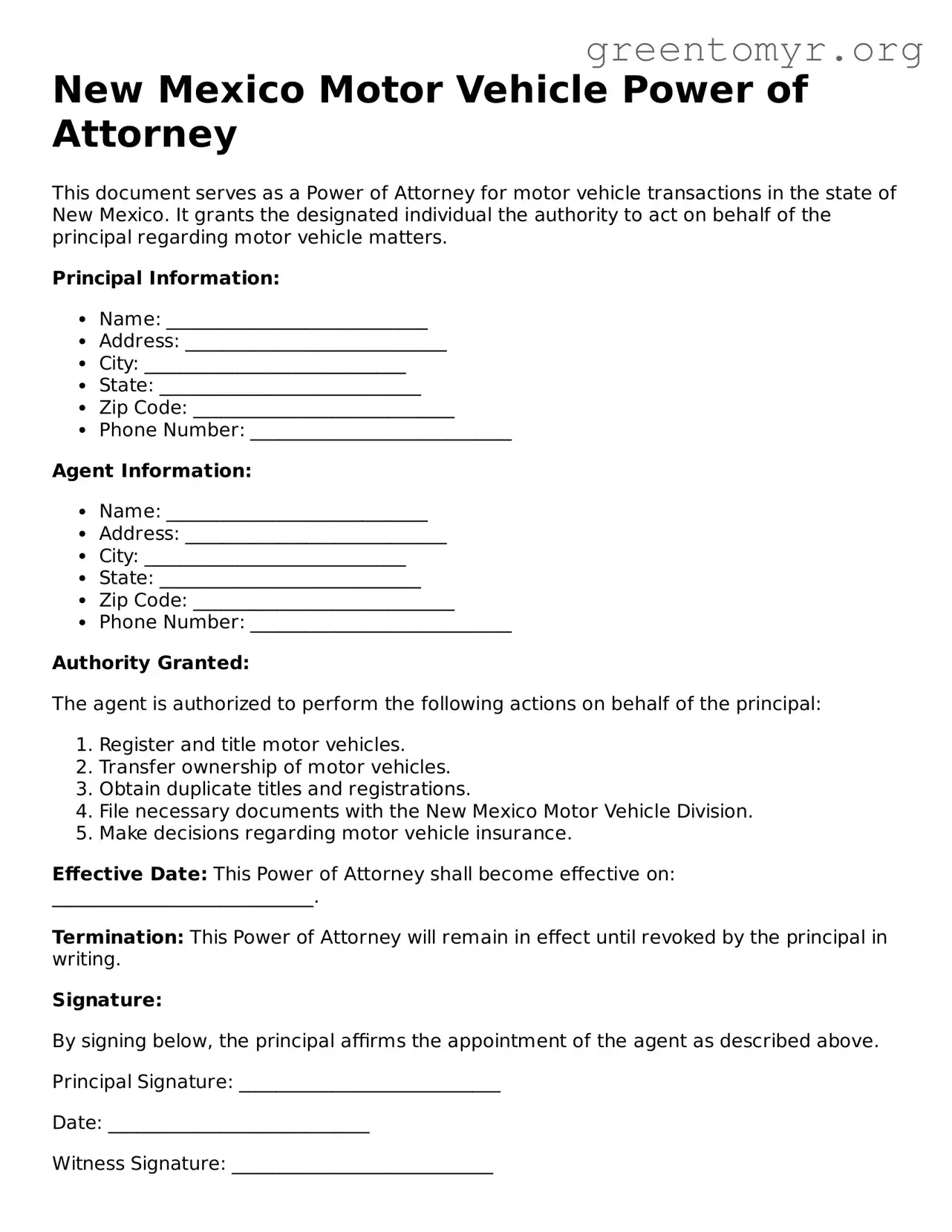
The New Mexico Motor Vehicle Power of Attorney form is a crucial document for anyone needing to delegate authority regarding motor vehicle transactions. This form allows a person, known as the principal, to appoint another individual, referred to as the agent, to act on their behalf. The agent can handle various tasks, including registering a vehicle, transferring ownership, or obtaining titles. It is essential for the principal to specify the powers granted to the agent clearly, ensuring that the agent can perform only the tasks authorized. The form must be signed by the principal and may require notarization to be legally binding. Understanding the scope and limitations of this power of attorney is vital for both parties involved, as it establishes a legal relationship built on trust and responsibility. By using this form, individuals can simplify the process of managing vehicle-related matters, especially when they are unable to do so personally due to time constraints or other obligations.
New Mexico Motor Vehicle Power of Attorney
This document serves as a Power of Attorney for motor vehicle transactions in the state of New Mexico. It grants the designated individual the authority to act on behalf of the principal regarding motor vehicle matters.
Principal Information:
Agent Information:
Authority Granted:
The agent is authorized to perform the following actions on behalf of the principal:
Effective Date: This Power of Attorney shall become effective on: ____________________________.
Termination: This Power of Attorney will remain in effect until revoked by the principal in writing.
Signature:
By signing below, the principal affirms the appointment of the agent as described above.
Principal Signature: ____________________________
Date: ____________________________
Witness Signature: ____________________________
Date: ____________________________
Notary Public:
State of New Mexico, County of ____________________________.
Subscribed and sworn to before me this _____ day of __________, 20__.
Notary Public Signature: ____________________________
My Commission Expires: ____________________________
| Fact Name | Description |
|---|---|
| Purpose | The New Mexico Motor Vehicle Power of Attorney form allows an individual to authorize another person to act on their behalf regarding motor vehicle transactions. |
| Governing Law | This form is governed by the New Mexico Statutes, specifically Section 66-3-1 NMSA 1978. |
| Signatories | Both the principal (the person granting power) and the agent (the person receiving power) must sign the form. |
| Notarization | The form must be notarized to ensure its validity and to prevent fraud. |
| Scope of Authority | The authority granted can be limited to specific transactions or can be general, covering all motor vehicle-related matters. |
| Revocation | The principal can revoke the power of attorney at any time, provided they do so in writing. |
| Duration | There is no specific expiration date unless stated in the document; it remains effective until revoked. |
| Usage | This form is commonly used for buying, selling, or transferring vehicle titles. |
| Filing Requirements | While the form itself does not need to be filed with any government entity, it should be kept in a secure location. |
| Legal Advice | Consulting with a legal professional is recommended to ensure that the form meets all legal requirements and personal needs. |
Filling out the New Mexico Motor Vehicle Power of Attorney form is a straightforward process. Once completed, this form allows you to designate someone to handle specific vehicle-related matters on your behalf. Follow these steps to ensure you fill it out correctly.
Once you have completed these steps, your form will be ready to use. Ensure the attorney-in-fact understands their responsibilities and keep a copy for your records.
The New Mexico Motor Vehicle Power of Attorney form is a legal document that allows an individual, known as the principal, to designate another person, referred to as the agent, to act on their behalf regarding motor vehicle matters. This can include tasks such as transferring ownership, registering a vehicle, or obtaining title documents. By using this form, the principal can ensure that their wishes are carried out even if they are unable to attend to these matters personally.
There are several situations where a Motor Vehicle Power of Attorney may be beneficial:
Completing the Motor Vehicle Power of Attorney form involves several straightforward steps:
After completing the form, provide a copy to your agent and keep one for your records.
The Motor Vehicle Power of Attorney form is specifically designed for use in New Mexico. While some states may recognize a power of attorney from another state, it is essential to check the specific requirements of the state where you intend to use it. To avoid complications, it may be beneficial to consult with a legal professional or obtain a power of attorney form that is tailored to the laws of the other state.
Filling out the New Mexico Motor Vehicle Power of Attorney form can be straightforward, but many people make mistakes that can lead to delays or complications. One common error is failing to provide accurate information about the vehicle. Ensure that the vehicle's make, model, year, and VIN are correct. Inaccuracies can cause issues when transferring ownership or handling other vehicle-related matters.
Another frequent mistake is neglecting to sign the form. Both the principal and the agent must sign the document. Without these signatures, the form is not valid. Double-check that all required signatures are present before submitting the form.
People often overlook the importance of specifying the powers granted to the agent. The form allows for various powers, and it is crucial to clearly outline what the agent can do on behalf of the principal. Vague language can lead to misunderstandings and disputes later on.
Many individuals also forget to date the form. A date is essential as it indicates when the powers were granted. Without a date, the authority of the agent may be questioned, leading to potential legal issues.
Another mistake involves not providing adequate identification for both the principal and the agent. It is advisable to include copies of valid identification to verify identities. This step adds an extra layer of security and helps avoid complications.
Some people fail to notify the agent about their appointment. It is important that the agent knows they have been granted power of attorney. If the agent is unaware, they cannot act on behalf of the principal when needed.
Another common error is not keeping a copy of the completed form. Retaining a copy ensures that both the principal and the agent have access to the document if questions arise in the future. It serves as a reference for the powers granted and the terms of the agreement.
In addition, individuals sometimes forget to check for any local requirements. While the New Mexico form is standardized, local jurisdictions may have specific rules or additional documentation needed. Researching these requirements can prevent delays.
Some people also make the mistake of using outdated forms. Ensure that you are using the most current version of the New Mexico Motor Vehicle Power of Attorney form. Using an outdated form can lead to rejection by the motor vehicle department.
Lastly, many individuals do not seek assistance when needed. If there is any uncertainty about how to fill out the form correctly, it is wise to consult a professional. Taking the time to ensure accuracy can save significant trouble down the line.
When dealing with the New Mexico Motor Vehicle Power of Attorney form, several other documents may be necessary to ensure a smooth transaction. Each of these documents serves a specific purpose and can help clarify the authority granted to the agent. Below are four commonly used forms that often accompany the Power of Attorney.
Understanding these documents can simplify the process of managing vehicle transactions in New Mexico. Each form plays a crucial role in ensuring legal compliance and protecting the interests of all parties involved.
When filling out the New Mexico Motor Vehicle Power of Attorney form, attention to detail is crucial. Here are six important do's and don'ts to ensure the process goes smoothly.
By following these guidelines, you can help ensure that your Power of Attorney form is filled out correctly and efficiently.
The New Mexico Motor Vehicle Power of Attorney form is often misunderstood. Below are some common misconceptions along with clarifications to help individuals navigate this important document.
This is incorrect. While the form is commonly used for vehicle sales, it can also authorize someone to handle other motor vehicle-related tasks, such as registration and title transfers.
In reality, individuals can fill out the form themselves. It is designed to be user-friendly, allowing vehicle owners to appoint an agent without legal representation.
Notarization is not a requirement for the New Mexico Motor Vehicle Power of Attorney form. However, having it notarized can add an extra layer of authenticity.
This is false. Any trusted individual, whether a family member or a friend, can be designated as an agent. It is essential that the person chosen is reliable.
The validity of the form depends on the specific terms outlined within it. If no expiration date is stated, it remains in effect until the vehicle owner revokes it.
This is not true. Vehicle owners have the right to revoke the Power of Attorney at any time, provided they follow the proper procedures for doing so.
While it is primarily designed for use within New Mexico, it may also be accepted in other states, depending on local laws and regulations.
On the contrary, the process is straightforward. With clear instructions, individuals can efficiently complete the form without unnecessary complications.
When dealing with the New Mexico Motor Vehicle Power of Attorney form, there are several important points to keep in mind. This form allows one person to authorize another to act on their behalf regarding motor vehicle matters. Here are key takeaways:
By following these steps, you can effectively use the New Mexico Motor Vehicle Power of Attorney form to manage your vehicle-related needs.