Content Navigation

In New Mexico, the Non-disclosure Agreement (NDA) form plays a crucial role in protecting sensitive information shared between parties. This legal document is often used in business settings, where confidentiality is paramount. It establishes a clear understanding of what information must remain private, detailing the obligations of each party involved. The NDA outlines the specific types of information considered confidential, such as trade secrets, business plans, or proprietary data. Additionally, it sets the duration of the confidentiality obligation, which can vary depending on the nature of the information shared. By signing this agreement, parties can foster trust and encourage open communication, knowing that their valuable information is safeguarded. Understanding the key elements of the New Mexico NDA form is essential for anyone looking to navigate business relationships while protecting their intellectual property and sensitive data.

New Mexico Non-disclosure Agreement Example

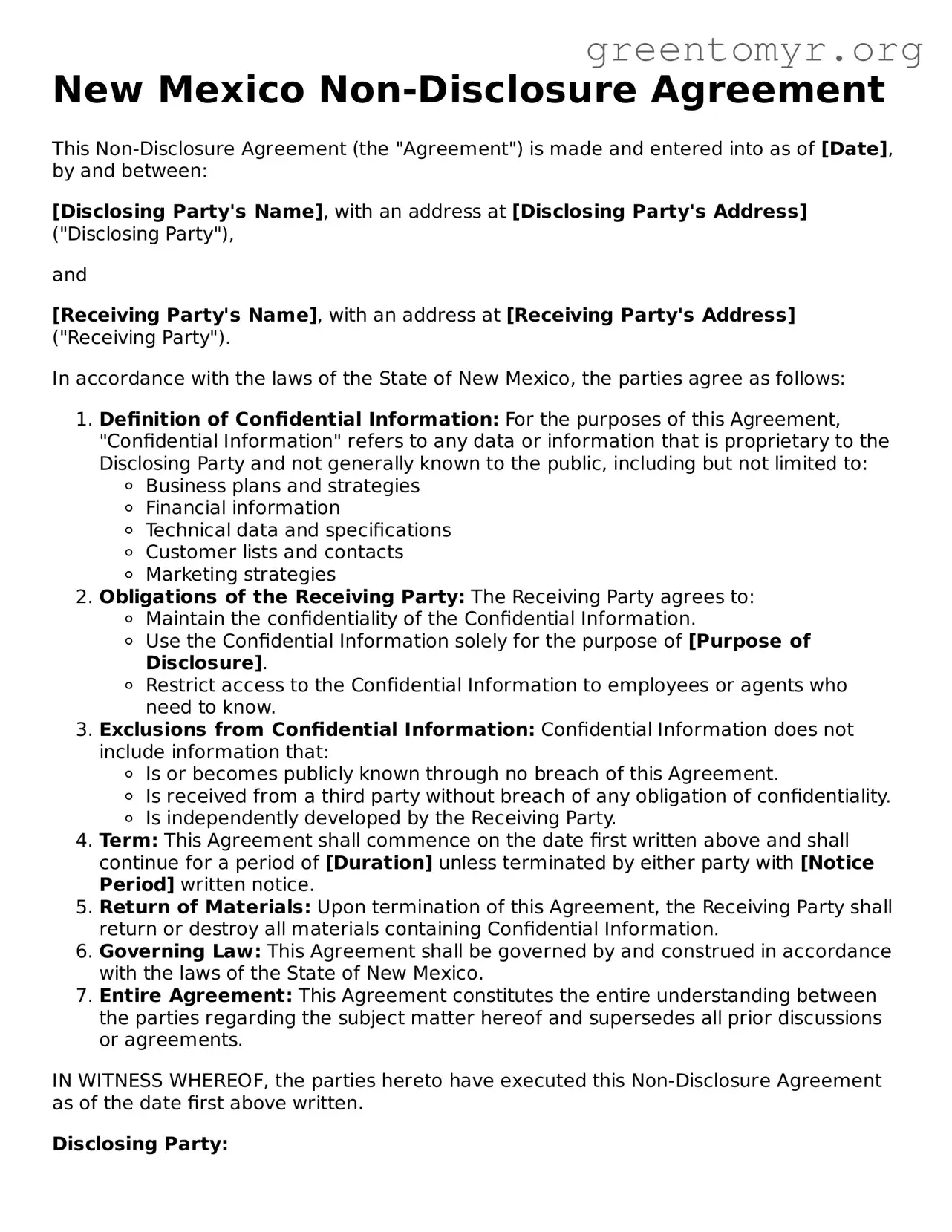
New Mexico Non-Disclosure Agreement

This Non-Disclosure Agreement (the "Agreement") is made and entered into as of [Date], by and between:

[Disclosing Party's Name], with an address at [Disclosing Party's Address] ("Disclosing Party"),

and

[Receiving Party's Name], with an address at [Receiving Party's Address] ("Receiving Party").

In accordance with the laws of the State of New Mexico, the parties agree as follows:

  1. Definition of Confidential Information: For the purposes of this Agreement, "Confidential Information" refers to any data or information that is proprietary to the Disclosing Party and not generally known to the public, including but not limited to:
    • Business plans and strategies
    • Financial information
    • Technical data and specifications
    • Customer lists and contacts
    • Marketing strategies
  2. Obligations of the Receiving Party: The Receiving Party agrees to:
    • Maintain the confidentiality of the Confidential Information.
    • Use the Confidential Information solely for the purpose of [Purpose of Disclosure].
    • Restrict access to the Confidential Information to employees or agents who need to know.
  3. Exclusions from Confidential Information: Confidential Information does not include information that:
    • Is or becomes publicly known through no breach of this Agreement.
    • Is received from a third party without breach of any obligation of confidentiality.
    • Is independently developed by the Receiving Party.
  4. Term: This Agreement shall commence on the date first written above and shall continue for a period of [Duration] unless terminated by either party with [Notice Period] written notice.
  5. Return of Materials: Upon termination of this Agreement, the Receiving Party shall return or destroy all materials containing Confidential Information.
  6. Governing Law: This Agreement shall be governed by and construed in accordance with the laws of the State of New Mexico.
  7. Entire Agreement: This Agreement constitutes the entire understanding between the parties regarding the subject matter hereof and supersedes all prior discussions or agreements.

IN WITNESS WHEREOF, the parties hereto have executed this Non-Disclosure Agreement as of the date first above written.

Disclosing Party:

___________________________

[Name and Title]

Receiving Party:

___________________________

[Name and Title]

PDF Form Features

Fact Name Description
Definition A Non-disclosure Agreement (NDA) in New Mexico is a legal contract that protects confidential information shared between parties.
Governing Law The NDA is governed by the laws of the State of New Mexico, specifically under the Uniform Trade Secrets Act.
Parties Involved Typically, an NDA involves at least two parties: the disclosing party and the receiving party.
Duration of Confidentiality The duration for which the information must remain confidential is specified in the agreement, often ranging from one to five years.
Enforcement If a breach occurs, the injured party may seek legal remedies, including injunctions and damages, under New Mexico law.

Guide to Using New Mexico Non-disclosure Agreement

Completing the New Mexico Non-disclosure Agreement form is an important step in protecting sensitive information. Once you have filled out the form correctly, you can proceed to have both parties sign it, ensuring that the agreement is legally binding.

  1. Download the Form: Obtain the New Mexico Non-disclosure Agreement form from a reliable source, such as a legal website or local government office.
  2. Read the Instructions: Familiarize yourself with any specific instructions provided with the form to ensure accurate completion.
  3. Identify the Parties: Fill in the names and addresses of both parties involved in the agreement. This typically includes the disclosing party and the receiving party.
  4. Define Confidential Information: Clearly outline what constitutes confidential information in the agreement. Be specific to avoid ambiguity.
  5. Specify the Purpose: Indicate the purpose for which the confidential information will be shared. This helps clarify the context of the agreement.
  6. Set the Duration: Determine how long the confidentiality obligations will last. This can be a specific time frame or tied to certain events.
  7. Review the Terms: Carefully read through all the terms and conditions outlined in the form. Make sure everything is clear and acceptable to both parties.
  8. Sign the Agreement: Both parties should sign and date the agreement. Ensure that each party receives a copy for their records.

Get Answers on New Mexico Non-disclosure Agreement

What is a Non-disclosure Agreement (NDA) in New Mexico?

A Non-disclosure Agreement (NDA) is a legally binding contract that establishes a confidential relationship between parties. In New Mexico, it is commonly used to protect sensitive information from being disclosed to unauthorized individuals or entities. NDAs can be used in various contexts, including business transactions, employment relationships, and collaborations.

Who typically uses NDAs in New Mexico?

NDAs are utilized by a variety of individuals and organizations, including:

  • Businesses sharing proprietary information with potential partners or investors.
  • Employers requiring employees to protect company secrets.
  • Freelancers and contractors working with clients who have confidential information.

What information can be protected under an NDA?

Generally, an NDA can protect any information that is deemed confidential. This may include:

  1. Trade secrets
  2. Business plans
  3. Financial information
  4. Customer lists
  5. Product designs

However, information that is publicly available or already known to the receiving party is typically not covered.

How long does an NDA last in New Mexico?

The duration of an NDA can vary based on the agreement between the parties. Many NDAs specify a time frame, which can range from a few years to indefinitely. It is essential to clearly outline the duration in the agreement to avoid confusion in the future.

What are the consequences of breaching an NDA?

Breaching an NDA can result in several consequences, including:

  • Legal action, which may lead to monetary damages.
  • Injunctions to prevent further disclosure of information.
  • Loss of business relationships and reputation.

Parties should take the terms of the NDA seriously to avoid these potential outcomes.

Can an NDA be modified after it is signed?

Yes, an NDA can be modified, but both parties must agree to the changes. Modifications should be documented in writing and signed by both parties to ensure clarity and enforceability. Verbal agreements regarding changes may not hold up in a legal context.

Is it necessary to have a lawyer review an NDA in New Mexico?

While it is not legally required, having a lawyer review an NDA is highly recommended. A legal professional can help ensure that the agreement is clear, enforceable, and tailored to the specific needs of the parties involved. This can prevent potential disputes and misunderstandings in the future.

Common mistakes

Filling out a Non-disclosure Agreement (NDA) in New Mexico can seem straightforward, but there are common pitfalls that individuals often encounter. One significant mistake is failing to clearly define the confidential information. Many people assume that the term "confidential information" is self-explanatory, but it is crucial to specify what exactly is considered confidential. Without a clear definition, misunderstandings may arise, leading to disputes down the line.

Another frequent error is neglecting to identify the parties involved adequately. When individuals do not provide full names and contact information, it can create confusion about who is bound by the agreement. This oversight can undermine the effectiveness of the NDA, as it may be difficult to enforce the terms if the parties are not clearly identified.

Many individuals also overlook the importance of including a time frame for the confidentiality obligations. An NDA should specify how long the information must remain confidential. Without this timeframe, the agreement may lack clarity, leaving parties uncertain about their responsibilities. This uncertainty can lead to potential breaches of the agreement and legal complications.

Additionally, people often forget to consider the consequences of breaching the NDA. While it may seem obvious that there would be repercussions, explicitly outlining these consequences in the agreement is essential. This clarity not only serves as a deterrent against breaches but also provides a clear course of action should a violation occur.

Lastly, individuals may rush through the signing process without fully understanding the terms of the agreement. It is vital to read and comprehend each section of the NDA before signing. Ignoring this step can lead to unintended commitments and obligations. Taking the time to review the document carefully can save significant headaches in the future.

Documents used along the form

A Non-disclosure Agreement (NDA) is an important document for protecting sensitive information. In New Mexico, several other forms and documents often accompany an NDA to ensure comprehensive legal protection. Here are four commonly used documents:

  • Confidentiality Agreement: This document outlines the terms under which parties agree to keep certain information private. It may cover a broader scope than an NDA, including verbal communications and other forms of information sharing.
  • Employment Agreement: This is a contract between an employer and employee that may include clauses about confidentiality. It often outlines the expectations and responsibilities of both parties, including how sensitive information should be handled.
  • Intellectual Property Assignment Agreement: This document transfers ownership of intellectual property rights from one party to another. It ensures that any inventions or creative works developed during a partnership remain protected and attributed correctly.
  • Mutual Non-disclosure Agreement: Unlike a standard NDA, this agreement involves two parties agreeing to protect each other's confidential information. It is useful in situations where both parties will share sensitive data.

Understanding these documents can help individuals and businesses safeguard their interests while fostering trust and collaboration. Each plays a vital role in maintaining confidentiality and protecting valuable information in various professional settings.

Similar forms

  • Confidentiality Agreement: Similar to a Non-disclosure Agreement, this document ensures that parties keep shared information private. It often outlines what information is considered confidential.
  • Non-compete Agreement: This agreement prevents one party from entering into competition with another for a specified time and within a specific area. It protects business interests just like a Non-disclosure Agreement protects sensitive information.
  • Non-solicitation Agreement: This document restricts one party from soliciting the other’s clients or employees. Like a Non-disclosure Agreement, it aims to protect business relationships and confidential information.
  • Mutual Non-disclosure Agreement: Both parties agree to keep each other’s information confidential. This is similar to a standard Non-disclosure Agreement but emphasizes mutual protection.
  • Service Agreement: Often includes confidentiality clauses to protect proprietary information shared during the service provision. This aligns with the purpose of a Non-disclosure Agreement.
  • Employment Agreement: Many employment contracts contain confidentiality provisions. These clauses help protect company secrets and sensitive information, similar to a Non-disclosure Agreement.
  • Partnership Agreement: This document outlines the relationship between partners and often includes confidentiality terms. It ensures that shared information remains protected, akin to a Non-disclosure Agreement.
  • Licensing Agreement: When one party licenses intellectual property to another, confidentiality clauses are often included. These clauses serve a similar purpose as those in a Non-disclosure Agreement.

Dos and Don'ts

When filling out the New Mexico Non-disclosure Agreement form, it is important to approach the process with care. Here are some guidelines to consider:

  • Do read the entire form carefully before starting to fill it out.
  • Do provide accurate information to ensure the agreement is valid.
  • Do sign and date the form in the appropriate sections.
  • Do keep a copy of the completed agreement for your records.
  • Don't leave any required fields blank; fill in all necessary information.
  • Don't use vague language; be specific about the information being protected.
  • Don't rush through the process; take your time to avoid mistakes.
  • Don't ignore the terms of the agreement; understand your obligations.
  • Don't forget to consult with a legal professional if you have questions.

By following these guidelines, you can ensure that your Non-disclosure Agreement is completed correctly and serves its intended purpose effectively.

Misconceptions

Non-disclosure agreements (NDAs) are important legal documents used to protect sensitive information. However, there are several misconceptions about the New Mexico Non-disclosure Agreement form that can lead to confusion. Below are some of these misconceptions explained.

  • All NDAs are the same. Many people believe that all NDAs are identical. In reality, each NDA can be tailored to fit specific needs and circumstances.
  • NDAs are only for businesses. While businesses often use NDAs, individuals can also benefit from them. Anyone sharing confidential information may want to consider an NDA.
  • Signing an NDA means you can never talk about anything. NDAs typically protect specific information. You can still discuss non-confidential matters freely.
  • NDAs are only enforceable in court. While NDAs can be enforced in court, many disputes are resolved through negotiation or mediation before reaching that stage.
  • Once signed, an NDA lasts forever. Most NDAs have a specific duration. After this period, the obligations to keep information confidential may end.
  • All NDAs require a lawyer to draft. Although having a lawyer is beneficial, individuals can create their own NDAs using templates. However, care should be taken to ensure they meet legal standards.
  • NDAs prevent all information from being shared. NDAs cannot prevent information that is already public or independently discovered from being shared.

Understanding these misconceptions can help individuals and businesses use NDAs more effectively. It is essential to know what an NDA can and cannot do in order to protect sensitive information properly.

Key takeaways

When considering the New Mexico Non-disclosure Agreement (NDA), it is important to understand its purpose and how to effectively utilize the form. Here are some key takeaways:

  • Purpose of the NDA: The primary goal of an NDA is to protect sensitive information shared between parties. It ensures that confidential details remain private and are not disclosed to unauthorized individuals.
  • Parties Involved: Clearly identify the parties involved in the agreement. This typically includes the disclosing party, who shares the information, and the receiving party, who agrees to keep it confidential.
  • Definition of Confidential Information: Specify what constitutes confidential information. This can include trade secrets, business plans, financial data, and any other sensitive material.
  • Duration of Confidentiality: Determine how long the NDA will remain in effect. This duration can vary based on the nature of the information and the relationship between the parties.
  • Permitted Disclosures: Outline any circumstances under which the receiving party may disclose the confidential information. This could include legal obligations or prior written consent from the disclosing party.
  • Consequences of Breach: Clearly state the consequences if the NDA is violated. This may include legal action, monetary damages, or injunctive relief to prevent further disclosure.

Understanding these elements can help ensure that the NDA serves its intended purpose effectively and protects the interests of all parties involved.