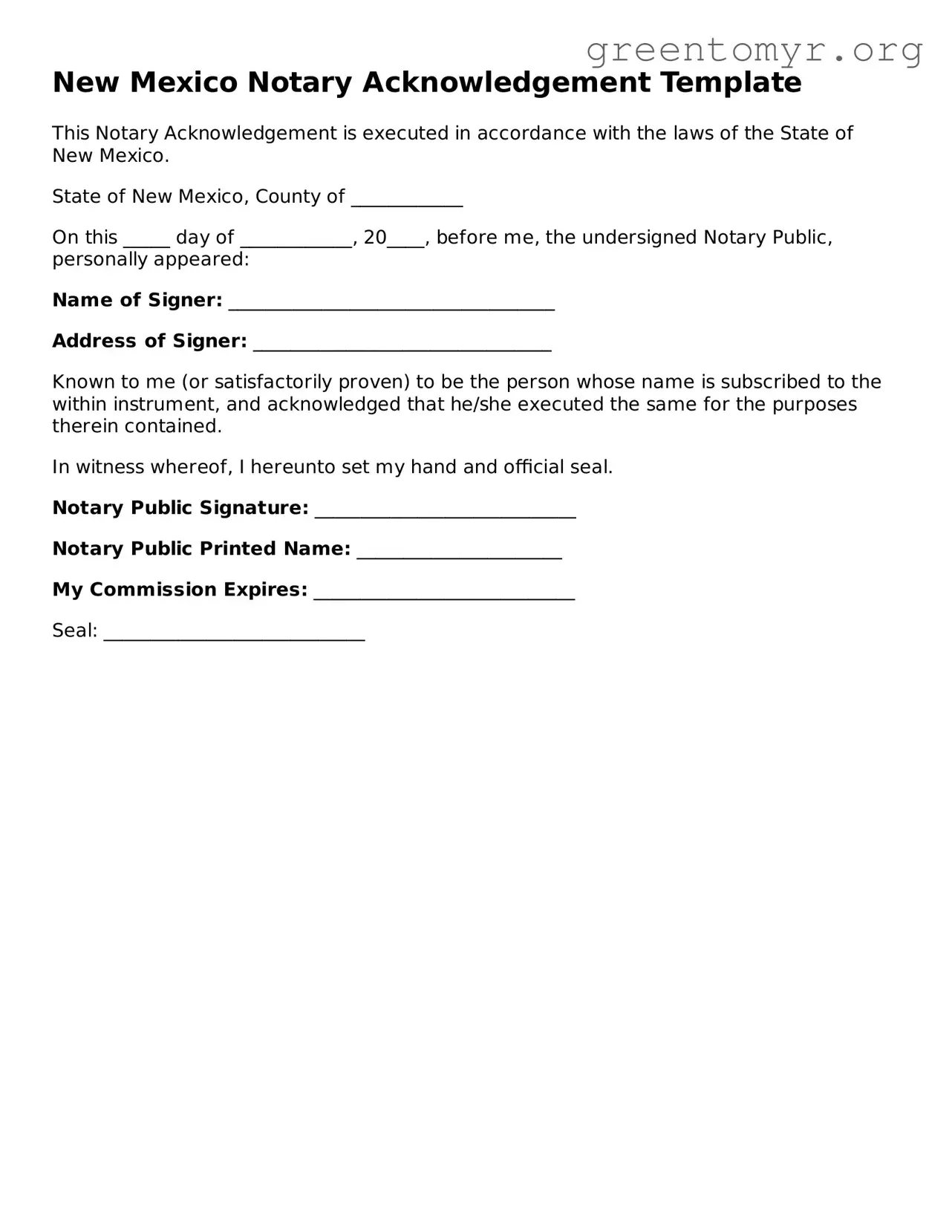
The New Mexico Notary Acknowledgement form plays a crucial role in the realm of notarization, ensuring that documents are executed with authenticity and integrity. This form serves as a declaration by a notary public that a signer has willingly and knowingly appeared before them to confirm their identity and the voluntary nature of their signature. Typically, the form includes essential details such as the name of the signer, the date of the acknowledgment, and the notary's signature and seal. It is often used for various legal documents, including contracts, deeds, and affidavits, providing a layer of protection against fraud. By utilizing this form, individuals can ensure that their documents are recognized as valid and binding in legal contexts. Understanding the components and purpose of the New Mexico Notary Acknowledgement form is vital for anyone involved in the execution of important legal documents in the state.
New Mexico Notary Acknowledgement Template
This Notary Acknowledgement is executed in accordance with the laws of the State of New Mexico.
State of New Mexico, County of ____________
On this _____ day of ____________, 20____, before me, the undersigned Notary Public, personally appeared:
Name of Signer: ___________________________________
Address of Signer: ________________________________
Known to me (or satisfactorily proven) to be the person whose name is subscribed to the within instrument, and acknowledged that he/she executed the same for the purposes therein contained.
In witness whereof, I hereunto set my hand and official seal.
Notary Public Signature: ____________________________
Notary Public Printed Name: ______________________
My Commission Expires: ____________________________
Seal: ____________________________
| Fact Name | Details |
|---|---|
| Purpose | The New Mexico Notary Acknowledgment form is used to verify the identity of the signer and confirm their willingness to sign a document. |
| Governing Law | This form is governed by the New Mexico Statutes, specifically Section 14-12-1 through 14-12-16. |
| Required Information | The form requires the name of the person signing, the date of the acknowledgment, and the notary's signature and seal. |
| Signer's Presence | The signer must appear in person before the notary at the time of the acknowledgment. |
| Notary Qualifications | In New Mexico, notaries must be at least 18 years old, a resident of the state, and hold a valid notary commission. |
| Validity | The acknowledgment is valid as long as it is completed in accordance with state laws and the notary's commission is active. |
After obtaining the New Mexico Notary Acknowledgement form, it is essential to complete it accurately to ensure that the notarization process proceeds smoothly. Follow these steps to fill out the form correctly.
Once the form is completed, it is ready for submission or further processing as required. Ensure that all information is accurate to avoid any delays in the notarization process.
The New Mexico Notary Acknowledgement form is a legal document used to verify the identity of a person signing a document. It confirms that the signer appeared before a notary public, who then certifies the signature. This process helps prevent fraud and ensures the authenticity of the document.
You typically need to use a Notary Acknowledgement form when signing important documents, such as real estate transactions, wills, or powers of attorney. If a document requires notarization, using this form is often necessary to validate the signature.
In New Mexico, a notary public must be at least 18 years old, a resident of the state, and have completed the required training. They must also pass a background check and obtain a notary commission from the Secretary of State.
You can find a notary public through various sources:
When meeting with a notary, you should bring:
If you forget to sign the document, the notary cannot proceed with the notarization. You will need to sign the document in the presence of the notary for the acknowledgment to be valid.
Yes, a notary can refuse to notarize a document for several reasons, including:
Yes, notaries in New Mexico are allowed to charge a fee for their services. The maximum fee a notary can charge is set by the state. It’s advisable to check with the notary beforehand about their fees.
A Notary Acknowledgement does not have an expiration date. However, the document itself may have a validity period depending on the nature of the transaction. Always check the requirements related to the specific document.
If you suspect that a notary has acted improperly, you should report the issue to the New Mexico Secretary of State’s office. They can investigate the matter and take appropriate action if necessary.
Filling out the New Mexico Notary Acknowledgement form can seem straightforward, but many individuals trip up on common mistakes. One frequent error is failing to include the correct date. Acknowledgements must be dated accurately, as this information is critical for the validity of the document. If the date is missing or incorrect, it could lead to complications down the line.
Another common mistake is neglecting to identify the signer properly. The form requires the full name of the person whose signature is being acknowledged. Omitting middle names or using nicknames can create confusion and may render the document invalid. Always ensure that the name matches the identification presented.
People often forget to check the identification of the signer. A notary must verify that the individual signing the document is indeed who they claim to be. Acceptable forms of ID include a driver's license or passport. Skipping this step can lead to legal issues, as the notary’s role is to confirm the identity of the signer.
In addition, some individuals mistakenly leave the notary's signature blank. The notary must sign the form after witnessing the signature. A blank signature line could lead to questions about the authenticity of the document. Always ensure that the notary has signed before submitting or filing the form.
Another pitfall is not including the notary's seal. The seal acts as an official mark, confirming that the notary has performed their duties correctly. Without this seal, the document may be considered incomplete or unofficial. It’s essential to ensure that the seal is present and clearly legible.
People sometimes overlook the importance of the notary's commission details. The form requires the notary to include their commission number and the expiration date of their commission. Missing this information can lead to questions about the notary's authority, potentially invalidating the document.
Moreover, failing to use the correct form can be a significant error. New Mexico has specific requirements for notary acknowledgments, and using an outdated or incorrect form can lead to complications. Always verify that you are using the most current version of the form.
In some cases, individuals may not understand the difference between a notary acknowledgment and a jurat. Acknowledgments confirm that a signature was made in the presence of the notary, while jurats require the signer to swear or affirm the truth of the contents. Using the wrong type of notarial act can invalidate the document.
Lastly, one of the most overlooked mistakes is not keeping a record of the notarial act. Notaries are required to maintain a journal of their activities. Failing to do so can lead to challenges regarding the authenticity of the notarization. It’s important to document each transaction properly to protect all parties involved.
The New Mexico Notary Acknowledgement form is commonly used in various legal and official transactions. However, it is often accompanied by other important documents that help establish the validity and context of the transaction. Below is a list of forms and documents frequently utilized alongside the Notary Acknowledgement form.
These documents play a crucial role in ensuring that legal transactions are conducted smoothly and with proper verification. Understanding their functions can help individuals navigate the complexities of legal processes more effectively.
The Notary Acknowledgment form serves a specific purpose in the realm of legal documentation, particularly in verifying the identity of signers and the authenticity of signatures. Several other documents share similar functions. Here are four such documents:
When filling out the New Mexico Notary Acknowledgment form, it is important to follow specific guidelines to ensure the document is valid and properly executed. Here is a list of things you should and shouldn't do:
When it comes to the New Mexico Notary Acknowledgment form, several misconceptions can lead to confusion. Understanding these misconceptions can help individuals navigate the notarization process more effectively. Here are five common misunderstandings:
By dispelling these misconceptions, individuals can approach the notarization process with greater clarity and confidence. Always consult reliable sources or professionals when in doubt about the requirements in your state.
When filling out and using the New Mexico Notary Acknowledgment form, it’s important to understand the essential elements involved. Here are some key takeaways:
By following these guidelines, you can effectively use the New Mexico Notary Acknowledgment form and ensure that your documents are properly notarized.