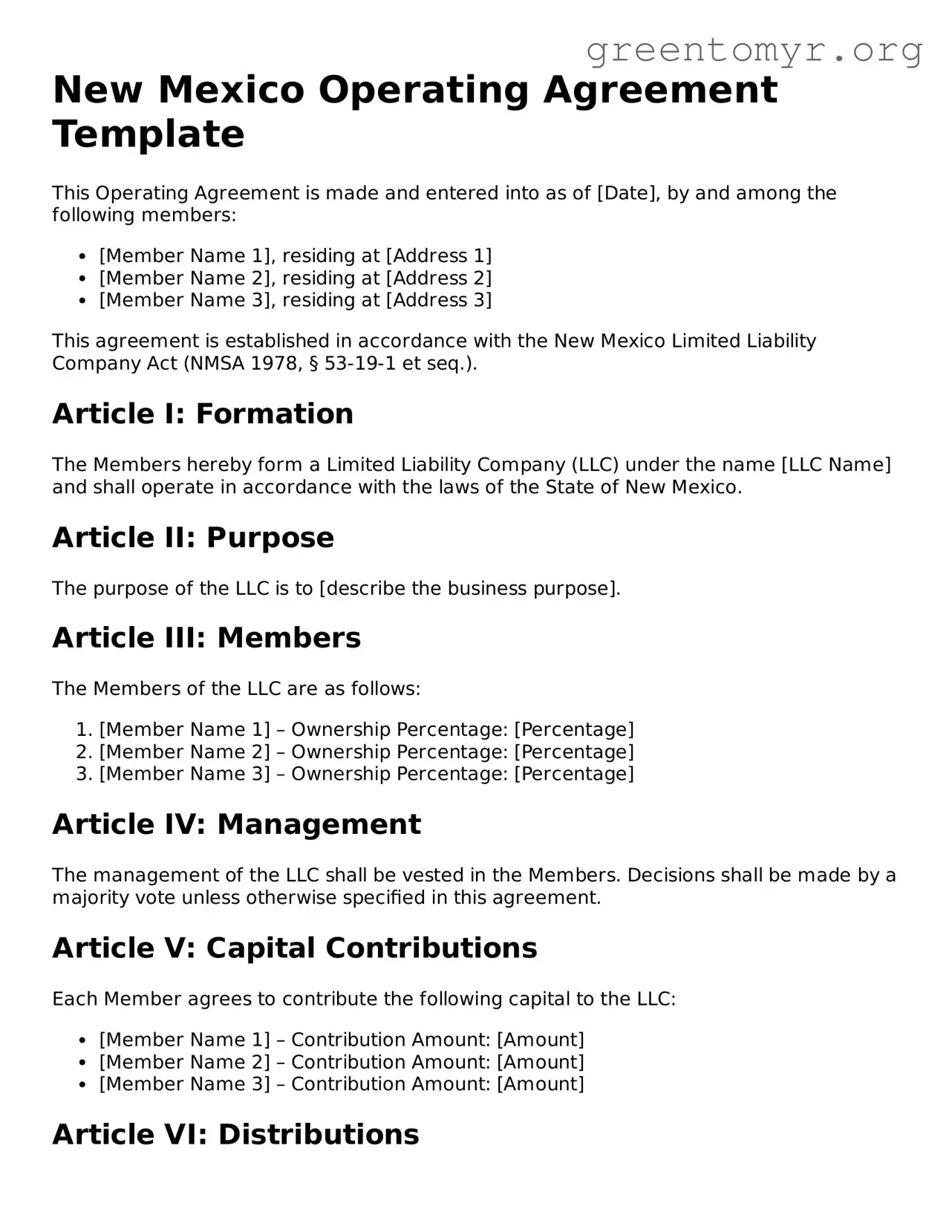
The New Mexico Operating Agreement form is a crucial document for individuals and businesses looking to establish a limited liability company (LLC) in the state. This form outlines the internal operations and management structure of the LLC, ensuring that all members are on the same page regarding their roles and responsibilities. Key aspects include provisions for ownership interests, profit distribution, and decision-making processes. Additionally, the agreement addresses member meetings, voting rights, and procedures for adding or removing members. By clearly defining these elements, the Operating Agreement helps prevent disputes and fosters a collaborative environment among members. Furthermore, it provides legal protection and clarity, which can be essential for both new and existing LLCs in navigating the complexities of business operations in New Mexico.
New Mexico Operating Agreement Template
This Operating Agreement is made and entered into as of [Date], by and among the following members:
This agreement is established in accordance with the New Mexico Limited Liability Company Act (NMSA 1978, § 53-19-1 et seq.).
Article I: Formation
The Members hereby form a Limited Liability Company (LLC) under the name [LLC Name] and shall operate in accordance with the laws of the State of New Mexico.
Article II: Purpose
The purpose of the LLC is to [describe the business purpose].
Article III: Members
The Members of the LLC are as follows:
Article IV: Management
The management of the LLC shall be vested in the Members. Decisions shall be made by a majority vote unless otherwise specified in this agreement.
Article V: Capital Contributions
Each Member agrees to contribute the following capital to the LLC:
Article VI: Distributions
Profits and losses shall be allocated to the Members in proportion to their ownership percentages as outlined in Article III.
Article VII: Indemnification
The LLC shall indemnify each Member against any losses, expenses, or liabilities incurred in connection with the LLC, provided that such indemnification shall not apply to matters arising from gross negligence or willful misconduct.
Article VIII: Amendments
This Operating Agreement may be amended only by a written agreement signed by all Members.
Article IX: Governing Law
This agreement shall be governed by and construed in accordance with the laws of the State of New Mexico.
IN WITNESS WHEREOF, the Members have executed this Operating Agreement as of the date first above written.
______________________________
[Member Name 1]
______________________________
[Member Name 2]
______________________________
[Member Name 3]
| Fact Name | Description |
|---|---|
| Governing Law | The New Mexico Operating Agreement is governed by the New Mexico Limited Liability Company Act. |
| Purpose | This form outlines the management structure and operating procedures for a limited liability company (LLC) in New Mexico. |
| Flexibility | The agreement allows members to customize the rules and regulations that govern their LLC, providing flexibility in operations. |
| Member Rights | It defines the rights and responsibilities of members, including voting rights and profit distribution. |
| Filing Requirement | While not required to be filed with the state, it is essential for internal governance and should be kept with company records. |
Once you have the New Mexico Operating Agreement form in hand, it's time to get started. This document is essential for outlining the structure and rules of your business. Carefully filling it out will help ensure that your operations run smoothly and that all members are on the same page. Follow these steps to complete the form accurately.
After completing the form, review it for accuracy and completeness. Each member should have a copy for their records. This agreement serves as a foundational document for your LLC, guiding operations and member relations.
A New Mexico Operating Agreement is a legal document that outlines the management structure and operational procedures of a limited liability company (LLC) in New Mexico. It serves as a foundational agreement among members, detailing their rights, responsibilities, and the distribution of profits and losses.
An Operating Agreement is crucial for several reasons:
No, New Mexico does not legally require LLCs to have an Operating Agreement. However, having one is highly recommended. It provides clarity and helps prevent disputes among members. Without it, the default rules set by state law will apply, which may not align with the members' intentions.
While any member of the LLC can draft the Operating Agreement, it is often beneficial to involve a legal professional. An attorney can ensure that the document complies with state laws and meets the specific needs of the business and its members.
An effective Operating Agreement should cover the following key elements:
Yes, the Operating Agreement can be amended. Typically, the process for making changes is outlined within the agreement itself. Most often, amendments require a majority or unanimous consent from the members, depending on what the agreement specifies.
The Operating Agreement itself does not directly affect tax treatment. However, it can influence how profits and losses are allocated among members, which can impact each member's tax liability. Members should consult with a tax professional to understand the implications of their specific agreement.
If an LLC does not have an Operating Agreement, it will be governed by New Mexico's default LLC laws. This can lead to unexpected outcomes, such as default management structures or profit-sharing arrangements that may not align with the members' intentions. Disputes may also be harder to resolve without a clear framework.
It is advisable to review the Operating Agreement regularly, especially after significant changes in the business, such as adding new members or altering the management structure. Annual reviews can help ensure that the agreement remains relevant and effective in guiding the LLC's operations.
When completing the New Mexico Operating Agreement form, individuals often overlook crucial details that can lead to complications. One common mistake is failing to include all members of the LLC. Each member's name and role should be clearly stated. Omitting even one member can create confusion regarding ownership and responsibilities.
Another frequent error is neglecting to specify the management structure of the LLC. Whether the LLC is member-managed or manager-managed must be clearly indicated. This distinction is vital, as it affects how decisions are made and who has authority within the organization.
Many individuals also make the mistake of not outlining the financial contributions of each member. It is essential to document how much each member is contributing, whether in cash, property, or services. This information helps avoid disputes over ownership percentages and profit distribution in the future.
Additionally, some people fail to address the procedures for adding or removing members. The Operating Agreement should include clear guidelines on how changes in membership will be handled. Without these provisions, the LLC may face challenges in adjusting to new circumstances.
Lastly, individuals often forget to include a dispute resolution clause. This clause is critical for outlining how conflicts among members will be resolved. Without it, members may find themselves in prolonged disputes, which can be costly and detrimental to the LLC’s operations.
The New Mexico Operating Agreement form is an essential document for limited liability companies (LLCs) in the state. It outlines the management structure, responsibilities, and operational procedures of the company. Alongside this agreement, several other forms and documents are commonly utilized to ensure compliance and smooth operation of the LLC. Below is a list of these related documents.
These documents work together to provide a comprehensive framework for the operation and governance of an LLC in New Mexico. Ensuring that all necessary forms are completed and filed accurately is crucial for the legal and operational integrity of the business.
The Operating Agreement is a crucial document for limited liability companies (LLCs), outlining the management structure and operational guidelines. Several other documents share similarities with the Operating Agreement in terms of purpose and function. Below is a list of eight documents that are comparable to the Operating Agreement:
When filling out the New Mexico Operating Agreement form, it's essential to approach the task with care. This document is crucial for defining the management structure and operational procedures of your business. Here are four things to consider:
When it comes to the New Mexico Operating Agreement form, several misconceptions can lead to confusion for business owners and entrepreneurs. Understanding these misconceptions is crucial for ensuring compliance and making informed decisions. Below are five common misunderstandings about this important document.
By dispelling these misconceptions, business owners can better appreciate the value of the New Mexico Operating Agreement form and utilize it effectively to protect their interests and foster a successful business environment.
When filling out and using the New Mexico Operating Agreement form, several important considerations come into play. Here are key takeaways to keep in mind:
By carefully considering these elements, members can create a comprehensive Operating Agreement that serves the best interests of the LLC and its members.