In New Mexico, the Power of Attorney (POA) form serves as a crucial legal document that allows individuals to appoint someone they trust to make decisions on their behalf. This form can be tailored to suit various needs, whether for financial matters, healthcare decisions, or general management of affairs. A well-structured POA ensures that your wishes are respected, even if you become unable to communicate them yourself. The document can be durable, meaning it remains effective even if you become incapacitated, or it can be limited to specific tasks or time frames. Understanding the key components of the New Mexico Power of Attorney form, including the designation of the agent, the powers granted, and the necessary signatures, is essential for ensuring that the document accurately reflects your intentions. Additionally, it is important to consider the implications of revoking a POA, should your circumstances change. By familiarizing yourself with these elements, you can create a robust framework for managing your affairs in a way that aligns with your preferences and needs.
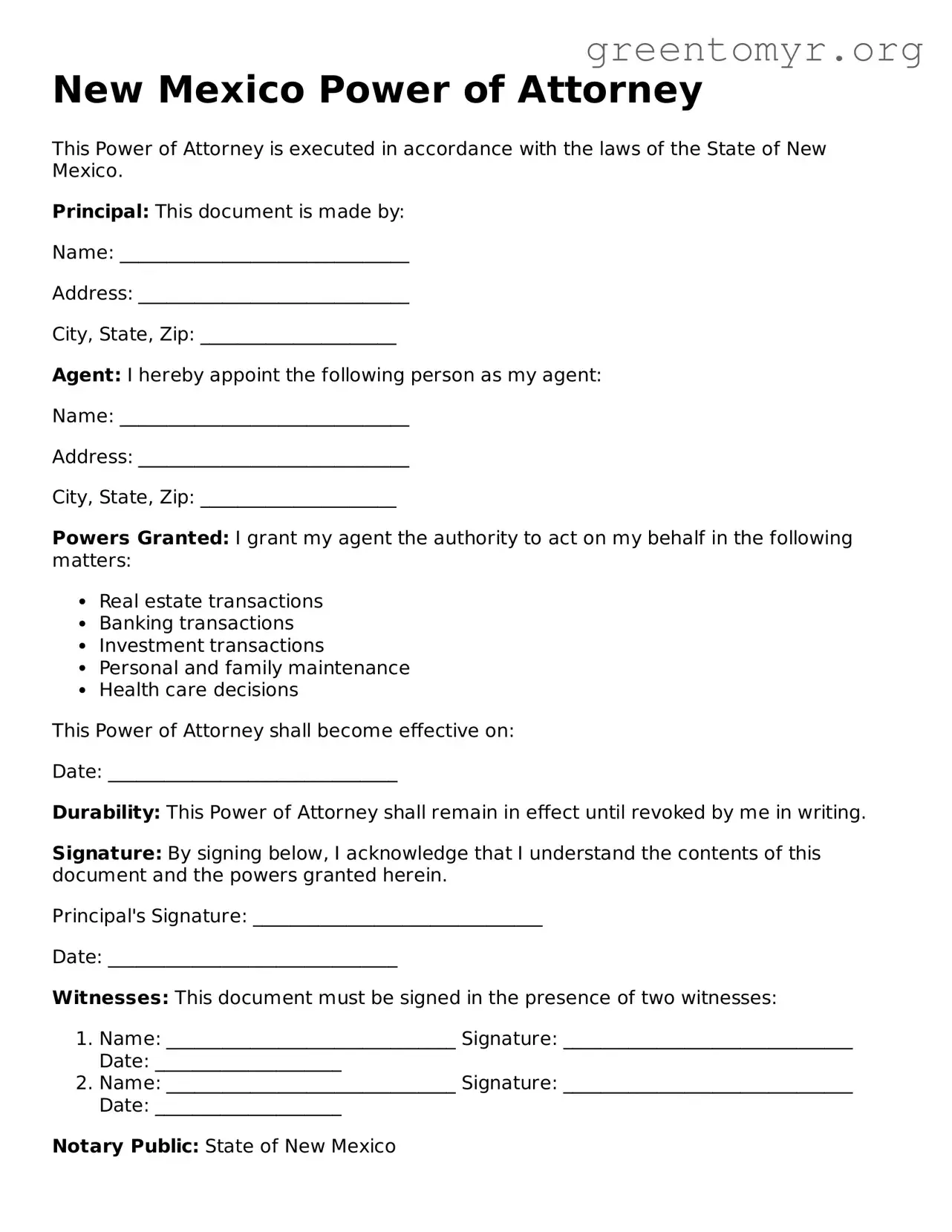
New Mexico Power of Attorney
This Power of Attorney is executed in accordance with the laws of the State of New Mexico.
Principal: This document is made by:
Name: _______________________________
Address: _____________________________
City, State, Zip: _____________________
Agent: I hereby appoint the following person as my agent:
Name: _______________________________
Address: _____________________________
City, State, Zip: _____________________
Powers Granted: I grant my agent the authority to act on my behalf in the following matters:
This Power of Attorney shall become effective on:
Date: _______________________________
Durability: This Power of Attorney shall remain in effect until revoked by me in writing.
Signature: By signing below, I acknowledge that I understand the contents of this document and the powers granted herein.
Principal's Signature: _______________________________
Date: _______________________________
Witnesses: This document must be signed in the presence of two witnesses:
Notary Public: State of New Mexico
Subscribed and sworn before me on this ______ day of __________, 20____.
Notary Public Signature: _______________________________
My Commission Expires: _______________________________
| Fact Name | Description |
|---|---|
| Governing Law | The New Mexico Power of Attorney form is governed by the New Mexico Uniform Power of Attorney Act, specifically NMSA 1978, Sections 46B-1 to 46B-13. |
| Definition | A Power of Attorney (POA) is a legal document that allows one person to act on behalf of another in legal or financial matters. |
| Types of POA | New Mexico recognizes several types of POA, including general, limited, and durable powers of attorney. |
| Durable Power of Attorney | A durable power of attorney remains effective even if the principal becomes incapacitated. |
| Agent's Authority | The agent's authority can be broad or limited, depending on the principal's wishes as outlined in the document. |
| Execution Requirements | The form must be signed by the principal and witnessed by two individuals or notarized to be valid. |
| Revocation | A principal can revoke a Power of Attorney at any time, as long as they are mentally competent. |
| Agent's Duties | The agent has a fiduciary duty to act in the best interests of the principal and must keep accurate records of all transactions. |
| Healthcare Decisions | A separate document, often called an advance directive, is needed for healthcare decisions in New Mexico. |
| Legal Assistance | While individuals can create a Power of Attorney without legal help, consulting an attorney is advisable to ensure all legal requirements are met. |
Filling out the New Mexico Power of Attorney form is a straightforward process, but it requires attention to detail. After completing the form, you will need to ensure it is signed and witnessed properly to make it legally binding.
A Power of Attorney (POA) in New Mexico is a legal document that allows one person to act on behalf of another person in legal or financial matters. The person who grants this authority is called the principal, while the person receiving the authority is known as the agent or attorney-in-fact. This arrangement can be useful for managing finances, making healthcare decisions, or handling other important matters when the principal is unable to do so themselves.
New Mexico recognizes several types of Power of Attorney, including:
To create a Power of Attorney in New Mexico, follow these steps:
Yes, you can revoke a Power of Attorney at any time, as long as you are mentally competent. To do this, you should create a written revocation document and notify your agent and any institutions that were provided with the original Power of Attorney. It’s advisable to keep a copy of the revocation for your records.
If the principal becomes incapacitated, a Durable Power of Attorney remains in effect, allowing the agent to continue making decisions on their behalf. However, if a general Power of Attorney is used and does not specify that it is durable, it may become invalid upon the principal's incapacity. Therefore, it is essential to consider the type of POA when planning for potential future incapacity.
While it is not legally required to have an attorney to create a Power of Attorney in New Mexico, consulting with one can be beneficial. An attorney can help ensure that the document meets all legal requirements and accurately reflects your wishes. This can prevent potential disputes or misunderstandings in the future.
Filling out a Power of Attorney (POA) form in New Mexico can be a straightforward process, but mistakes can lead to complications. One common error is not clearly specifying the powers granted. If the document lacks detail, the agent may not have the authority to act in specific situations. It's crucial to outline exactly what decisions the agent can make on your behalf.
Another frequent mistake is failing to date the document. A Power of Attorney should always include a date to establish when it takes effect. Without a date, it may be challenging to determine the validity of the document, leading to potential disputes or confusion regarding its authority.
People often forget to sign the form. A signature is essential for the POA to be legally binding. Even if the form is filled out correctly, a missing signature can render it ineffective. Additionally, witnesses or notarization requirements must be met to ensure the document's acceptance by financial institutions or healthcare providers.
In some cases, individuals overlook the importance of selecting the right agent. Choosing someone who is not trustworthy or lacks the ability to manage your affairs can lead to serious consequences. It’s essential to select an agent who understands your wishes and can act in your best interest.
Another mistake involves not discussing the POA with the designated agent. Communication is key. If the agent is unaware of their responsibilities or your preferences, they may make decisions that do not align with your wishes. Having an open dialogue can help prevent misunderstandings later on.
Lastly, individuals may neglect to review and update the Power of Attorney as circumstances change. Life events, such as marriage, divorce, or the death of an agent, can impact the effectiveness of the document. Regularly reviewing and updating the POA ensures it remains aligned with your current situation and intentions.
When utilizing the New Mexico Power of Attorney form, several other documents may be necessary to ensure comprehensive legal coverage. Below is a list of commonly associated forms and documents.
Each of these documents serves a specific purpose and can enhance the effectiveness of the Power of Attorney. It is advisable to consider these forms when planning for future needs.
When filling out the New Mexico Power of Attorney form, it is important to approach the process with care. Below are some guidelines that can help ensure the form is completed correctly.
When it comes to the New Mexico Power of Attorney form, many people hold misconceptions that can lead to confusion. Here are seven common misunderstandings:
Many believe that a Power of Attorney is solely for financial decisions. However, it can also grant authority for medical decisions, property management, and more, depending on how it is set up.
While having a Power of Attorney notarized can add an extra layer of security, it is not a strict requirement in New Mexico. The form can still be valid without a notary, provided it meets other conditions.
This is not true. You can revoke or modify a Power of Attorney at any time, as long as you are mentally competent. It’s important to follow the proper procedures for changes to ensure they are recognized.
In New Mexico, a Power of Attorney can remain effective even if the principal becomes incapacitated, especially if it is a durable Power of Attorney. This allows the agent to continue making decisions on behalf of the principal.
While you can choose a trusted individual, certain restrictions apply. For example, some professionals, like a doctor or lawyer, may have limitations on acting as an agent due to conflicts of interest.
An agent must always act in the best interest of the principal. They cannot make decisions that go against the principal's known wishes or best interests, even if granted authority.
People of all ages can benefit from having a Power of Attorney. Life is unpredictable, and having this document in place can provide peace of mind for anyone, regardless of their health status.
Understanding these misconceptions can help individuals make informed decisions regarding the Power of Attorney in New Mexico.
Filling out and utilizing a Power of Attorney (POA) form in New Mexico is an important step in ensuring that your financial and healthcare decisions can be managed according to your wishes. Here are some key takeaways to keep in mind:
Understanding these key points can help you navigate the process of establishing a Power of Attorney in New Mexico effectively.