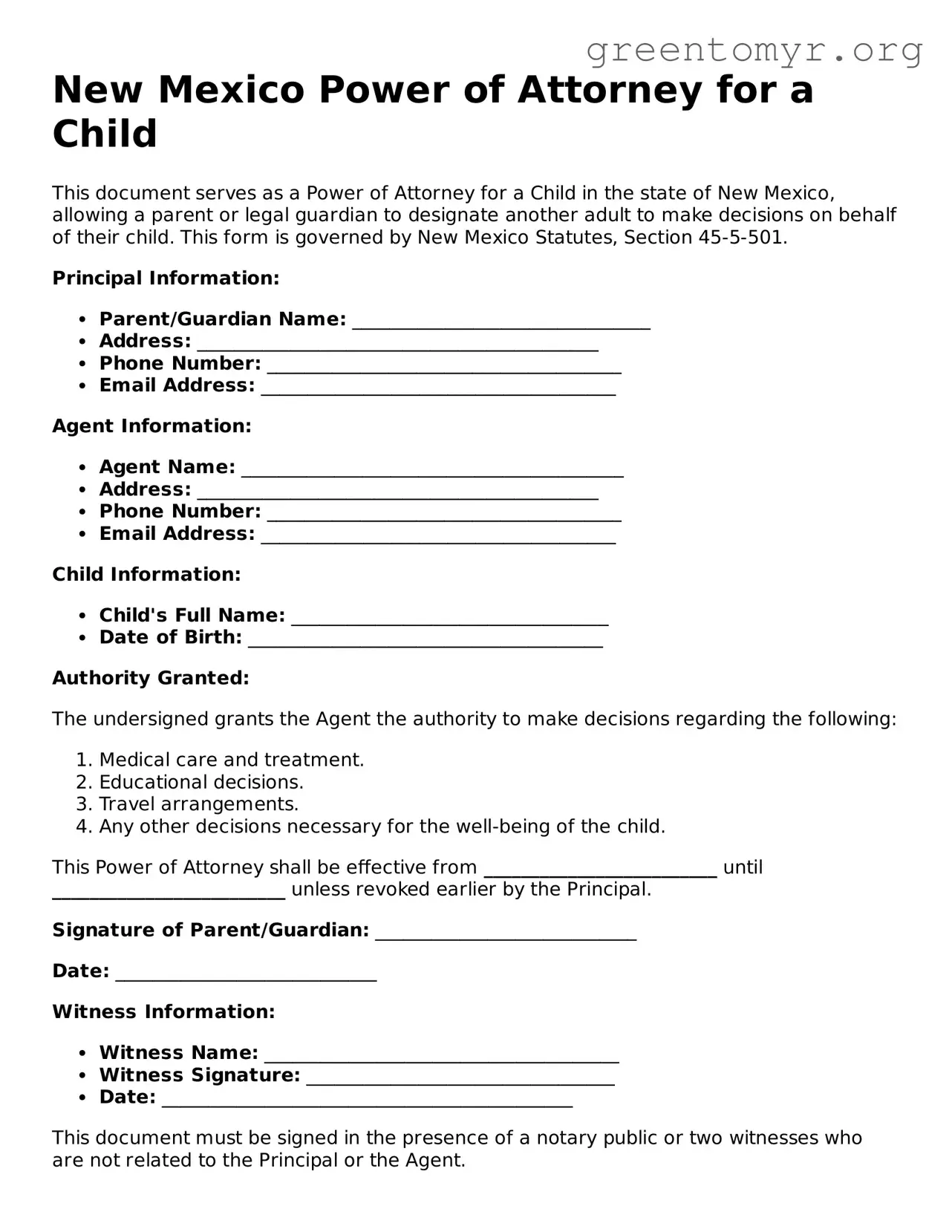
In New Mexico, the Power of Attorney for a Child form serves as a vital legal tool for parents or guardians seeking to delegate their authority to another trusted adult. This form allows for the temporary transfer of decision-making powers regarding a child's care, education, and medical needs. It's particularly useful in situations where a parent might be unavailable due to travel, military service, or other commitments. By using this form, parents can ensure that their child continues to receive the necessary support and guidance from someone they trust. The document outlines specific powers that can be granted, such as the ability to enroll the child in school, make healthcare decisions, and manage daily activities. Importantly, this arrangement can be tailored to meet the unique needs of each family, allowing for flexibility in the duration and scope of authority granted. Understanding how to properly complete and execute this form can help provide peace of mind for parents while ensuring that their child's best interests are always prioritized.
New Mexico Power of Attorney for a Child
This document serves as a Power of Attorney for a Child in the state of New Mexico, allowing a parent or legal guardian to designate another adult to make decisions on behalf of their child. This form is governed by New Mexico Statutes, Section 45-5-501.
Principal Information:
Agent Information:
Child Information:
Authority Granted:
The undersigned grants the Agent the authority to make decisions regarding the following:
This Power of Attorney shall be effective from _________________________ until _________________________ unless revoked earlier by the Principal.
Signature of Parent/Guardian: ____________________________
Date: ____________________________
Witness Information:
This document must be signed in the presence of a notary public or two witnesses who are not related to the Principal or the Agent.
| Fact Name | Description |
|---|---|
| Purpose | The New Mexico Power of Attorney for a Child form allows a parent or guardian to designate another adult to make decisions for their child. |
| Governing Law | This form is governed by New Mexico Statutes, specifically Section 40-5A-1 through 40-5A-4. |
| Duration | The power of attorney can be effective for a specific period or until revoked by the parent or guardian. |
| Eligibility | Any adult can be appointed as an agent, provided they are trustworthy and capable of making decisions for the child. |
| Revocation | The parent or guardian can revoke the power of attorney at any time, as long as they provide proper notice to the agent. |
| Limitations | The form does not grant the agent the authority to make medical decisions unless specifically stated. |
Filling out the New Mexico Power of Attorney for a Child form is a straightforward process that allows you to designate someone to make decisions on behalf of your child. Once you have completed the form, ensure that all necessary signatures are obtained and the document is stored safely. Here’s how to fill it out step-by-step.
Once you have completed these steps, review the form for accuracy. It’s important to keep a copy for your records and provide the designated person with their own copy. This ensures that everyone involved is clear on the authority granted and the responsibilities entailed.
A Power of Attorney for a Child is a legal document that allows a parent or legal guardian to grant another adult the authority to make decisions on behalf of their child. This can include decisions related to education, healthcare, and other important matters. It is particularly useful in situations where the parent is unavailable or unable to care for the child temporarily.
Any responsible adult can be appointed as an agent. This could be a relative, family friend, or another trusted individual. It is essential to choose someone who understands the responsibilities involved and is willing to act in the best interest of the child.
The Power of Attorney for a Child remains in effect until the specified expiration date stated in the document or until it is revoked by the parent or legal guardian. If no expiration date is provided, it typically remains valid for up to six months. However, it is advisable to review the form periodically and update it as needed.
Yes, in New Mexico, the Power of Attorney for a Child must be notarized to be legally binding. This means that the document should be signed in the presence of a notary public, who will then verify the identities of the signers and witness the signing.
Absolutely. The parent or legal guardian can revoke the Power of Attorney at any time, as long as they provide written notice to the agent and any relevant parties. It is advisable to formally document the revocation and, if possible, notify the agent in person to ensure clarity.
The agent can make various decisions regarding the child's welfare, including:
However, the agent cannot make decisions that would permanently affect the child's status, such as placing the child for adoption or changing their legal guardianship.
Yes, New Mexico has a specific form that must be used to create a Power of Attorney for a Child. It is important to ensure that the form complies with state laws and includes all necessary information. It may be beneficial to consult with a legal professional to ensure that the form is completed correctly.
If the agent is unable to fulfill their responsibilities, it is important to appoint a new agent as soon as possible. The parent or legal guardian can revoke the original Power of Attorney and create a new one, designating a different individual. Communication with the new agent is crucial to ensure they understand their role and responsibilities.
Yes, if you are a legal guardian or have legal custody of the child, you can use the Power of Attorney for a Child form. It is essential to ensure that you have the legal authority to make decisions on behalf of the child before proceeding.
The Power of Attorney for a Child form can be obtained from various sources, including:
Always ensure that the form you are using is the most current version and complies with New Mexico laws.
Filling out the New Mexico Power of Attorney for a Child form can be straightforward, but several common mistakes can lead to complications. One frequent error is failing to provide complete information about the child. Every detail matters, including the child's full name, date of birth, and address. Incomplete information can delay the process or even invalidate the form.
Another mistake often made is not specifying the powers granted to the agent. The form allows for various powers, such as medical decisions or educational choices. If these powers are not clearly defined, the agent may face challenges in making decisions on behalf of the child. Clarity is key; vague language can lead to misunderstandings later on.
People sometimes forget to sign and date the form. Without a signature, the document holds no legal weight. Additionally, both parents or legal guardians must sign if they are available. A missing signature can create confusion about who holds authority, potentially leading to legal disputes.
Another common oversight is neglecting to have the form notarized. In New Mexico, notarization adds a layer of legitimacy to the document. Without it, the form may not be recognized by schools or medical facilities, which can hinder the agent's ability to act in emergencies.
Lastly, individuals often overlook the need to provide copies of the form to relevant parties. Once the Power of Attorney is executed, it’s crucial to distribute copies to schools, doctors, and anyone else who may need to recognize the agent's authority. Failing to do so can result in delays and confusion when immediate decisions are necessary.
When preparing a Power of Attorney for a Child in New Mexico, it is often essential to consider additional documents that may be necessary to ensure comprehensive care and legal authority. These forms can provide clarity and support in various situations involving the child's welfare. Below is a list of commonly used documents that accompany the Power of Attorney for a Child form.
In summary, these additional documents play a vital role in ensuring that the Power of Attorney for a Child is effective and comprehensive. Each form serves a specific purpose, providing the necessary legal authority for various aspects of the child's life. It is crucial to review and prepare these documents carefully to protect the child's best interests.
When filling out the New Mexico Power of Attorney for a Child form, it's important to follow specific guidelines to ensure the document is valid and effective. Here are five things you should and shouldn't do:
Misconceptions about the New Mexico Power of Attorney for a Child form can lead to confusion. Here are eight common misunderstandings:
Understanding these misconceptions can help ensure that the Power of Attorney for a Child is used effectively and appropriately.
When considering the New Mexico Power of Attorney for a Child form, it is essential to understand its purpose and implications. This document allows a parent or legal guardian to designate another individual to make decisions on behalf of their child. Here are some key takeaways to keep in mind:
By following these guidelines, you can ensure that the Power of Attorney for a Child form serves its intended purpose effectively and responsibly.