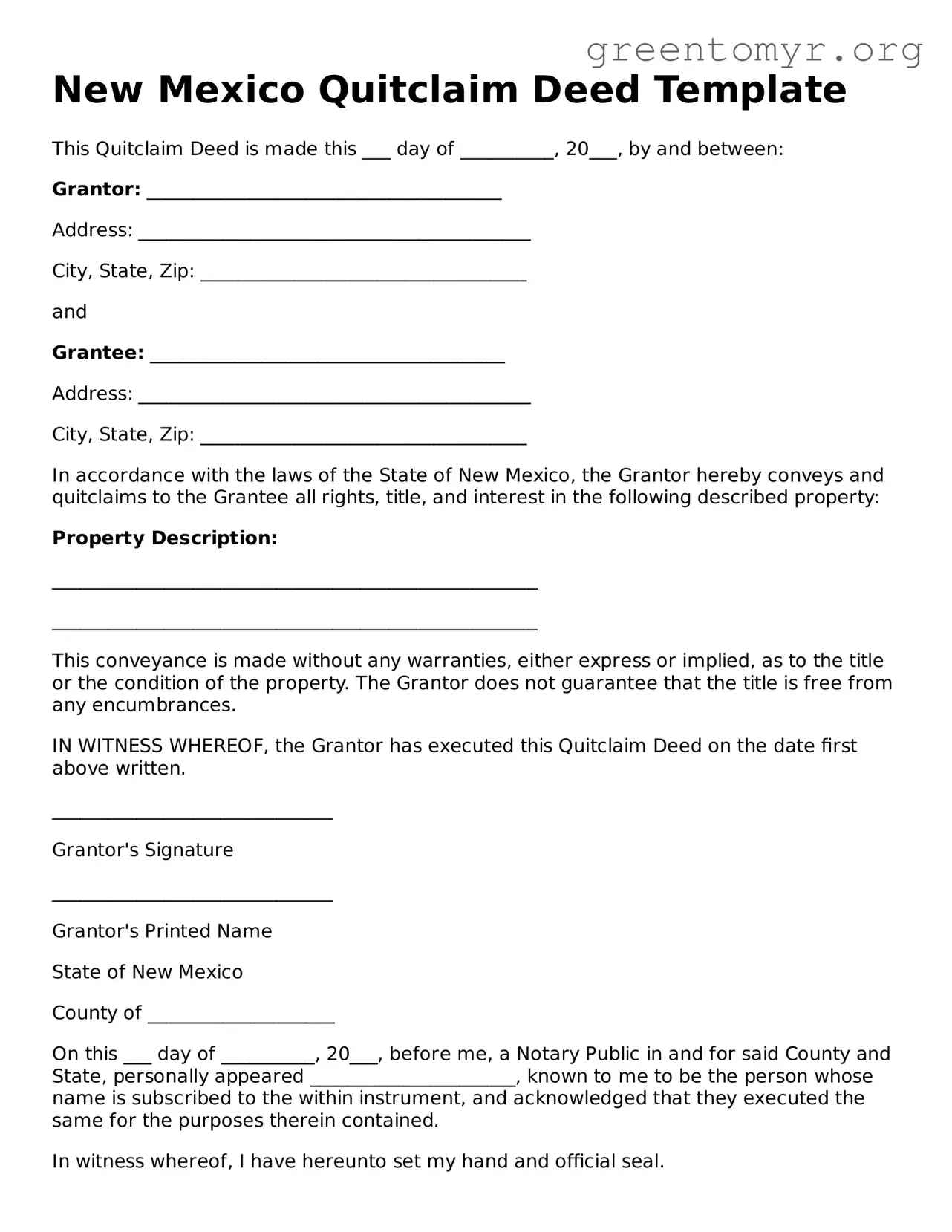
The New Mexico Quitclaim Deed form is a vital tool for property transactions, allowing individuals to transfer ownership rights without any warranties or guarantees. This form is particularly useful when the seller is uncertain about the property’s title or when the transfer occurs between family members or trusted parties. It simplifies the process by focusing solely on the transfer of interest rather than the property's condition. The form typically includes essential information such as the names of the grantor and grantee, a legal description of the property, and the date of the transfer. It’s important to note that while a quitclaim deed can expedite the transfer process, it does not protect the grantee from potential claims against the property. Understanding the implications of using a quitclaim deed is crucial for both parties involved, as it can significantly impact future ownership rights and responsibilities.
New Mexico Quitclaim Deed Template
This Quitclaim Deed is made this ___ day of __________, 20___, by and between:
Grantor: ______________________________________
Address: __________________________________________
City, State, Zip: ___________________________________
and
Grantee: ______________________________________
Address: __________________________________________
City, State, Zip: ___________________________________
In accordance with the laws of the State of New Mexico, the Grantor hereby conveys and quitclaims to the Grantee all rights, title, and interest in the following described property:
Property Description:
____________________________________________________
____________________________________________________
This conveyance is made without any warranties, either express or implied, as to the title or the condition of the property. The Grantor does not guarantee that the title is free from any encumbrances.
IN WITNESS WHEREOF, the Grantor has executed this Quitclaim Deed on the date first above written.
______________________________
Grantor's Signature
______________________________
Grantor's Printed Name
State of New Mexico
County of ____________________
On this ___ day of __________, 20___, before me, a Notary Public in and for said County and State, personally appeared ______________________, known to me to be the person whose name is subscribed to the within instrument, and acknowledged that they executed the same for the purposes therein contained.
In witness whereof, I have hereunto set my hand and official seal.
______________________________
Notary Public
My commission expires: _______________
| Fact Name | Description |
|---|---|
| Definition | A Quitclaim Deed is a legal document used to transfer ownership of real estate from one party to another without any guarantees regarding the property title. |
| Governing Law | The Quitclaim Deed in New Mexico is governed by the New Mexico Statutes, specifically under Chapter 47, Article 1. |
| Usage | This form is often used in situations where property is transferred between family members or in divorce settlements, as it provides a simple way to convey interest without extensive title searches. |
| Requirements | To be valid, the Quitclaim Deed must be signed by the grantor (the person transferring the property) and notarized. It should also include a legal description of the property. |
| Recording | After the deed is completed, it should be recorded with the county clerk's office in the county where the property is located to provide public notice of the transfer. |
After you have gathered the necessary information and documents, you are ready to fill out the New Mexico Quitclaim Deed form. Completing this form accurately is essential for a smooth transfer of property rights. Follow these steps carefully to ensure all required details are included.
Once the Quitclaim Deed is properly filled out and recorded, it will serve as a legal document confirming the transfer of property rights. Keep a copy for your records and ensure the grantee receives their copy as well.
A Quitclaim Deed is a legal document used to transfer ownership of real estate from one party to another in New Mexico. Unlike a warranty deed, which guarantees that the grantor holds clear title to the property, a quitclaim deed offers no such assurances. It simply conveys whatever interest the grantor has in the property at the time of the transfer. This makes it a common choice for transferring property between family members or in situations where the grantor does not want to guarantee the title.
Completing a Quitclaim Deed involves several steps:
There are several advantages to using a Quitclaim Deed:
Yes, there are potential risks to consider:
Filling out a Quitclaim Deed form in New Mexico can be straightforward, but many make mistakes that can lead to complications. One common error is failing to provide the correct names of the parties involved. Ensure that the names of both the grantor and grantee are spelled correctly and match their legal documents.
Another frequent mistake is neglecting to include the legal description of the property. This description should be precise and detailed. Without it, the deed may not be valid, and future ownership could be challenged.
People often forget to sign the document. A Quitclaim Deed must be signed by the grantor. If this step is overlooked, the deed will not transfer ownership as intended.
In some cases, individuals do not have the deed notarized. New Mexico law requires that the Quitclaim Deed be notarized to be legally binding. Without notarization, the document may be considered invalid.
Another mistake is not including the date of the transaction. This date is essential for establishing the timeline of ownership. Omitting it can lead to confusion or disputes later on.
Some individuals fail to check for any existing liens or encumbrances on the property. If there are outstanding debts tied to the property, the new owner could inherit these issues. It’s vital to conduct a title search before completing the deed.
People may also overlook the need for witnesses. Depending on the situation, having witnesses can strengthen the validity of the deed. Always verify if witnesses are required in your specific case.
Another common error is using outdated forms. Laws and requirements can change, so it’s important to ensure you are using the most current version of the Quitclaim Deed form.
Many individuals also forget to file the Quitclaim Deed with the appropriate county office. After signing and notarizing, the deed must be recorded to protect the new owner’s rights. Failure to do so can lead to issues down the line.
Finally, people sometimes misinterpret the implications of a Quitclaim Deed. This type of deed does not guarantee clear title. It simply transfers whatever interest the grantor has in the property. Understanding this can prevent future misunderstandings and disputes.
When dealing with property transfers in New Mexico, the Quitclaim Deed is a common document used. However, several other forms and documents often accompany it to ensure the transfer is complete and legally binding. Below is a list of these important documents, each serving a specific purpose in the property transaction process.
In summary, while the New Mexico Quitclaim Deed is essential for transferring property, these additional documents play a crucial role in ensuring the process is thorough and legally sound. Each document serves a unique purpose, contributing to a smooth transition of property ownership.
When filling out the New Mexico Quitclaim Deed form, it is important to follow certain guidelines to ensure the document is completed correctly. Below is a list of things you should and shouldn't do.
Following these guidelines can help ensure that the Quitclaim Deed is processed smoothly and accurately.
Understanding the New Mexico Quitclaim Deed form is essential for anyone involved in property transactions. However, several misconceptions can lead to confusion. Here are six common misunderstandings:
Many believe that a quitclaim deed provides a guarantee of clear title. In reality, this type of deed transfers whatever interest the grantor has, if any, without any warranties. Buyers should conduct their due diligence.
While quitclaim deeds are often used in divorce settlements to transfer property between spouses, they are not limited to this situation. They can be used in various scenarios, including transferring property to family members or as part of estate planning.
Some people think that once a quitclaim deed is executed, it cannot be undone. However, a grantor may still have the ability to revoke the deed under certain circumstances, particularly if the transfer was not completed properly.
It is a common belief that using a quitclaim deed removes all liability associated with the property. This is not true. The new owner may still be liable for existing liens or encumbrances, as the deed does not clear these issues.
Many assume quitclaim deeds can only be used for real estate transactions. However, they can also be used to transfer other types of property interests, such as vehicles or personal belongings, depending on state laws.
Some individuals believe that quitclaim deeds do not need to be notarized. In New Mexico, a quitclaim deed must be notarized to be legally effective and to ensure proper recording.
Being informed about these misconceptions can help individuals make better decisions when dealing with property transfers in New Mexico.
When filling out and using the New Mexico Quitclaim Deed form, it is essential to consider the following key takeaways: