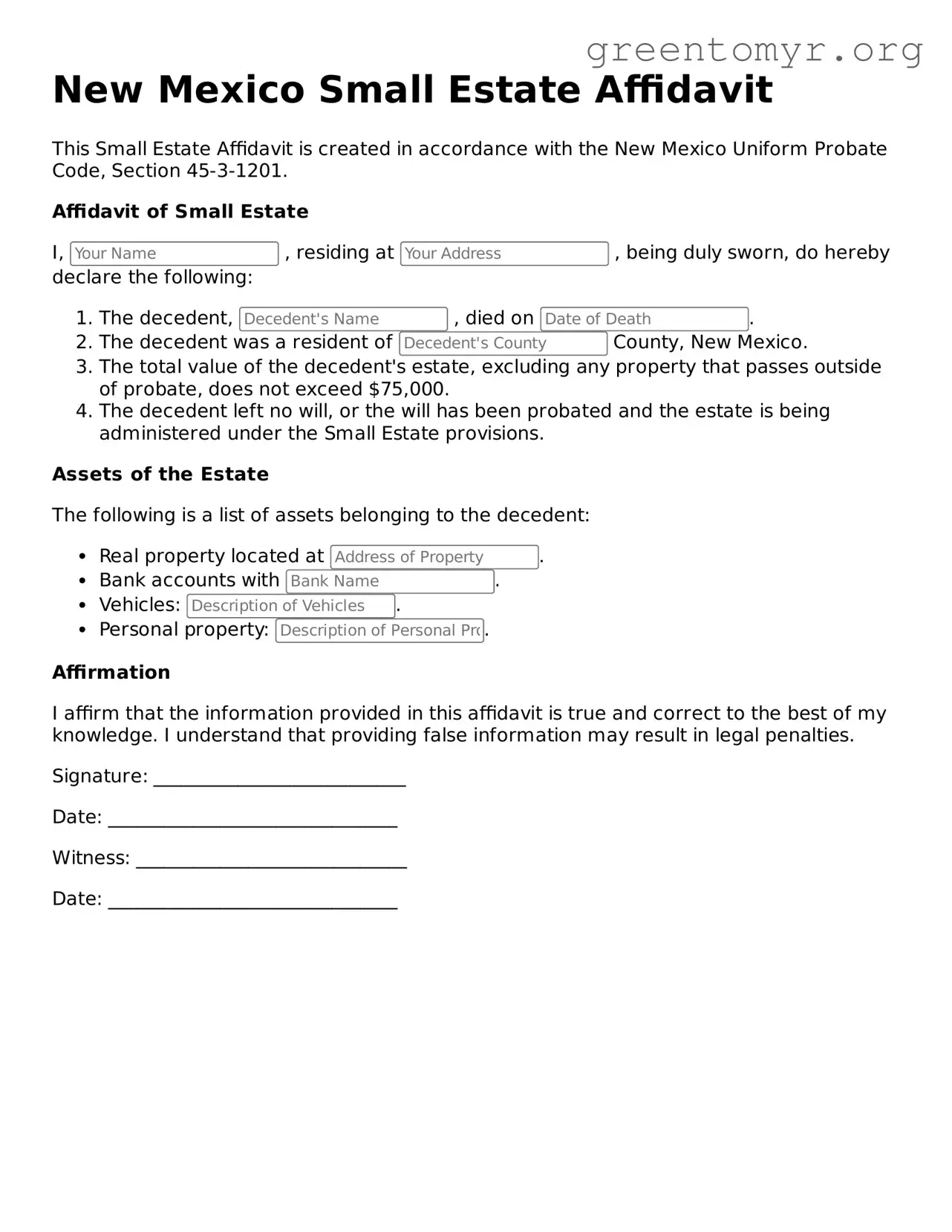
The New Mexico Small Estate Affidavit form serves as a vital legal tool for individuals dealing with the estate of a deceased person. This form simplifies the process of transferring assets when the total value of the estate is below a certain threshold, which is currently set at $75,000 for personal property and $100,000 for real property. By utilizing this affidavit, heirs can bypass the lengthy and often costly probate process, allowing for a more efficient resolution of the estate. The form requires specific information, including the decedent's details, a list of assets, and the names of the heirs. Additionally, the affidavit must be signed under penalty of perjury, affirming the accuracy of the information provided. This process not only facilitates the distribution of assets but also ensures that the rights of heirs are protected in accordance with New Mexico law.
New Mexico Small Estate Affidavit
This Small Estate Affidavit is created in accordance with the New Mexico Uniform Probate Code, Section 45-3-1201.
Affidavit of Small Estate
I, , residing at , being duly sworn, do hereby declare the following:
Assets of the Estate
The following is a list of assets belonging to the decedent:
Affirmation
I affirm that the information provided in this affidavit is true and correct to the best of my knowledge. I understand that providing false information may result in legal penalties.
Signature: ___________________________
Date: _______________________________
Witness: _____________________________
Date: _______________________________
| Fact Name | Description |
|---|---|
| Purpose | The New Mexico Small Estate Affidavit allows individuals to claim assets of a deceased person without going through formal probate. |
| Eligibility | This form can be used when the total value of the deceased's estate is $75,000 or less, excluding real estate. |
| Governing Law | The Small Estate Affidavit is governed by New Mexico Statutes, specifically Section 45-3-1201. |
| Filing Requirements | The affidavit must be signed by the person claiming the assets and typically needs to be notarized. |
| Use of Assets | Once the affidavit is filed, the claimant can access the deceased's assets, such as bank accounts and personal property. |
Once you have the New Mexico Small Estate Affidavit form ready, you will need to fill it out accurately to proceed with settling the estate. Follow these steps to complete the form correctly.
After filling out the form, gather any required documents, such as the death certificate or will, and prepare to file the affidavit with the appropriate court or authority.
A Small Estate Affidavit is a legal document that allows individuals to claim assets of a deceased person without going through the lengthy and often costly probate process. In New Mexico, this option is available for estates valued at $75,000 or less, excluding certain types of property like real estate. It streamlines the transfer of assets, making it easier for heirs or beneficiaries to access what they are entitled to.
Generally, any individual who is an heir or beneficiary of the deceased can use the Small Estate Affidavit. This includes family members like spouses, children, parents, or siblings. However, it’s important to ensure that you meet the eligibility requirements, such as being named in the will or being an heir under New Mexico law if there is no will.
The Small Estate Affidavit can be used to claim personal property, such as bank accounts, vehicles, and personal belongings. However, it cannot be used for real estate or assets that are held in a trust. If the estate includes real property, a different legal process must be followed.
There is no strict deadline for filing a Small Estate Affidavit in New Mexico. However, it’s advisable to act promptly to avoid complications. Delaying the process may lead to issues, especially if debts or taxes are owed by the estate. Taking timely action helps ensure that assets are transferred smoothly to the rightful heirs.
While it is not required to have an attorney to file a Small Estate Affidavit, consulting one can be beneficial. An attorney can help ensure that the affidavit is completed correctly and that all necessary steps are followed. If the estate is complicated or if disputes arise among heirs, legal guidance becomes even more crucial.
If someone contests the Small Estate Affidavit, it may lead to a legal dispute. In such cases, the matter may need to be resolved in court. The court will review the claims and evidence presented by both sides before making a decision. Having legal representation can be vital in navigating these disputes effectively.
Once filed, a Small Estate Affidavit cannot be revoked. However, if new information comes to light or if the estate's value exceeds the small estate limit, it may be necessary to pursue formal probate proceedings. In such situations, it’s wise to seek legal advice to understand the best course of action.
The Small Estate Affidavit form can be obtained online through the New Mexico courts’ website or from local probate court offices. It’s important to ensure that you are using the most current version of the form to avoid any issues during the filing process.
When filling out the New Mexico Small Estate Affidavit form, many people make common mistakes that can delay the process or even lead to rejection. One frequent error is not providing accurate information about the deceased. It's crucial to include the full name, date of birth, and date of death. Any discrepancies can raise questions and complicate the handling of the estate.
Another mistake often seen is the omission of required signatures. All necessary parties, such as heirs or beneficiaries, must sign the affidavit. If even one signature is missing, the form may be deemed incomplete. This can lead to additional delays as individuals are tracked down to provide their consent.
People also tend to overlook the importance of including a complete list of assets. The Small Estate Affidavit requires a detailed inventory of the deceased's property. Failing to list all assets or providing vague descriptions can result in legal complications. It’s essential to be thorough and precise to ensure a smooth process.
Additionally, many individuals forget to check the eligibility requirements for using the Small Estate Affidavit. Not all estates qualify for this simplified process. If the total value of the estate exceeds the state limit, the affidavit cannot be used. This oversight can lead to frustration and additional legal steps.
Lastly, a common mistake is not properly notarizing the document. The affidavit must be notarized to be valid. If this step is skipped, the form may not be accepted by financial institutions or courts. Ensuring that the document is properly executed is vital for the estate to be settled without issues.
The New Mexico Small Estate Affidavit is a useful tool for settling the estates of individuals who have passed away, particularly when the estate's value is below a certain threshold. However, several other forms and documents may be necessary to facilitate the process. Below is a list of these documents, each serving a specific purpose in the estate administration process.
These documents are integral to the process of settling an estate in New Mexico. Having them prepared and organized can significantly streamline the administration of the estate and ensure compliance with state laws.
The Small Estate Affidavit is a useful tool for settling the estates of deceased individuals without the need for formal probate proceedings. Several other documents serve similar purposes in streamlining the process of transferring assets. Here are four documents that share similarities with the Small Estate Affidavit:
When filling out the New Mexico Small Estate Affidavit form, there are important dos and don'ts to keep in mind. Following these guidelines can help ensure that the process goes smoothly.
The New Mexico Small Estate Affidavit form is often misunderstood. Here are five common misconceptions:
This is incorrect. The limit is actually $50,000 for individuals and $100,000 for married couples. Many people mistakenly believe the threshold is lower.
While it is important to address outstanding debts, the Small Estate Affidavit can still be used even if some debts remain. However, the heirs may be responsible for those debts.
This is a misconception. The Small Estate Affidavit can be used to transfer both personal property and real estate, making it a versatile tool for small estates.
While legal assistance can be helpful, it is not required. Many individuals successfully complete the form on their own, provided they understand the requirements.
This is not true. Any person who is entitled to inherit under New Mexico law can use the Small Estate Affidavit, not just immediate family.
Filling out and using the New Mexico Small Estate Affidavit form can be a straightforward process if you understand the key points involved. Here are some important takeaways to consider:
Understanding these key points will facilitate a smoother process when dealing with small estates in New Mexico.