Content Navigation

In the realm of estate planning, the Transfer-on-Death (TOD) Deed form in New Mexico stands out as a powerful tool for individuals looking to streamline the transfer of their real property upon death. This legal document allows property owners to designate beneficiaries who will receive their property directly, bypassing the often lengthy and costly probate process. By filling out this form, individuals can maintain control of their property during their lifetime while ensuring a smooth transition to their chosen heirs after passing. The TOD Deed can be particularly beneficial for those with straightforward estate plans, as it simplifies the transfer process and can help avoid disputes among family members. Additionally, it’s important to note that the deed must be properly executed and recorded to be effective, and it can be revoked or changed at any time before the owner’s death. Understanding the nuances of this form can empower property owners in New Mexico to make informed decisions about their legacy and the future of their assets.

New Mexico Transfer-on-Death Deed Example

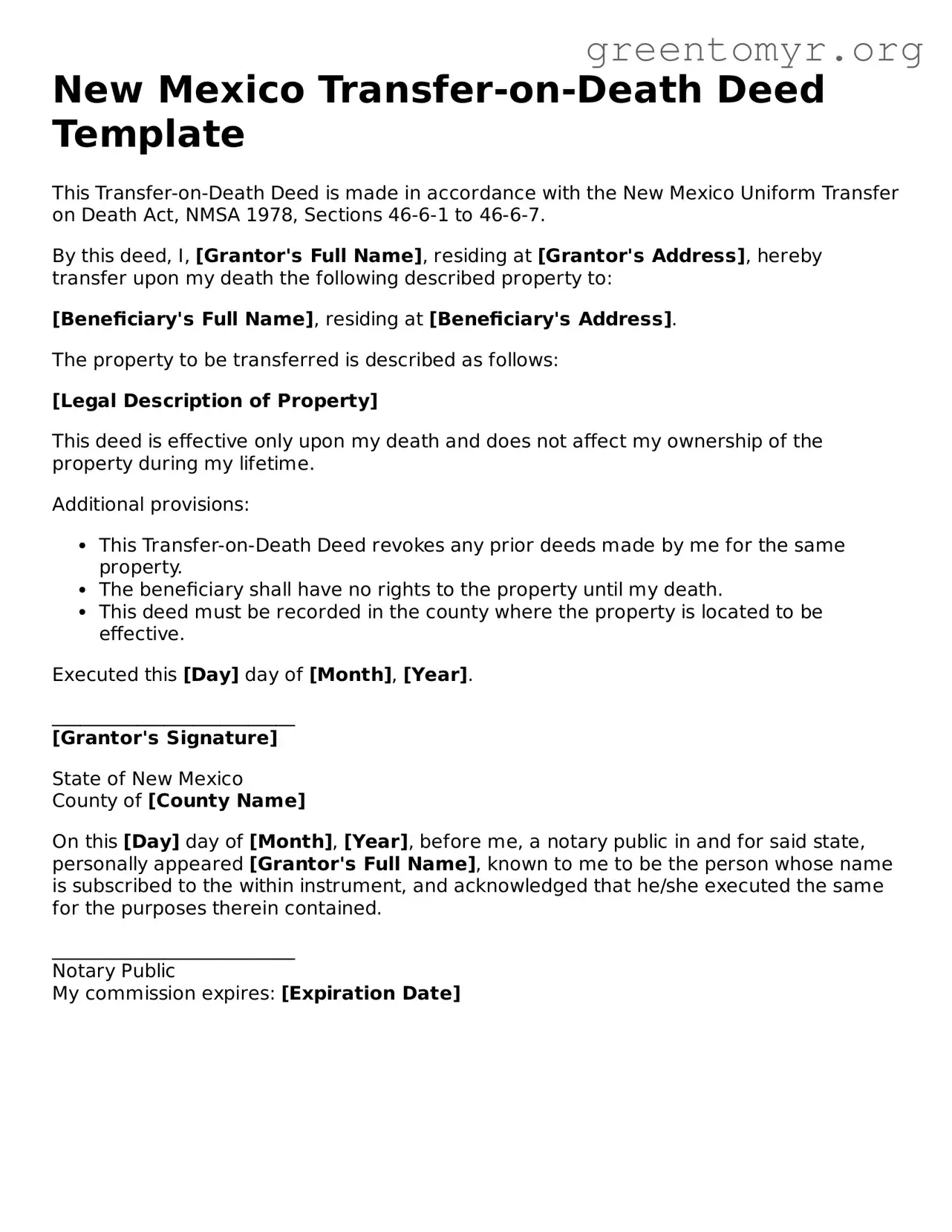
New Mexico Transfer-on-Death Deed Template

This Transfer-on-Death Deed is made in accordance with the New Mexico Uniform Transfer on Death Act, NMSA 1978, Sections 46-6-1 to 46-6-7.

By this deed, I, [Grantor's Full Name], residing at [Grantor's Address], hereby transfer upon my death the following described property to:

[Beneficiary's Full Name], residing at [Beneficiary's Address].

The property to be transferred is described as follows:

[Legal Description of Property]

This deed is effective only upon my death and does not affect my ownership of the property during my lifetime.

Additional provisions:

  • This Transfer-on-Death Deed revokes any prior deeds made by me for the same property.
  • The beneficiary shall have no rights to the property until my death.
  • This deed must be recorded in the county where the property is located to be effective.

Executed this [Day] day of [Month], [Year].

__________________________
[Grantor's Signature]

State of New Mexico
County of [County Name]

On this [Day] day of [Month], [Year], before me, a notary public in and for said state, personally appeared [Grantor's Full Name], known to me to be the person whose name is subscribed to the within instrument, and acknowledged that he/she executed the same for the purposes therein contained.

__________________________
Notary Public
My commission expires: [Expiration Date]

PDF Form Features

Fact Name Description
Purpose The New Mexico Transfer-on-Death Deed allows property owners to transfer real estate to beneficiaries upon their death without going through probate.
Governing Law This deed is governed by the New Mexico Uniform Transfer on Death Act, found in NMSA 1978, Sections 45-6-401 to 45-6-409.
Requirements The deed must be signed by the property owner and recorded in the county where the property is located before the owner's death.
Revocation The Transfer-on-Death Deed can be revoked at any time by the property owner, provided the revocation is properly recorded.

Guide to Using New Mexico Transfer-on-Death Deed

Once you have the New Mexico Transfer-on-Death Deed form ready, you will need to fill it out carefully. Make sure to have all necessary information at hand, including details about the property and the beneficiaries. Follow these steps to complete the form correctly.

  1. Begin by entering the date at the top of the form.
  2. Provide the full name and address of the property owner. This should include any middle names or initials.
  3. Next, describe the property being transferred. Include the address and legal description, which can often be found in the property deed.
  4. Identify the beneficiaries by listing their full names and addresses. Make sure to clarify if there are multiple beneficiaries.
  5. Indicate whether the beneficiaries will receive the property equally or in specific proportions.
  6. Sign the form in the designated area. Ensure your signature matches the name provided at the beginning of the form.
  7. Have the form notarized. This step is crucial for the deed to be legally valid.
  8. Finally, file the completed form with the county clerk’s office where the property is located. Keep a copy for your records.

Get Answers on New Mexico Transfer-on-Death Deed

  1. What is a Transfer-on-Death Deed in New Mexico?

    A Transfer-on-Death Deed (TODD) allows a property owner to transfer real estate to a beneficiary upon their death without going through probate. This deed is an effective way to ensure that your property goes directly to your chosen beneficiary, simplifying the transfer process and potentially saving time and money.

  2. Who can use a Transfer-on-Death Deed?

    Any individual who owns real estate in New Mexico can use a Transfer-on-Death Deed. This includes homeowners, co-owners, and even individuals who hold property in trust. However, it's important to ensure that the deed is properly executed and recorded to be effective.

  3. How do I create a Transfer-on-Death Deed?

    To create a Transfer-on-Death Deed, follow these steps:

    • Obtain the appropriate form, which can often be found online or through a legal professional.
    • Fill out the form with accurate information about the property and the beneficiary.
    • Sign the deed in front of a notary public.
    • Record the deed with the county clerk's office where the property is located.
  4. Do I need to notify the beneficiary about the Transfer-on-Death Deed?

    While it is not legally required to notify the beneficiary, it is a good practice to inform them. This helps avoid confusion later on and ensures that they are aware of their future interest in the property.

  5. Can I change or revoke a Transfer-on-Death Deed?

    Yes, you can change or revoke a Transfer-on-Death Deed at any time while you are still alive. To do this, you would need to create a new deed that either changes the beneficiary or states that the previous deed is revoked. Make sure to record the new deed with the county clerk's office to ensure it is effective.

  6. What happens if the beneficiary dies before me?

    If the beneficiary named in the Transfer-on-Death Deed passes away before you do, the deed will typically become void. You may want to name alternate beneficiaries to avoid complications. If no alternate beneficiary is named, the property will go through probate and be distributed according to your will or state law.

  7. Are there any tax implications with a Transfer-on-Death Deed?

    Generally, there are no immediate tax implications when you create a Transfer-on-Death Deed. The property will not be considered part of your estate for estate tax purposes. However, the beneficiary may face capital gains taxes when they sell the property. It’s wise to consult a tax professional for personalized advice.

  8. While you can complete a Transfer-on-Death Deed without legal assistance, consulting a lawyer is recommended. A legal professional can ensure that the deed is properly drafted and executed, helping you avoid potential issues down the line.

Common mistakes

Filling out the New Mexico Transfer-on-Death Deed form can be straightforward, but many individuals make common mistakes that can lead to complications. One frequent error is failing to accurately identify the property. It is essential to provide a clear and complete legal description of the property being transferred. Omitting details or using vague terms can create confusion and may invalidate the deed.

Another mistake often seen is not properly naming the beneficiaries. The form requires the full names of the individuals who will inherit the property. Using nicknames, initials, or incorrect spellings can result in disputes or delays in the transfer process. It's crucial to double-check the names against official identification to ensure accuracy.

Additionally, some individuals overlook the requirement for signatures. The Transfer-on-Death Deed must be signed by the owner in the presence of a notary public. Failing to have the deed notarized can render it ineffective. It is advisable to confirm that the notary is properly commissioned and that all signatures are correctly executed.

Lastly, individuals sometimes neglect to record the deed with the appropriate county clerk’s office. Even if the deed is filled out correctly, it must be filed to be legally binding. Without this step, the transfer may not be recognized after the owner’s death. Ensuring timely recording can prevent potential legal challenges and ensure a smooth transfer of property.

Documents used along the form

The New Mexico Transfer-on-Death Deed form is a useful tool for transferring real estate upon the owner's death without going through probate. However, several other documents often accompany this deed to ensure a smooth transfer process. Below are some commonly used forms and documents related to the Transfer-on-Death Deed.

  • Affidavit of Death: This document verifies the death of the property owner. It is often required to prove that the transfer can take place as outlined in the Transfer-on-Death Deed.
  • Will: If the property owner has a will, it may provide additional context regarding the transfer of assets. This document can clarify the owner's intentions and may be referenced during the transfer process.
  • Property Deed: The existing deed for the property being transferred provides essential information about ownership. It helps confirm that the property is eligible for transfer under the terms of the Transfer-on-Death Deed.
  • Notice of Transfer-on-Death Deed: This notice is filed with the county clerk to inform interested parties of the transfer arrangement. It serves as public notice and may help prevent disputes later on.
  • Beneficiary Designation Form: If the property owner has designated beneficiaries for other assets, this form can help ensure that all transfers are aligned with their wishes. It provides clarity on how other assets should be handled alongside the property.

Using these documents in conjunction with the Transfer-on-Death Deed can help facilitate a clear and effective transfer of property. Each document plays a specific role in ensuring that the wishes of the property owner are honored and that the process is as seamless as possible for the beneficiaries.

Similar forms

  • Will: A will is a legal document that outlines how a person's assets should be distributed after their death. Like a Transfer-on-Death Deed, it allows individuals to specify beneficiaries for their property. However, a will must go through probate, whereas a Transfer-on-Death Deed does not.
  • Living Trust: A living trust is an arrangement where a person places their assets into a trust during their lifetime. Similar to a Transfer-on-Death Deed, it allows for the direct transfer of assets to beneficiaries without probate. However, a living trust requires more management and formalities than a Transfer-on-Death Deed.
  • Joint Tenancy: Joint tenancy is a form of property ownership where two or more people hold title to a property together. Upon the death of one owner, the property automatically transfers to the surviving owner(s). This is similar to a Transfer-on-Death Deed in that it avoids probate, but it involves shared ownership during the owner's lifetime.
  • Payable-on-Death (POD) Accounts: A POD account allows individuals to designate beneficiaries who will receive the account's funds upon their death. Like a Transfer-on-Death Deed, it facilitates a direct transfer of assets without probate. However, POD accounts are specific to financial accounts, whereas a Transfer-on-Death Deed pertains to real estate.
  • Transfer-on-Death (TOD) Registration: Similar to a Transfer-on-Death Deed, a TOD registration allows individuals to designate beneficiaries for securities or investment accounts. Both documents enable a smooth transfer of assets upon death, bypassing the probate process, but they apply to different types of property.
  • Life Estate: A life estate is a property arrangement where an individual has the right to use a property for their lifetime, with the property passing to another person upon their death. This is similar to a Transfer-on-Death Deed in that it establishes a future interest for beneficiaries, but it also provides the life tenant with certain rights and responsibilities during their lifetime.

Dos and Don'ts

When filling out the New Mexico Transfer-on-Death Deed form, it is essential to follow specific guidelines to ensure the document is valid and serves its intended purpose. Below are some important dos and don'ts to keep in mind.

  • Do ensure that you are the owner of the property you wish to transfer.
  • Do provide accurate legal descriptions of the property.
  • Do include the names and contact information of the beneficiaries.
  • Do sign the deed in front of a notary public.
  • Don't forget to record the deed with the county clerk’s office.
  • Don't use vague language when describing the property or beneficiaries.
  • Don't attempt to fill out the form without understanding its implications.
  • Don't leave any sections of the form blank; all required fields must be completed.

By adhering to these guidelines, you can help ensure that your Transfer-on-Death Deed is completed correctly and effectively. Proper planning can make a significant difference in how your assets are handled in the future.

Misconceptions

Understanding the New Mexico Transfer-on-Death Deed (TODD) form can be challenging due to common misconceptions. Here are nine prevalent misunderstandings:

  1. It only applies to real estate. Many believe the TODD is limited to real property. However, it specifically pertains to transferring real estate upon death, not personal property or financial assets.
  2. It requires probate. Some think that using a TODD necessitates probate. In reality, properties transferred via a TODD bypass the probate process, simplifying the transfer for beneficiaries.
  3. It can be revoked only in writing. There's a misconception that a TODD can only be revoked through formal written means. In fact, it can also be revoked by executing a new TODD or by the owner’s death.
  4. All heirs must agree to the transfer. People often assume that all heirs must consent to a TODD. The deed is effective regardless of other heirs’ opinions, as it is a unilateral decision by the property owner.
  5. It’s automatically effective upon signing. Some believe that simply signing the TODD makes it effective immediately. The deed must be recorded with the county clerk to take effect.
  6. Only spouses can be beneficiaries. There’s a notion that only a spouse can be named as a beneficiary. In truth, anyone can be designated, including friends, relatives, or charities.
  7. It eliminates all tax implications. A common misunderstanding is that a TODD avoids all tax consequences. While it may help avoid probate taxes, other taxes, such as capital gains taxes, may still apply.
  8. It is only for wealthy individuals. Many think that only wealthy individuals can benefit from a TODD. In reality, it is a useful tool for anyone who wants to simplify the transfer of their property.
  9. It’s too complicated to use. Some feel intimidated by the TODD process. However, with proper guidance, it can be a straightforward way to ensure your property goes to the desired beneficiaries.

By addressing these misconceptions, individuals can make informed decisions about using the New Mexico Transfer-on-Death Deed to manage their property effectively.

Key takeaways

When considering the New Mexico Transfer-on-Death Deed form, there are several important points to keep in mind. This deed allows you to transfer real estate to your beneficiaries without going through probate. Here are some key takeaways:

  • Eligibility: Only individuals who own real estate in New Mexico can use this deed. It must be filled out correctly to be valid.
  • Beneficiaries: You can name one or more beneficiaries. It's crucial to ensure their information is accurate to avoid any complications later.
  • Revocation: You have the option to revoke the deed at any time before your passing. This flexibility allows you to change your mind if your circumstances change.
  • Filing: After completing the form, you must file it with the county clerk's office where the property is located. This step is essential for the deed to take effect.
  • Effective Date: The transfer occurs automatically upon your death. Your beneficiaries will receive the property without going through the probate process.

By understanding these key points, you can confidently navigate the process of using the New Mexico Transfer-on-Death Deed form. It’s a powerful tool for estate planning, allowing for a smoother transition of your property to your loved ones.