Content Navigation

The New York Bill of Sale form serves as a crucial document in the transfer of ownership for personal property. This legally binding agreement outlines essential details, including the names and addresses of both the seller and buyer, a description of the item being sold, and the purchase price. By capturing this information, the form helps protect the interests of both parties involved in the transaction. Additionally, it may include provisions regarding warranties or the condition of the item, ensuring clarity and transparency. As a vital tool in private sales, the Bill of Sale facilitates a smooth exchange and provides evidence of the transaction for future reference. Understanding its components and significance can greatly enhance the buying and selling experience in New York.

New York Bill of Sale Example

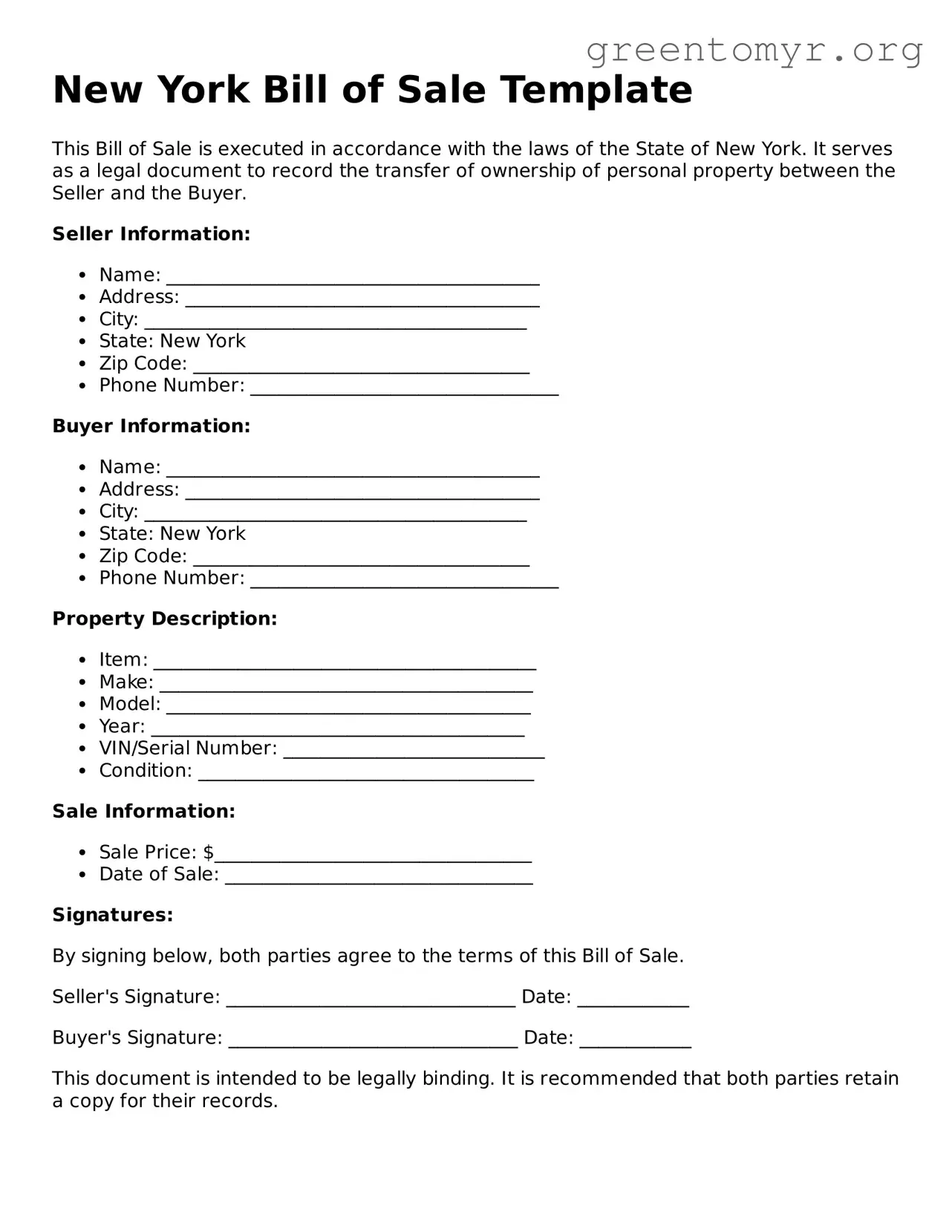
New York Bill of Sale Template

This Bill of Sale is executed in accordance with the laws of the State of New York. It serves as a legal document to record the transfer of ownership of personal property between the Seller and the Buyer.

Seller Information:

  • Name: ________________________________________
  • Address: ______________________________________
  • City: _________________________________________
  • State: New York
  • Zip Code: ____________________________________
  • Phone Number: _________________________________

Buyer Information:

  • Name: ________________________________________
  • Address: ______________________________________
  • City: _________________________________________
  • State: New York
  • Zip Code: ____________________________________
  • Phone Number: _________________________________

Property Description:

  • Item: _________________________________________
  • Make: ________________________________________
  • Model: _______________________________________
  • Year: ________________________________________
  • VIN/Serial Number: ____________________________
  • Condition: ____________________________________

Sale Information:

  • Sale Price: $__________________________________
  • Date of Sale: _________________________________

Signatures:

By signing below, both parties agree to the terms of this Bill of Sale.

Seller's Signature: _______________________________ Date: ____________

Buyer's Signature: _______________________________ Date: ____________

This document is intended to be legally binding. It is recommended that both parties retain a copy for their records.

PDF Form Features

Fact Name Description
Purpose A Bill of Sale in New York is used to document the transfer of ownership of personal property, such as vehicles or equipment.
Governing Law The New York Bill of Sale is governed by the New York Uniform Commercial Code (UCC) and other applicable state laws.
Requirements The form typically requires the names of the buyer and seller, a description of the item, and the sale price.
Notarization While notarization is not always required, having the Bill of Sale notarized can provide additional legal protection.

Guide to Using New York Bill of Sale

After obtaining the New York Bill of Sale form, you will need to provide specific information to ensure the document is complete. Follow the steps below to accurately fill out the form.

  1. Begin with the date of the sale. Write the month, day, and year at the top of the form.
  2. Enter the names and addresses of both the seller and the buyer. Ensure that all details are correct and legible.
  3. Provide a description of the item being sold. Include details such as make, model, year, and any identifying numbers, like a VIN for vehicles.
  4. Specify the sale price. Clearly state the amount in both numbers and words to avoid any confusion.
  5. Include any warranties or guarantees if applicable. If none are offered, you can state “as is.”
  6. Both the seller and buyer should sign and date the form at the bottom. Ensure that signatures are clear and match the names provided earlier.

Once you have completed the form, keep a copy for your records. The buyer should also retain a copy for their documentation. This ensures both parties have proof of the transaction.

Get Answers on New York Bill of Sale

  1. What is a New York Bill of Sale?

    A New York Bill of Sale is a legal document that records the transfer of ownership of personal property from one party to another. This document serves as proof of the transaction and outlines essential details about the sale, including the names of the buyer and seller, a description of the item, and the sale price.

  2. When do I need a Bill of Sale in New York?

    You need a Bill of Sale when you sell or purchase personal property, such as vehicles, boats, or equipment. While not always required by law, having a Bill of Sale provides legal protection and clarity for both parties involved in the transaction.

  3. What information should be included in a Bill of Sale?

    A comprehensive Bill of Sale should include the following information:

    • Names and addresses of the buyer and seller
    • Description of the item being sold
    • Sale price
    • Date of the transaction
    • Signatures of both parties
  4. Is a Bill of Sale required for vehicle sales in New York?

    Yes, a Bill of Sale is required for vehicle sales in New York. It is essential for registering the vehicle in the buyer's name and for providing proof of ownership. The New York Department of Motor Vehicles (DMV) often requires this document during the registration process.

  5. Can I create my own Bill of Sale?

    Yes, you can create your own Bill of Sale. Ensure that it includes all necessary details and complies with New York state laws. Many templates are available online to help you draft a valid document.

  6. Do I need to have the Bill of Sale notarized?

    While notarization is not typically required for a Bill of Sale in New York, it can provide an additional layer of protection. Having the document notarized can help verify the identities of the parties involved and the authenticity of the signatures.

  7. How long should I keep a Bill of Sale?

    It is advisable to keep a Bill of Sale for at least three years after the transaction. This period covers potential disputes or issues that may arise regarding the sale. Storing it in a safe place ensures easy access when needed.

  8. What if there are issues with the item sold?

    If issues arise with the item sold, the Bill of Sale can serve as a reference point for resolving disputes. It outlines the terms of the sale and can clarify what was agreed upon. Depending on the situation, you may need to consult with a legal professional for further guidance.

Common mistakes

Filling out the New York Bill of Sale form can seem straightforward, but many people make common mistakes that can lead to complications down the road. One frequent error is not providing complete information about the buyer and seller. It’s essential to include full names, addresses, and contact information for both parties. Incomplete details can cause confusion and may even affect the validity of the sale.

Another mistake often made is failing to accurately describe the item being sold. The form requires a clear and detailed description, including the make, model, year, and any identifying numbers, such as a Vehicle Identification Number (VIN) for vehicles. Omitting this information can lead to disputes later on regarding ownership or the condition of the item.

People also sometimes forget to include the sale price. It’s important to write down the exact amount agreed upon by both parties. Leaving this blank or providing an incorrect figure can create misunderstandings and legal issues. Always double-check to ensure that the sale price is clearly stated.

Additionally, signatures are crucial. Some individuals neglect to sign the document or fail to have it signed by both the buyer and the seller. A Bill of Sale without proper signatures may not hold up in legal situations. Always ensure that both parties sign and date the form to confirm the transaction.

Lastly, many overlook the importance of keeping a copy of the completed Bill of Sale. After filling out the form, it’s wise for both parties to retain a copy for their records. This serves as proof of the transaction and can be invaluable if any disputes arise in the future. Remember, keeping good records is key to a smooth transaction.

Documents used along the form

When engaging in a transaction that involves the New York Bill of Sale, it is often necessary to have additional documents to ensure a smooth process. These forms help clarify ownership, protect both parties, and provide necessary legal backing. Here is a list of other commonly used forms and documents that may accompany a Bill of Sale in New York.

  • Title Transfer Form: This document is crucial when transferring ownership of a vehicle. It officially updates the vehicle's title to reflect the new owner's information.
  • Vehicle Registration Application: Required for registering a newly acquired vehicle, this form helps establish legal ownership with the Department of Motor Vehicles (DMV).
  • Odometer Disclosure Statement: This form is often necessary for vehicle sales. It certifies the mileage on the vehicle at the time of sale, protecting both the buyer and seller from future disputes.
  • Affidavit of Identity: In cases where a seller's identity may be questioned, this affidavit helps verify the seller's identity and their right to sell the item.
  • Purchase Agreement: This document outlines the terms of the sale, including price, payment methods, and any warranties or guarantees, providing clarity for both parties.
  • Sales Tax Form: Depending on the item being sold, this form may be necessary to document the sales tax collected during the transaction, ensuring compliance with state laws.
  • Power of Attorney: If one party cannot be present to sign the Bill of Sale, this document allows another person to act on their behalf, facilitating the transaction.
  • Inspection Report: For vehicles, an inspection report may be required to confirm that the vehicle meets safety and emissions standards before the sale is finalized.

Having these additional forms ready can simplify the process of buying or selling an item in New York. Each document serves a specific purpose, ensuring that all aspects of the transaction are legally sound and transparent. Always consider consulting with a professional if you have questions about any of these documents.

Similar forms

The Bill of Sale is a crucial document in various transactions, particularly when buying or selling personal property. It serves as proof of ownership transfer and can be likened to several other documents in its purpose and function. Here are seven documents that share similarities with the Bill of Sale:

  • Purchase Agreement: This document outlines the terms of a sale, including price and conditions. Like a Bill of Sale, it confirms the transfer of ownership but often includes more detailed terms and conditions.
  • Lease Agreement: A lease agreement allows for the temporary transfer of property rights. While a Bill of Sale indicates a permanent transfer, both documents formalize the arrangement between parties.
  • Title Transfer Document: When vehicles are sold, a title transfer document is used to officially change ownership. This is similar to a Bill of Sale in that it provides legal proof of the transfer.
  • Gift Deed: A gift deed transfers property without monetary exchange. Both documents serve to indicate a change in ownership, but a gift deed specifically pertains to gifts.
  • Sales Invoice: A sales invoice details a transaction, including item descriptions and prices. While it serves as a record of sale, it may not always transfer ownership like a Bill of Sale does.
  • Warranty Deed: This document transfers real estate ownership and guarantees the property is free of claims. Like a Bill of Sale, it provides legal assurance of ownership transfer but is specific to real estate.
  • Promissory Note: A promissory note outlines a promise to pay a specific amount. While it doesn't directly transfer ownership, it can accompany a Bill of Sale in transactions involving financing.

Understanding these documents can help you navigate transactions more effectively, ensuring that you have the right paperwork in place for your specific needs.

Dos and Don'ts

When filling out the New York Bill of Sale form, it’s important to ensure accuracy and clarity. Here are five things to do and avoid:

  • Do include all necessary details about the transaction, such as the date, buyer, seller, and item description.
  • Do sign and date the form to validate the transaction.
  • Do provide a clear and accurate description of the item being sold, including any serial numbers if applicable.
  • Do keep a copy of the completed Bill of Sale for your records.
  • Do check for any state-specific requirements that might apply to your sale.
  • Don't leave any fields blank; incomplete information can lead to disputes.
  • Don't use vague language when describing the item; specificity is key.
  • Don't forget to ensure both parties have agreed on the terms before signing.
  • Don't alter the form after it has been signed; this can invalidate the document.
  • Don't ignore local laws that may impact the sale or require additional documentation.

Misconceptions

The New York Bill of Sale form is an important document for transferring ownership of personal property. However, several misconceptions exist about its use and requirements. Here are seven common misunderstandings:

  1. A Bill of Sale is only for vehicles. Many people believe this form is only necessary for cars or motorcycles. In reality, it can be used for any personal property, including furniture, electronics, and more.
  2. You don’t need a Bill of Sale for gifts. Some think that if property is given as a gift, a Bill of Sale is unnecessary. However, having a written record can help clarify ownership and avoid disputes later.
  3. It must be notarized. While notarization can add an extra layer of security, it is not a requirement for a Bill of Sale in New York. A simple signature from both parties is usually sufficient.
  4. Only one copy is needed. Many assume that one signed copy is enough. It’s best practice to create multiple copies, so both the buyer and seller have their own records.
  5. All sales are final with a Bill of Sale. Some believe that signing this document means there are no returns or warranties. In fact, terms regarding returns or warranties should be clearly stated in the Bill of Sale.
  6. A Bill of Sale is the same as a receipt. While both documents serve as proof of transaction, a Bill of Sale typically includes more detailed information about the item and the terms of the sale.
  7. It’s only necessary for high-value items. Many think that a Bill of Sale is only needed for expensive items. However, it’s a good idea to use one for any transfer of ownership, regardless of value.

Understanding these misconceptions can help ensure a smoother transaction when buying or selling personal property in New York.

Key takeaways

When it comes to buying or selling personal property in New York, a Bill of Sale is an essential document. Here are some key takeaways to keep in mind:

  • Purpose of the Bill of Sale: This document serves as proof of the transaction between the buyer and seller. It outlines the details of the sale and protects both parties.
  • Information Required: Be sure to include the names and addresses of both the buyer and seller, a description of the item being sold, and the sale price. Accurate details are crucial.
  • Signatures Matter: Both parties should sign the Bill of Sale. This not only confirms the agreement but also adds an extra layer of security in case of disputes.
  • Consider Notarization: While not always required, having the document notarized can provide additional validation and help prevent potential legal issues down the line.
  • Keep Copies: After the transaction, both the buyer and seller should retain a copy of the Bill of Sale. This ensures that both parties have proof of the transaction for future reference.

By following these guidelines, you can ensure that your Bill of Sale is completed correctly and serves its intended purpose effectively.