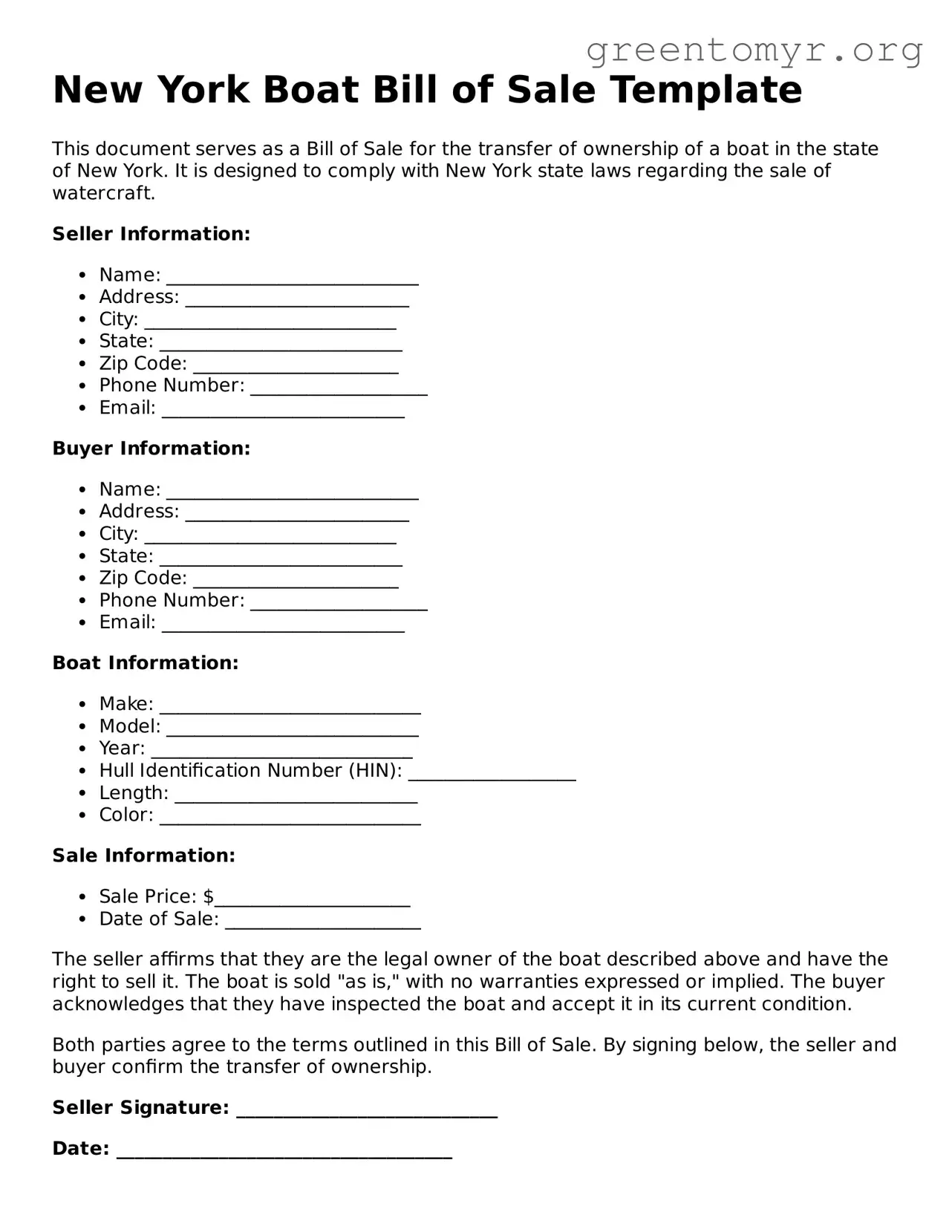
When purchasing or selling a boat in New York, a Boat Bill of Sale form is an essential document that facilitates a smooth transaction. This form serves as a written record of the sale, detailing key information about the vessel, such as its make, model, year, and hull identification number. It also includes the names and addresses of both the buyer and seller, ensuring that both parties have a clear understanding of the transaction. Additionally, the form may outline the purchase price and any terms or conditions agreed upon during the sale. By providing a comprehensive account of the transfer, the Boat Bill of Sale not only protects the interests of both parties but also helps to establish legal ownership and can be instrumental when registering the boat with state authorities. Understanding the nuances of this form is crucial for anyone involved in the buying or selling of a boat in New York, as it ensures compliance with local laws and regulations while safeguarding the rights of both the buyer and seller.
New York Boat Bill of Sale Template
This document serves as a Bill of Sale for the transfer of ownership of a boat in the state of New York. It is designed to comply with New York state laws regarding the sale of watercraft.
Seller Information:
Buyer Information:
Boat Information:
Sale Information:
The seller affirms that they are the legal owner of the boat described above and have the right to sell it. The boat is sold "as is," with no warranties expressed or implied. The buyer acknowledges that they have inspected the boat and accept it in its current condition.
Both parties agree to the terms outlined in this Bill of Sale. By signing below, the seller and buyer confirm the transfer of ownership.
Seller Signature: ____________________________
Date: ____________________________________
Buyer Signature: ____________________________
Date: ____________________________________
This Bill of Sale is governed by the laws of the state of New York.
| Fact Name | Description |
|---|---|
| Purpose | The New York Boat Bill of Sale is used to document the transfer of ownership of a boat from one party to another. |
| Governing Law | This form is governed by New York State laws, specifically the New York General Obligations Law. |
| Required Information | The form requires details such as the buyer's and seller's names, addresses, and the boat's description. |
| Notarization | While notarization is not mandatory, it is recommended to ensure the document's authenticity. |
| Tax Implications | Sales tax may apply to the transaction, and both parties should be aware of their tax responsibilities. |
| Use of Form | This form is commonly used for private sales, as well as sales through dealerships. |
| Record Keeping | Both the buyer and seller should keep a copy of the completed Bill of Sale for their records. |
| Boat Registration | The Bill of Sale is often required for registering the boat with the New York State Department of Motor Vehicles. |
| Transfer of Title | Completing the Bill of Sale helps facilitate the transfer of the boat's title from seller to buyer. |
| Dispute Resolution | In case of disputes, the Bill of Sale serves as a legal document that outlines the terms of the sale. |
Filling out the New York Boat Bill of Sale form is an important step in the process of transferring ownership of a boat. After completing the form, ensure that both the buyer and seller keep a copy for their records. This documentation is crucial for legal and registration purposes.
A New York Boat Bill of Sale form is a legal document that records the sale of a boat from one party to another. It serves as proof of the transaction and includes important details such as the boat's description, the sale price, and the names of both the buyer and seller. This document is essential for transferring ownership and can be used for registration purposes with the state.
The Boat Bill of Sale form typically requires the following information:
Providing accurate information is crucial to avoid any future disputes or complications.
In New York, notarization of the Boat Bill of Sale is not strictly required. However, having the document notarized can add an extra layer of authenticity and help protect both parties in case of disputes. It may also be beneficial when registering the boat with the state.
Once you have filled out the Boat Bill of Sale form, both the buyer and seller should keep a copy for their records. The seller should provide the buyer with the original signed document. The buyer will need this document when registering the boat with the New York Department of Motor Vehicles (DMV) or any other relevant authority. Make sure to check if any additional documents are required for registration.
If you notice mistakes on the Boat Bill of Sale after it has been completed, it’s important to correct them promptly. Both parties should agree on the corrections. You can either cross out the incorrect information and write in the correct details, or you may choose to create a new form altogether. Ensure that both parties sign the corrected document to confirm the changes.
Filling out the New York Boat Bill of Sale form can be straightforward, but many people make common mistakes that can lead to complications later on. One frequent error is providing incorrect or incomplete information about the boat. Details such as the hull identification number, make, model, and year are crucial. Missing even one piece of information can create issues during registration or when transferring ownership.
Another mistake involves the buyer and seller failing to sign the document. Both parties must sign the Boat Bill of Sale for it to be valid. Without the necessary signatures, the transaction may not be legally recognized, leaving both parties vulnerable to disputes. It is essential to ensure that all signatures are present before finalizing the sale.
People often overlook the importance of including the sale price. The form should clearly state the amount the buyer has agreed to pay. Omitting this detail can lead to misunderstandings and potential legal issues down the line. It also serves as a record for tax purposes, so clarity is vital.
Another common oversight is neglecting to date the form. A date is important for establishing when the sale took place. This can affect the timeline for registration and any associated taxes. Without a date, it may be challenging to prove when the transaction occurred, which can complicate future dealings.
Lastly, many individuals fail to keep a copy of the completed form. Retaining a copy is essential for both the buyer and the seller. It serves as proof of the transaction and can be invaluable in case of disputes or for future reference. Always make sure to have a signed copy for your records.
When purchasing or selling a boat in New York, the Boat Bill of Sale form is a key document that outlines the transaction details. However, several other forms and documents are often needed to ensure a smooth transfer of ownership and compliance with state regulations. Below are some of the essential documents commonly used alongside the Boat Bill of Sale.
Having these documents prepared and organized can facilitate a seamless transaction, ensuring that all legal requirements are met and both parties are protected. It’s always a good idea to consult with a professional if you have any questions about the process or specific requirements.
When filling out the New York Boat Bill of Sale form, it’s important to ensure accuracy and clarity. Here are some dos and don’ts to keep in mind:
The New York Boat Bill of Sale form is an important document for anyone buying or selling a boat in New York. However, several misconceptions exist about this form that can lead to confusion. Here are seven common misunderstandings:
Many people believe that a Bill of Sale is only required for larger transactions. In reality, it is advisable for all boat sales, regardless of the value, to have this document to provide proof of ownership and protect both parties.
Some individuals think that the Bill of Sale is only applicable to new boats. However, it is equally important for used boats. This form ensures that the transfer of ownership is documented, regardless of the boat's age.
There is a misconception that a Bill of Sale does not require notarization. While notarization is not mandatory for all transactions, having the document notarized can provide an extra layer of security and authenticity.
Some people assume that only the seller’s signature is necessary. In truth, both the buyer and the seller should sign the Bill of Sale to confirm the agreement and the transfer of ownership.
Many believe that the Bill of Sale is only needed for private transactions. However, it is also important for sales made through dealerships or brokers to ensure that all parties are protected legally.
Some individuals think that the Bill of Sale is difficult to understand or complete. In reality, the form is straightforward and typically requires basic information about the boat, the buyer, and the seller.
Lastly, a common misconception is that a Bill of Sale is not needed for registering a boat. In New York, a Bill of Sale is often required to register the boat and obtain a title, making it an essential document in the ownership process.
Understanding these misconceptions can help ensure a smoother transaction when buying or selling a boat in New York. It is always wise to consult with a knowledgeable professional if any questions arise regarding the Bill of Sale process.
Filling out and using the New York Boat Bill of Sale form is an important step in the process of buying or selling a boat. Here are key takeaways to keep in mind:
By following these guidelines, individuals can ensure a smoother transaction and protect their interests during the sale or purchase of a boat in New York.