Content Navigation

In the realm of real estate transactions, the New York Deed form plays a pivotal role in transferring property ownership from one party to another. This legal document serves as a formal declaration of the change in title, ensuring that the rights and responsibilities associated with the property are clearly outlined. Essential components of the form include the names of the grantor (the seller) and the grantee (the buyer), a detailed description of the property being transferred, and the signature of the grantor, which must be notarized to validate the transaction. Additionally, the form may require information about any encumbrances or liens on the property, providing transparency to the grantee regarding any existing financial obligations. Understanding the nuances of the New York Deed form is crucial for anyone involved in real estate, as it not only facilitates the legal transfer of property but also protects the interests of both parties in the transaction.

New York Deed Example

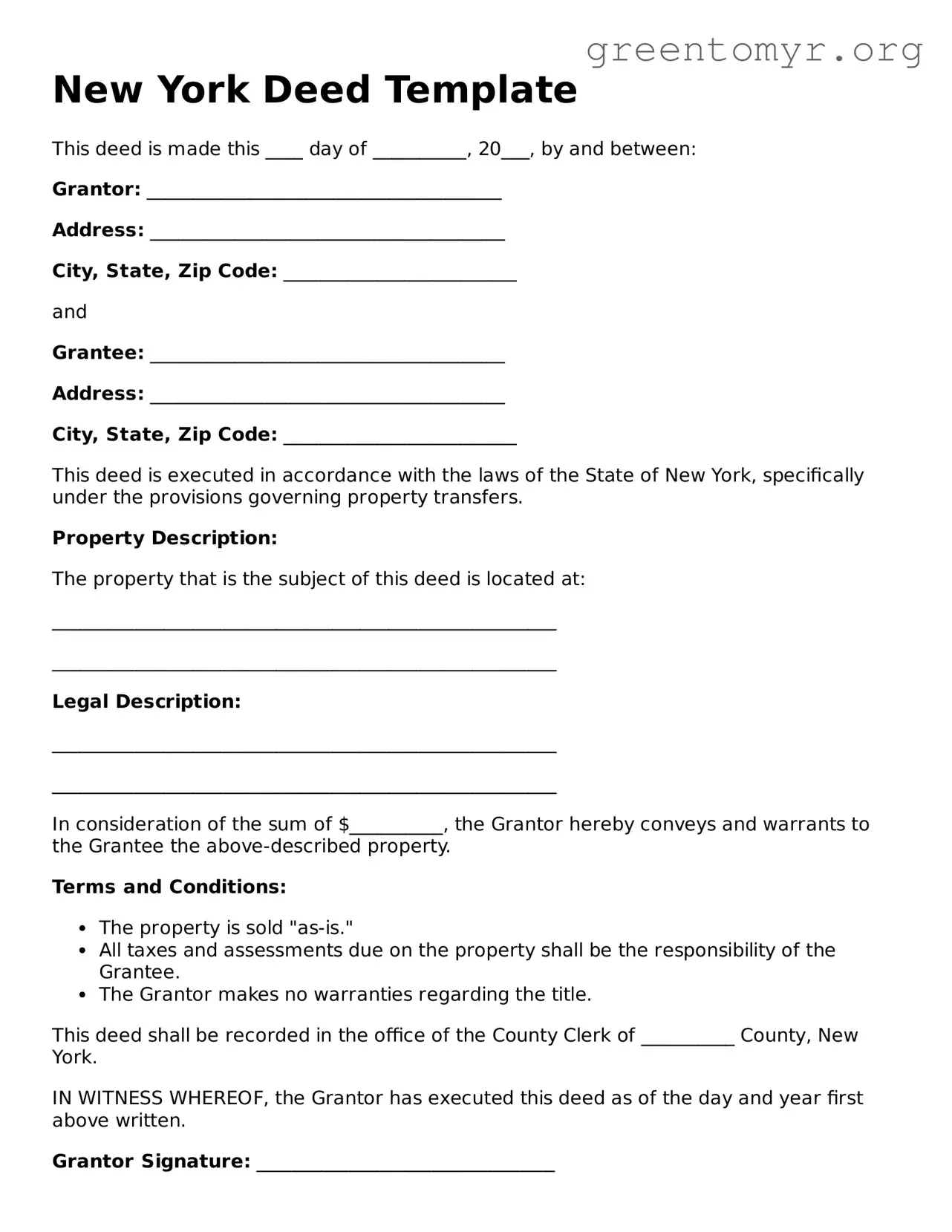
New York Deed Template

This deed is made this ____ day of __________, 20___, by and between:

Grantor: ______________________________________

Address: ______________________________________

City, State, Zip Code: _________________________

and

Grantee: ______________________________________

Address: ______________________________________

City, State, Zip Code: _________________________

This deed is executed in accordance with the laws of the State of New York, specifically under the provisions governing property transfers.

Property Description:

The property that is the subject of this deed is located at:

______________________________________________________

______________________________________________________

Legal Description:

______________________________________________________

______________________________________________________

In consideration of the sum of $__________, the Grantor hereby conveys and warrants to the Grantee the above-described property.

Terms and Conditions:

  • The property is sold "as-is."
  • All taxes and assessments due on the property shall be the responsibility of the Grantee.
  • The Grantor makes no warranties regarding the title.

This deed shall be recorded in the office of the County Clerk of __________ County, New York.

IN WITNESS WHEREOF, the Grantor has executed this deed as of the day and year first above written.

Grantor Signature: ________________________________

Date: ________________________________________

Witness Signature: _______________________________

Date: ________________________________________

Notary Public: _________________________________

My Commission Expires: ________________________

PDF Form Features

Fact Name Description
Purpose The New York Deed form is used to legally transfer ownership of real property from one party to another.
Types of Deeds In New York, common types of deeds include warranty deeds, quitclaim deeds, and bargain and sale deeds.
Governing Laws The New York Real Property Law governs the use and requirements of deed forms in the state.
Recording Requirements To ensure legal protection, the executed deed must be recorded in the county clerk's office where the property is located.

Guide to Using New York Deed

After completing the New York Deed form, the next step involves submitting it to the appropriate county clerk's office for recording. This ensures that the transfer of property ownership is officially recognized and documented.

  1. Obtain the New York Deed form from a reliable source or the county clerk's office.
  2. Fill in the date of the deed at the top of the form.
  3. Enter the name of the grantor (the person transferring the property) in the designated space.
  4. Provide the name of the grantee (the person receiving the property) in the next section.
  5. Include the property description, which should detail the location and boundaries of the property being transferred.
  6. Indicate the consideration amount, which is the price paid for the property.
  7. Sign the form in the appropriate area. The grantor’s signature is required.
  8. Have the signature notarized by a licensed notary public.
  9. Review the completed form for accuracy and completeness.
  10. Submit the form to the county clerk’s office along with any required fees.

Get Answers on New York Deed

What is a New York Deed form?

A New York Deed form is a legal document used to transfer ownership of real estate from one party to another in the state of New York. This form serves as proof of the transaction and outlines the details of the property being transferred, including the names of the parties involved, a description of the property, and any conditions of the transfer.

What types of deeds are available in New York?

New York recognizes several types of deeds, including:

  • Warranty Deed: Guarantees that the seller has clear title to the property and can defend against any claims.
  • Quitclaim Deed: Transfers whatever interest the seller has in the property without any guarantees.
  • Grant Deed: Implies that the seller has not transferred the property to anyone else and that the property is free from any encumbrances.
  • Executor's Deed: Used to transfer property from a deceased person's estate.

How do I complete a New York Deed form?

Completing a New York Deed form involves several steps:

  1. Identify the property being transferred, including its legal description.
  2. Clearly state the names and addresses of the grantor (seller) and grantee (buyer).
  3. Specify the type of deed being used.
  4. Include any necessary clauses or conditions related to the transfer.
  5. Sign the deed in the presence of a notary public.

Do I need to file the deed after completing it?

Yes, once the deed is completed and signed, it must be filed with the county clerk's office in the county where the property is located. This step is crucial as it provides public notice of the transfer and protects the new owner's rights to the property.

Are there any fees associated with filing a New York Deed?

Yes, there are typically fees associated with filing a deed in New York. These fees can vary by county, but they often include:

  • Recording fees
  • Transfer taxes
  • Potential additional charges for copies or certified copies of the deed

It's advisable to check with the local county clerk's office for the exact fees applicable to your situation.

Can I use a New York Deed form for any type of property?

Generally, a New York Deed form can be used for most types of real property, including residential, commercial, and vacant land. However, certain properties, such as those held in trust or subject to specific regulations, may require additional documentation or different forms. Always ensure that the deed complies with local laws and regulations to avoid complications.

Common mistakes

Filling out a New York Deed form can be a straightforward process, but many people make common mistakes that can lead to complications down the line. One frequent error is failing to include the correct names of the parties involved. It’s essential to ensure that the names of both the grantor (the seller) and the grantee (the buyer) are accurately listed. Any discrepancies can create confusion and may even invalidate the deed.

Another common mistake is neglecting to provide a proper legal description of the property. Simply writing the address is not sufficient. The legal description must be precise, detailing the boundaries and any relevant features of the property. Without this information, the deed may not adequately convey the intended property, leading to potential disputes.

Many individuals also overlook the importance of signatures. All parties involved in the transaction must sign the deed. Additionally, if the grantor is a business entity, the signature should be accompanied by the title of the person signing on behalf of the entity. Missing signatures can delay the recording process and create legal challenges.

Another mistake often made is failing to have the deed notarized. In New York, a deed must be acknowledged by a notary public to be legally valid. This step is crucial, as it verifies the identities of the signers and confirms that they willingly signed the document. Without notarization, the deed may not be accepted for recording.

Lastly, many people forget to check the filing requirements and fees associated with recording the deed. Each county in New York may have different requirements, including specific forms or fees. Being unaware of these can lead to delays in the recording process or even rejection of the deed. Always verify the local requirements to ensure a smooth transaction.

Documents used along the form

When completing a property transfer in New York, several important forms and documents accompany the Deed form. Each of these documents serves a specific purpose in ensuring the transaction is properly recorded and legally binding. Below is a brief overview of commonly used documents alongside the New York Deed form.

  • Affidavit of Title: This document provides a sworn statement from the seller, confirming their ownership of the property and asserting that there are no outstanding liens or claims against it. This helps protect the buyer from potential legal issues after the sale.
  • Transfer Tax Return: Also known as Form TP-584, this form is required to report the transfer of real property and to calculate any applicable transfer taxes. It must be filed with the county clerk's office at the time of the property transfer.
  • Notice of Sale: This document informs the local municipality of the sale of the property. It includes key details about the transaction, ensuring that the local government is aware of the change in ownership for tax and record-keeping purposes.
  • Property Survey: A property survey provides a detailed map of the property boundaries and any structures on the land. This document is essential for clarifying property lines and can help prevent disputes between neighbors.

Each of these documents plays a vital role in the property transfer process, ensuring clarity and legal protection for all parties involved. Understanding their significance can help facilitate a smoother transaction and provide peace of mind during this important step in property ownership.

Similar forms

The Deed form serves as an important legal document in property transactions and ownership transfers. It shares similarities with several other documents in the realm of real estate and legal agreements. Below is a list of ten documents that are comparable to the Deed form, along with explanations of their similarities:

  • Title Certificate: Like a Deed, a Title Certificate proves ownership of property. Both documents establish legal rights and can be used to verify the legitimacy of ownership.
  • Lease Agreement: A Lease Agreement outlines the terms under which one party can use another's property. Similar to a Deed, it formalizes the relationship between the parties involved, though it typically pertains to temporary use rather than ownership transfer.
  • Bill of Sale: This document transfers ownership of personal property, much like a Deed does for real estate. Both documents require signatures from the parties involved to validate the transfer.
  • Mortgage Agreement: A Mortgage Agreement secures a loan with the property as collateral. While a Deed transfers ownership, a Mortgage Agreement establishes the lender's interest in the property, linking both documents in the context of property financing.
  • Quitclaim Deed: This type of Deed transfers whatever interest the grantor has in the property without guaranteeing that the title is clear. Like a standard Deed, it is a means of transferring ownership, but it does so with less assurance regarding the property’s title.
  • Trust Agreement: A Trust Agreement allows property to be held by one party for the benefit of another. Similar to a Deed, it involves the transfer of property rights, but it also incorporates fiduciary responsibilities.
  • Power of Attorney: This document grants someone the authority to act on another's behalf in legal matters, including property transactions. Both the Power of Attorney and the Deed can facilitate the transfer of property rights, although they serve different roles in the process.
  • Affidavit of Title: This sworn statement attests to the ownership and status of a property. Like a Deed, it provides evidence of ownership but does so through a declaration rather than a transfer.
  • Property Transfer Agreement: This document outlines the terms of transferring property ownership. Similar to a Deed, it serves as a formal agreement between parties and includes details about the property in question.
  • Warranty Deed: A Warranty Deed guarantees that the grantor holds clear title to the property and has the right to sell it. Like a standard Deed, it facilitates the transfer of ownership but provides additional assurances regarding the title’s status.

Understanding these documents and their similarities to the Deed form can help clarify their roles in property transactions. Each serves a distinct purpose while also sharing common elements that reflect the importance of legal ownership and rights in real estate matters.

Dos and Don'ts

When filling out the New York Deed form, it's important to be careful and thorough. Here are some guidelines to help you navigate the process effectively:

  • Do ensure all names are spelled correctly. Mistakes can lead to complications later.
  • Do include the correct property description. This should match the information on the existing deed.
  • Do sign the form in the presence of a notary public. This step is crucial for the document's validity.
  • Don't leave any required fields blank. Incomplete forms may be rejected.
  • Don't use white-out or any correction fluid. If a mistake is made, it's best to cross it out and initial the change.
  • Don't forget to check local filing requirements. Different counties may have specific rules regarding deed submissions.

By following these tips, you can help ensure that your New York Deed form is completed correctly and efficiently.

Misconceptions

Understanding the New York Deed form is essential for anyone involved in real estate transactions in the state. However, several misconceptions can lead to confusion. Here are ten common misconceptions:

  1. All deeds are the same. Not all deeds serve the same purpose. New York recognizes various types of deeds, including warranty deeds and quitclaim deeds, each with distinct legal implications.
  2. A deed must be notarized to be valid. While notarization is highly recommended for proving authenticity, a deed can be valid without it as long as it meets other legal requirements.
  3. Deeds are only for transferring ownership. Deeds can also be used to create easements or to clarify property boundaries, not just for transferring ownership.
  4. You can use a generic deed form. Using a generic form may not comply with New York's specific requirements, which can lead to legal issues down the line.
  5. Once a deed is signed, it cannot be changed. While it is difficult to change a deed after it is executed, it is possible to amend it under certain circumstances.
  6. All property transfers require a deed. Some transfers, like those between spouses or through certain types of trusts, may not require a formal deed.
  7. A deed is the only document needed for a property transfer. In addition to a deed, other documents like title insurance and closing statements may be necessary to complete the transfer.
  8. Deeds can be created without legal advice. Although it is possible to draft a deed independently, consulting a legal professional is wise to avoid mistakes.
  9. Once recorded, a deed cannot be challenged. A recorded deed can still be contested in court under certain conditions, such as fraud or lack of capacity.
  10. All deeds must be recorded. While recording a deed is advisable for public notice, it is not legally required for the deed to be valid between the parties involved.

By addressing these misconceptions, individuals can navigate the complexities of the New York Deed form more effectively.

Key takeaways

Filling out and using the New York Deed form is an important process for transferring property ownership. Here are some key takeaways to consider:

  • Ensure that the deed accurately identifies the grantor (the person transferring the property) and the grantee (the person receiving the property).
  • Include a clear legal description of the property. This should detail the boundaries and location to avoid any confusion.
  • Sign the deed in front of a notary public. This step is crucial, as it validates the document and ensures its legal standing.
  • File the completed deed with the appropriate county clerk's office. This is necessary to make the transfer official and publicly recorded.
  • Consider consulting with a real estate attorney to ensure compliance with all state laws and regulations. This can help prevent potential disputes in the future.

Understanding these key points can facilitate a smoother property transfer process in New York.