When navigating the often complex waters of divorce in New York, understanding the Divorce Settlement Agreement form is crucial. This document serves as a roadmap for couples looking to finalize their separation with clarity and fairness. It outlines key aspects such as the division of assets, child custody arrangements, and spousal support, ensuring that both parties have a clear understanding of their rights and responsibilities. By addressing these important issues, the form helps to minimize conflict and provides a structured approach to what can be an emotionally charged process. Additionally, it can include provisions for the division of debts and other financial obligations, making it a comprehensive tool for achieving a fair settlement. Knowing how to effectively utilize this form can lead to a smoother transition into post-divorce life, allowing individuals to focus on their future rather than lingering disputes.
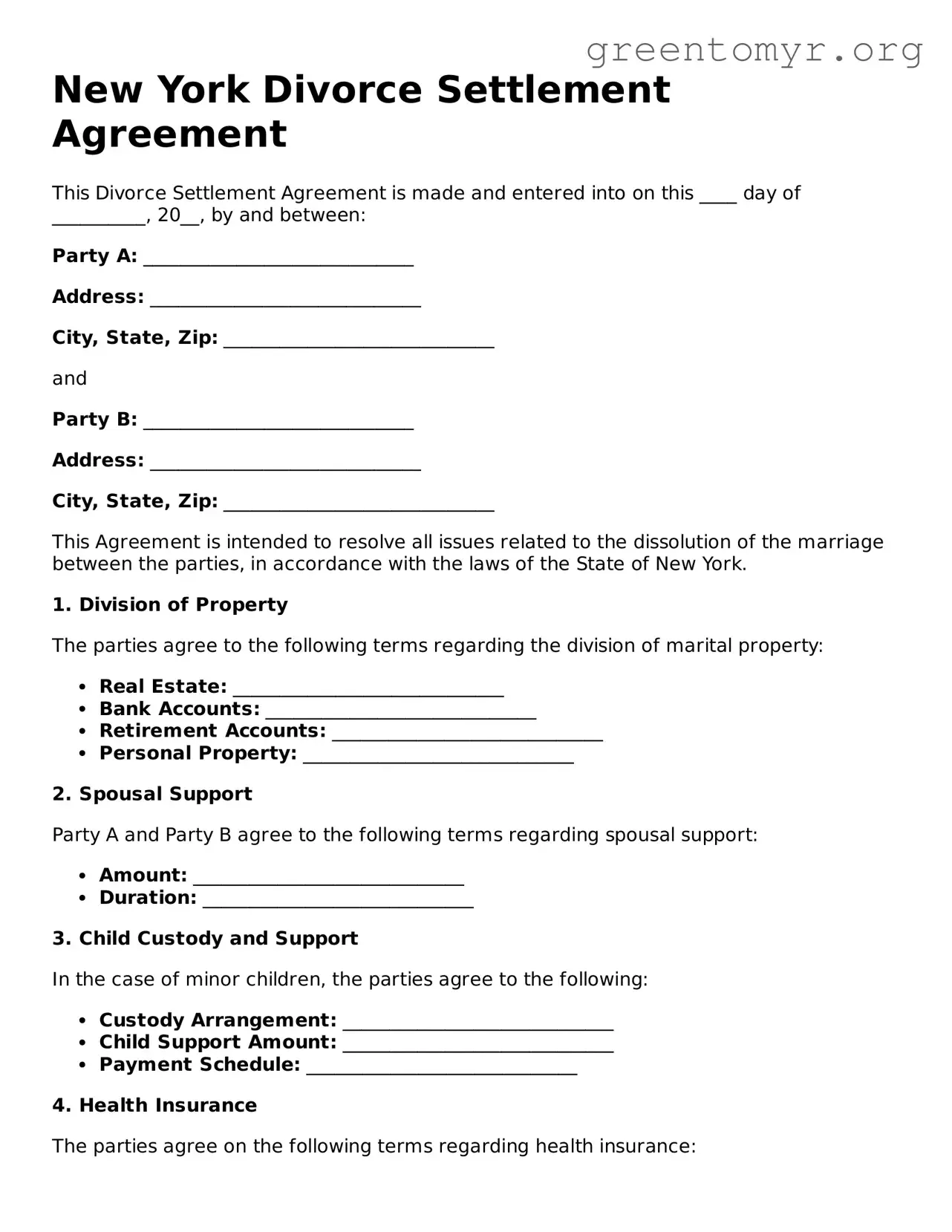
New York Divorce Settlement Agreement
This Divorce Settlement Agreement is made and entered into on this ____ day of __________, 20__, by and between:
Party A: _____________________________
Address: _____________________________
City, State, Zip: _____________________________
and
Party B: _____________________________
Address: _____________________________
City, State, Zip: _____________________________
This Agreement is intended to resolve all issues related to the dissolution of the marriage between the parties, in accordance with the laws of the State of New York.
1. Division of Property
The parties agree to the following terms regarding the division of marital property:
2. Spousal Support
Party A and Party B agree to the following terms regarding spousal support:
3. Child Custody and Support
In the case of minor children, the parties agree to the following:
4. Health Insurance
The parties agree on the following terms regarding health insurance:
5. Miscellaneous Provisions
This Agreement constitutes the entire understanding between the parties and supersedes any prior agreements. Any modifications must be in writing and signed by both parties.
IN WITNESS WHEREOF, the parties have executed this Divorce Settlement Agreement on the date first above written.
Party A Signature: _____________________________
Date: _____________________________
Party B Signature: _____________________________
Date: _____________________________
| Fact Name | Description |
|---|---|
| Purpose | The New York Divorce Settlement Agreement form outlines the terms agreed upon by both parties regarding the division of assets, debts, and other relevant issues during a divorce. |
| Governing Law | This agreement is governed by the New York Domestic Relations Law, which sets the legal framework for divorce proceedings in the state. |
| Mutual Agreement | Both spouses must voluntarily agree to the terms laid out in the settlement. This ensures that both parties have a say in the outcome. |
| Asset Division | The form details how marital property, including real estate, bank accounts, and personal belongings, will be divided between the spouses. |
| Child Custody | If applicable, the agreement specifies the arrangements for child custody, visitation rights, and decision-making responsibilities for any children involved. |
| Spousal Support | Details regarding any spousal support or alimony payments are included, outlining the amount and duration of support payments. |
| Legal Representation | While it is not mandatory, both parties are encouraged to seek legal advice to ensure their rights are protected before signing the agreement. |
| Finalization | Once signed, the agreement must be submitted to the court for approval. The court will review the terms to ensure they are fair and reasonable. |
After gathering all necessary information and documents, you will proceed to fill out the New York Divorce Settlement Agreement form. This form serves as a written record of the agreements made between both parties regarding various aspects of the divorce, such as property division, child custody, and support obligations.
A Divorce Settlement Agreement is a legal document that outlines the terms of a divorce between two parties. It covers various aspects such as property division, child custody, child support, and spousal support. This agreement is crucial as it helps both parties reach a mutual understanding and provides a clear framework for their post-divorce responsibilities.
Both spouses involved in a divorce should complete a Divorce Settlement Agreement. It is essential for those who wish to settle their divorce amicably without going to court. This document can help avoid lengthy legal battles and provides clarity on each party's rights and obligations.
A Divorce Settlement Agreement typically includes the following:
It is important to ensure that all terms are clearly defined to avoid misunderstandings in the future.
Once signed by both parties, the Divorce Settlement Agreement becomes a legally binding document. If one party fails to comply with the terms, the other party can seek enforcement through the court. This may involve filing a motion to compel compliance or seeking modification if circumstances change.
Yes, a Divorce Settlement Agreement can be modified, but only under certain circumstances. If there is a significant change in circumstances, such as a change in income or relocation, either party may request a modification. It is advisable to document any agreed changes formally to ensure clarity and legality.
If both parties cannot agree on the terms of the Divorce Settlement Agreement, they may need to consider mediation or seek legal representation. Mediation can help facilitate discussions and reach a compromise. If mediation fails, the case may proceed to court, where a judge will make the final decisions.
While it is not mandatory to have a lawyer draft a Divorce Settlement Agreement, it is highly recommended. A lawyer can provide valuable guidance, ensure that your rights are protected, and help navigate complex legal issues. If you choose to proceed without a lawyer, be sure to thoroughly research the requirements and implications of the agreement.
The time it takes to finalize a Divorce Settlement Agreement varies based on the complexity of the issues and the willingness of both parties to negotiate. If both parties are cooperative, it may take only a few weeks. However, if there are disputes or complications, it could take several months to reach an agreement.
The Divorce Settlement Agreement should be filed with the court that is handling your divorce case. It is essential to follow the specific filing procedures of that court to ensure the agreement is recognized and enforceable. Be sure to keep copies of all documents for your records.
Filling out the New York Divorce Settlement Agreement form can be a complex process, and many individuals make mistakes that can have significant consequences. One common error is failing to provide complete and accurate information. Incomplete forms can lead to delays in the divorce process and may require additional court appearances.
Another mistake is not fully understanding the financial implications of the agreement. Parties often overlook the importance of detailing all assets and debts. This oversight can result in disputes later on, as one party may feel entitled to more than what was agreed upon.
Additionally, individuals sometimes neglect to consider tax consequences related to asset division. For example, transferring retirement accounts or real estate may have tax implications that should be discussed with a financial advisor. Ignoring these details can lead to unexpected financial burdens post-divorce.
Some people also fail to include provisions for future changes in circumstances. Life is unpredictable, and including clauses that address potential changes, such as job loss or relocation, can prevent future conflicts. Without these considerations, one party may find themselves at a disadvantage later.
Moreover, parties may not seek legal advice before finalizing the agreement. While it is possible to complete the form without an attorney, having legal guidance can help ensure that all rights are protected and that the agreement is fair and equitable.
Another frequent mistake is not being clear about child custody and support arrangements. Ambiguities in these sections can lead to misunderstandings and disputes. Clear, detailed descriptions of custody arrangements and support obligations are essential for the well-being of the children involved.
Some individuals may also overlook the necessity of notarizing the agreement. Notarization adds a level of authenticity and can be crucial if the agreement is challenged in the future. Failing to have the document notarized may render it less enforceable.
Finally, individuals sometimes rush through the process, leading to oversight of important details. Taking the time to carefully review each section of the form can prevent mistakes that could complicate the divorce process. A thorough review can ensure that the agreement accurately reflects the intentions of both parties.
When navigating the process of divorce in New York, several key documents accompany the Divorce Settlement Agreement. Each of these forms plays a crucial role in ensuring that the divorce proceedings are clear, fair, and legally binding. Understanding these documents can help individuals better prepare for their divorce and facilitate smoother negotiations.
Each of these documents plays a vital role in the divorce process, ensuring clarity and fairness for both parties involved. Familiarity with these forms can help individuals navigate their divorce more effectively and protect their interests throughout the proceedings.
When filling out the New York Divorce Settlement Agreement form, it’s essential to approach the process thoughtfully. Here’s a list of things to do and things to avoid to ensure that your agreement is clear and legally sound.
By following these guidelines, you can help ensure that your Divorce Settlement Agreement is thorough and reflects your intentions clearly.
Many individuals going through a divorce may have misconceptions about the New York Divorce Settlement Agreement form. Understanding these misconceptions can help clarify the process and ensure that individuals are better prepared. Here are nine common misconceptions:
The Divorce Settlement Agreement is the same as a divorce decree. This is not true. The agreement outlines the terms both parties have agreed upon, while the decree is the court's final order that officially ends the marriage.
Once signed, the Divorce Settlement Agreement cannot be changed. In reality, if both parties agree, modifications can be made. However, any changes must be documented and, in some cases, approved by the court.
The form guarantees equal division of assets. The agreement reflects what both parties negotiate. It is possible for one party to receive more than the other based on various factors.
Only lawyers can draft a Divorce Settlement Agreement. While it is advisable to have legal assistance, individuals can draft their own agreements as long as they meet legal requirements.
The agreement is only about property division. This misconception overlooks other important issues such as child custody, visitation rights, and spousal support.
Signing the agreement means you cannot go to court. If disputes arise, parties can still seek court intervention. The agreement serves as a guideline but does not eliminate the possibility of court involvement.
The Divorce Settlement Agreement must be filed with the court immediately. While it is important to file it, there is often a timeline that allows for review and negotiation before submission.
All agreements are fair and equitable. Fairness is subjective. What seems fair to one party may not be perceived the same way by the other, making negotiation crucial.
Once the agreement is signed, there are no further obligations. Parties must adhere to the terms of the agreement. Failure to do so may result in legal consequences.
Recognizing these misconceptions can empower individuals to approach their divorce with a clearer understanding and better preparation.
Filling out and using the New York Divorce Settlement Agreement form is an important step in finalizing a divorce. Understanding the key elements can help ensure that the process goes smoothly. Here are some essential takeaways: