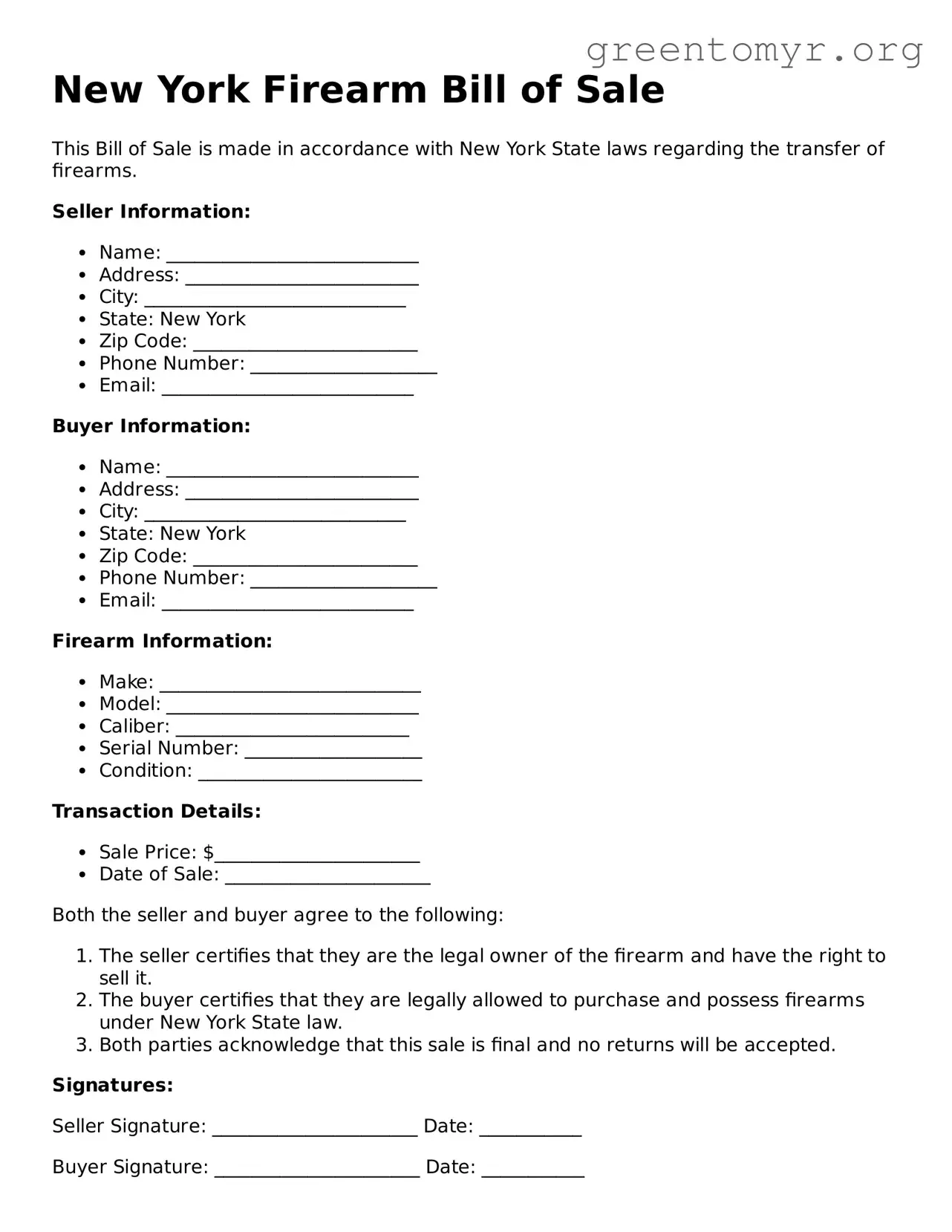
The New York Firearm Bill of Sale form serves as a crucial document for individuals engaged in the sale or transfer of firearms within the state. This form provides a clear record of the transaction, ensuring that both the buyer and seller have a mutual understanding of the terms involved. Key elements of the form include the identification details of both parties, descriptions of the firearm being sold, and the purchase price. Additionally, it often requires signatures from both the buyer and seller, thereby formalizing the agreement. This documentation not only protects the rights of both parties but also helps in maintaining compliance with state laws regarding firearm ownership and transfer. Understanding the importance of this form can significantly enhance the transparency and legality of firearm transactions in New York.
New York Firearm Bill of Sale
This Bill of Sale is made in accordance with New York State laws regarding the transfer of firearms.
Seller Information:
Buyer Information:
Firearm Information:
Transaction Details:
Both the seller and buyer agree to the following:
Signatures:
Seller Signature: ______________________ Date: ___________
Buyer Signature: ______________________ Date: ___________
This document serves as proof of the transaction and should be retained by both parties for their records.
| Fact Name | Description |
|---|---|
| Purpose | The New York Firearm Bill of Sale form is used to document the sale or transfer of a firearm between private parties. |
| Governing Law | This form is governed by New York State Penal Law § 400.00, which outlines the regulations surrounding firearm transactions. |
| Requirements | Both the seller and buyer must be legally eligible to own a firearm in New York State, and the form should include details such as the firearm's make, model, and serial number. |
| Record Keeping | It is advisable for both parties to keep a copy of the completed Bill of Sale for their records, as it serves as proof of the transaction. |
Once you have the New York Firearm Bill of Sale form ready, you can proceed to fill it out with the necessary details. This form is essential for documenting the transfer of firearm ownership. Accuracy is key, so take your time to ensure all information is correct.
After completing the form, keep copies for both the seller and buyer. It’s advisable to retain this documentation for future reference, as it serves as proof of the transaction. Make sure to review any local regulations that may apply to the sale of firearms in your area.
The New York Firearm Bill of Sale form is a legal document used to record the transfer of ownership of a firearm between two parties. This form serves as proof of the transaction and includes important details such as the buyer's and seller's information, the firearm's description, and the date of the sale. Although not always legally required, it is highly recommended to protect both parties in the event of future disputes.
While New York law does not mandate a Bill of Sale for private firearm transactions, it is advisable to complete one. Having a Bill of Sale can help document the transfer of ownership and may assist in proving that the seller no longer owns the firearm, which can be important for legal purposes. It also provides a clear record for the buyer that they have purchased the firearm legally.
A comprehensive Firearm Bill of Sale should include the following details:
Including this information helps ensure that the document is legally binding and clear in its terms.
No, notarization is not a requirement for a Firearm Bill of Sale in New York. However, having the document notarized can add an extra layer of authenticity and may be beneficial if any disputes arise in the future. It can also serve as a safeguard to verify the identities of the parties involved.
Yes, you can use a generic Bill of Sale template, but it is crucial to ensure that it includes all necessary details specific to the firearm transaction. Customized templates tailored for firearm sales are often available online and can provide better protection for both parties. Always double-check that the template complies with New York laws to avoid any potential issues.
If you lose your Bill of Sale, it is advisable to create a duplicate as soon as possible. Both parties should retain a copy of the original document. If you cannot recreate the original, you may want to draft a new Bill of Sale and have both parties sign it again. This new document can reference the original transaction to maintain a clear record.
Not having a Bill of Sale can lead to complications if legal issues arise regarding the ownership of the firearm. Without this document, proving ownership may become difficult, especially if the firearm is involved in a crime or if there are disputes about the sale. A Bill of Sale provides essential evidence of the transaction, protecting both the buyer and seller.
Filling out the New York Firearm Bill of Sale form requires attention to detail. One common mistake is failing to provide accurate personal information. Buyers and sellers must ensure that their names, addresses, and contact information are correct. Any discrepancies can lead to delays or complications in the transaction.
Another frequent error involves the description of the firearm. The form requires specific details, such as the make, model, caliber, and serial number. Omitting any of these details or providing incorrect information can invalidate the sale. It is essential to double-check this information before finalizing the document.
People often overlook the importance of signatures. Both the buyer and seller must sign the form for it to be legally binding. Sometimes, one party may forget to sign or may not date the document. This oversight can cause issues later, especially if there are disputes regarding the sale.
In some cases, individuals fail to include the date of the transaction. The date is crucial for record-keeping and legal purposes. Without it, tracking the sale can become complicated, especially if there are questions about the timing of the transfer.
Another mistake is not providing a witness signature when required. While not always necessary, having a witness can add an extra layer of legitimacy to the transaction. If the sale involves a private transfer, including a witness can help protect both parties in case of future disputes.
People sometimes forget to retain copies of the completed form. Both the buyer and seller should keep a copy for their records. This documentation can be vital if there are any questions or issues that arise after the sale.
Lastly, failing to understand local laws can lead to significant problems. While the form itself is straightforward, regulations regarding firearm sales can vary. It is important to be aware of any additional requirements that may exist at the city or county level to ensure compliance.
When engaging in the transfer of firearms in New York, several additional forms and documents may be necessary to ensure compliance with state laws and regulations. Each of these documents serves a specific purpose and can help facilitate a smooth transaction.
Utilizing these forms and documents can help ensure that all aspects of the firearm transfer process are handled legally and responsibly. It is important to stay informed about local laws and requirements to protect both parties involved in the transaction.
The Firearm Bill of Sale form serves a specific purpose in documenting the transfer of firearm ownership. However, several other documents share similarities in function or intent. Here are five such documents:
When filling out the New York Firearm Bill of Sale form, it’s essential to follow specific guidelines to ensure the process goes smoothly. Here are some important do's and don'ts:
By following these guidelines, you can ensure a smooth transaction when completing the Firearm Bill of Sale form.
The New York Firearm Bill of Sale form is often misunderstood. Here are seven common misconceptions about it:
Misconception 1: A bill of sale is not necessary for firearm transactions in New York.
In fact, while not always legally required, having a bill of sale is highly recommended. It provides proof of ownership and can protect both the buyer and seller.
Misconception 2: The bill of sale must be notarized.
Notarization is not a requirement for the bill of sale in New York. However, having it notarized can add an extra layer of authenticity.
Misconception 3: Only licensed dealers can use a bill of sale.
Both private sellers and licensed dealers can use the bill of sale. It is a useful tool for any transaction involving firearms.
Misconception 4: The bill of sale is the same as a background check.
The bill of sale does not replace the need for a background check. Buyers must still undergo the appropriate background check as mandated by law.
Misconception 5: The form does not need to include personal information.
Both the buyer's and seller's information should be included on the form. This ensures accountability and traceability in the transaction.
Misconception 6: Once the bill of sale is signed, the seller has no further responsibilities.
The seller may still have obligations, especially if the firearm is later used in a crime. Keeping records can help clarify the seller's position.
Misconception 7: A bill of sale is only for handguns.
The bill of sale can be used for all types of firearms, including rifles and shotguns. It is a versatile document for any firearm transaction.
Understanding these misconceptions can help ensure smoother and more compliant firearm transactions in New York.
When filling out and using the New York Firearm Bill of Sale form, it is essential to understand the following key points: