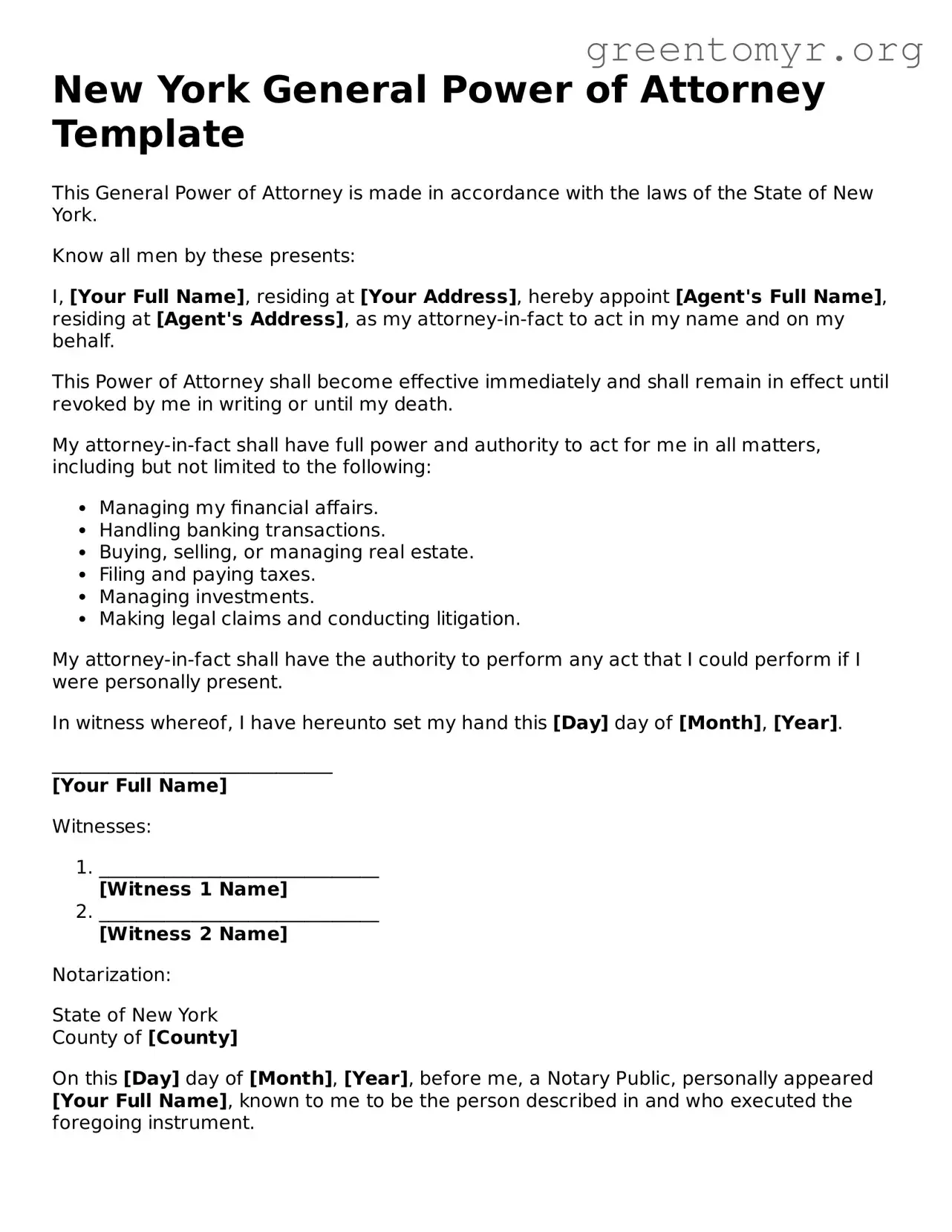
The New York General Power of Attorney form is a crucial legal document that allows individuals to appoint someone they trust to manage their financial affairs and make decisions on their behalf. This form can be particularly useful in situations where a person may be unable to handle their own affairs due to illness, travel, or other circumstances. By designating an agent, the principal grants them the authority to perform a wide range of tasks, including managing bank accounts, paying bills, buying or selling property, and handling investments. It’s important to note that this power can be tailored to fit specific needs, meaning that the principal can choose to grant broad or limited powers. Additionally, the form requires the principal to sign it in the presence of a notary public, ensuring that the document is legally binding. Understanding the implications of this form is essential, as it can significantly impact financial management and personal autonomy. With the right knowledge, individuals can make informed decisions about their legal and financial futures.
New York General Power of Attorney Template
This General Power of Attorney is made in accordance with the laws of the State of New York.
Know all men by these presents:
I, [Your Full Name], residing at [Your Address], hereby appoint [Agent's Full Name], residing at [Agent's Address], as my attorney-in-fact to act in my name and on my behalf.
This Power of Attorney shall become effective immediately and shall remain in effect until revoked by me in writing or until my death.
My attorney-in-fact shall have full power and authority to act for me in all matters, including but not limited to the following:
My attorney-in-fact shall have the authority to perform any act that I could perform if I were personally present.
In witness whereof, I have hereunto set my hand this [Day] day of [Month], [Year].
______________________________
[Your Full Name]
Witnesses:
Notarization:
State of New York
County of [County]
On this [Day] day of [Month], [Year], before me, a Notary Public, personally appeared [Your Full Name], known to me to be the person described in and who executed the foregoing instrument.
______________________________
Notary Public
| Fact Name | Description |
|---|---|
| Definition | A New York General Power of Attorney form allows an individual (the principal) to grant another person (the agent) the authority to make financial decisions on their behalf. |
| Governing Law | This form is governed by the New York General Obligations Law, specifically Article 5, Title 15. |
| Durability | The power of attorney can be durable, meaning it remains effective even if the principal becomes incapacitated. |
| Agent's Authority | The agent can perform various financial tasks, such as managing bank accounts, paying bills, and filing taxes. |
| Revocation | The principal can revoke the power of attorney at any time, as long as they are mentally competent. |
| Signature Requirements | The form must be signed by the principal and acknowledged before a notary public or another authorized official. |
| Witnesses | While not required, having one or two witnesses sign the document can strengthen its validity. |
| Limitations | Some powers, such as making healthcare decisions, are not covered under a general power of attorney and require a separate form. |
| Agent's Responsibilities | The agent must act in the best interest of the principal and keep accurate records of transactions made on their behalf. |
| Filing Requirements | There are no filing requirements with the state; however, it is advisable to keep copies in a safe place and share them with relevant parties. |
Completing the New York General Power of Attorney form is a straightforward process. This document allows you to designate someone to handle your financial matters on your behalf. Follow these steps carefully to ensure the form is filled out correctly.
A General Power of Attorney (GPOA) is a legal document that allows an individual, known as the principal, to appoint another person, referred to as the agent or attorney-in-fact, to act on their behalf. This authority can cover a wide range of financial and legal matters, including managing bank accounts, signing checks, and handling real estate transactions.
The powers granted can be quite broad. Some common powers include:
However, the principal can specify limitations or particular areas of authority within the document.
To create a GPOA in New York, follow these steps:
It's advisable to keep copies for your records and provide one to your agent.
No, a lawyer is not required to create a General Power of Attorney in New York. However, consulting a legal professional can help ensure that the document meets your specific needs and complies with state laws.
Yes, a General Power of Attorney can be revoked at any time by the principal, as long as they are mentally competent. To revoke the document, the principal should create a written revocation and notify the agent and any relevant institutions.
If the principal becomes incapacitated, a General Power of Attorney typically becomes ineffective unless it is a durable power of attorney. A durable power of attorney remains in effect even if the principal loses the ability to make decisions.
A General Power of Attorney executed in New York may not be valid in other states. Each state has its own laws regarding powers of attorney. It is important to check the specific requirements of the state where the powers will be used.
Yes, the principal can limit the powers granted in the General Power of Attorney. Specific tasks can be outlined, and certain powers can be excluded. This customization allows the principal to maintain control over what decisions the agent can make on their behalf.
When completing the New York General Power of Attorney form, individuals often overlook important details that can lead to complications. One common mistake is failing to clearly identify the principal and the agent. It is crucial that the names are spelled correctly and that the relationship between the two parties is clearly defined. This helps to avoid confusion and ensures that the agent has the authority to act on behalf of the principal.
Another frequent error involves not specifying the powers granted to the agent. The form allows for a range of powers, from managing financial affairs to making healthcare decisions. Leaving this section vague can lead to misunderstandings about what the agent is authorized to do. It is advisable to be as specific as possible to prevent any potential disputes.
Many people also neglect to sign and date the form correctly. The principal must sign the document in the presence of a notary public. If this step is skipped or done improperly, the power of attorney may be deemed invalid. Ensuring that all signatures are present and dated is a simple yet essential step in the process.
Another mistake is failing to consider the witnesses. In New York, while a power of attorney does not require witnesses, having them can add an extra layer of protection. If there are concerns about the principal's capacity or the authenticity of the document, witnesses can help validate the process. It is wise to have at least one witness present during the signing.
Lastly, individuals often forget to keep copies of the completed form. After the power of attorney is executed, it is important for both the principal and the agent to retain copies. This ensures that both parties have access to the document when needed and helps prevent misunderstandings. Keeping organized records can facilitate smoother transactions and decisions in the future.
A General Power of Attorney is a powerful legal document that allows one person to act on behalf of another in financial matters. However, it is often accompanied by other forms and documents that can provide additional clarity or serve specific purposes. Below is a list of commonly used documents that may be relevant when executing a General Power of Attorney in New York.
These documents can complement a General Power of Attorney, providing a comprehensive approach to managing one's affairs. It is crucial to consider each document's purpose and how they interact with one another to ensure that your intentions are clearly communicated and legally upheld.
The General Power of Attorney form is similar to several other legal documents that grant authority to act on someone else's behalf. Here are eight documents that share similarities:
When filling out the New York General Power of Attorney form, it is important to follow certain guidelines to ensure the document is valid and effective. Below are some recommended practices as well as common pitfalls to avoid.
By following these guidelines, individuals can help ensure that their General Power of Attorney form is completed correctly and serves its intended purpose.
Understanding the New York General Power of Attorney form can be tricky. There are several misconceptions that people often have. Let’s clear up some of these misunderstandings.
Many believe that a General Power of Attorney grants unrestricted authority. In reality, it only allows the agent to act within the specified powers outlined in the document.
While it is commonly used for financial transactions, it can also cover various aspects of healthcare and legal decisions, depending on how it is drafted.
This is false. A principal can revoke a General Power of Attorney at any time, as long as they are mentally competent.
In fact, a General Power of Attorney becomes invalid upon the principal's death. It does not extend to matters of the estate.
While it's wise to consult a lawyer, individuals can prepare their own General Power of Attorney as long as they follow the proper guidelines.
Although notarization is highly recommended and often required, the form may still be valid if it meets other legal criteria in New York.
These are not interchangeable. A Durable Power of Attorney remains effective even if the principal becomes incapacitated, while a General Power of Attorney does not.
Agents have a fiduciary duty to act in the best interest of the principal. They can be held accountable for any misuse of power.
Anyone, regardless of age or health, can benefit from having a General Power of Attorney to manage their affairs in case of unforeseen circumstances.
Each General Power of Attorney can be customized to fit individual needs. The powers granted can be tailored to specific situations.
By understanding these common misconceptions, you can make informed decisions about creating and using a General Power of Attorney in New York. Always consider your unique circumstances and consult with a professional if needed.
Filling out and using the New York General Power of Attorney form can be a crucial step in managing your financial and legal affairs. Here are some key takeaways to keep in mind:
By keeping these points in mind, you can effectively navigate the process of setting up a General Power of Attorney in New York.