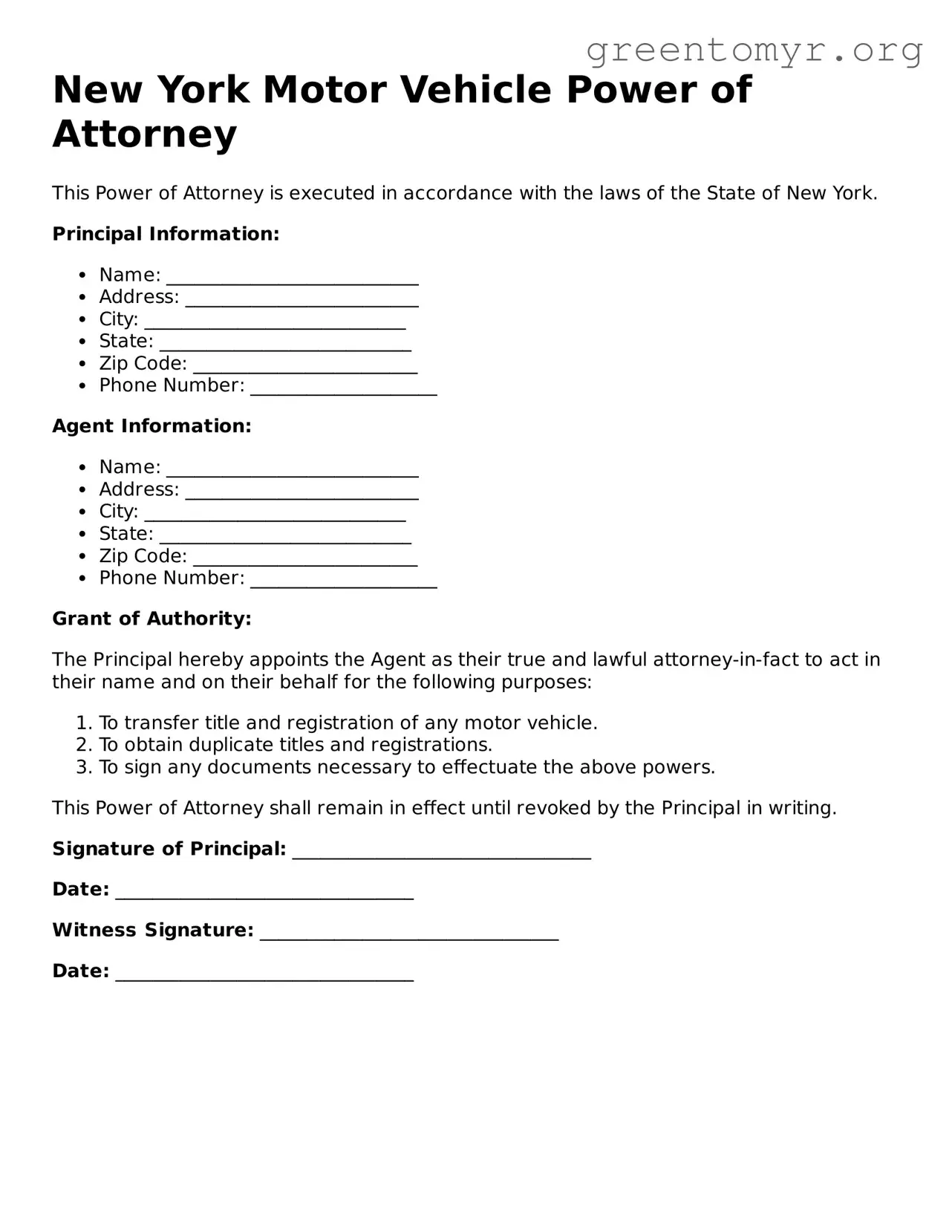
The New York Motor Vehicle Power of Attorney (POA) form is an essential document designed to empower individuals to delegate authority regarding their motor vehicle transactions to a trusted representative. This form is particularly useful for those who may be unable to handle their vehicle-related matters in person, whether due to health issues, time constraints, or other personal circumstances. By completing this form, a vehicle owner can authorize another person to perform a variety of tasks on their behalf, such as signing documents for vehicle registration, transferring ownership, or obtaining title certificates. The designated agent, once appointed, gains the legal authority to act in the best interest of the vehicle owner, ensuring that all necessary actions are taken efficiently and correctly. It is important to understand the specific powers being granted, as the form outlines the scope of authority clearly, allowing for customization based on individual needs. Moreover, the process of completing the form is straightforward, requiring basic information about both the vehicle owner and the appointed agent, along with appropriate signatures. Overall, the New York Motor Vehicle Power of Attorney form serves as a practical solution for facilitating vehicle transactions while providing peace of mind to vehicle owners who may need assistance.
New York Motor Vehicle Power of Attorney
This Power of Attorney is executed in accordance with the laws of the State of New York.
Principal Information:
Agent Information:
Grant of Authority:
The Principal hereby appoints the Agent as their true and lawful attorney-in-fact to act in their name and on their behalf for the following purposes:
This Power of Attorney shall remain in effect until revoked by the Principal in writing.
Signature of Principal: ________________________________
Date: ________________________________
Witness Signature: ________________________________
Date: ________________________________
| Fact Name | Description |
|---|---|
| Purpose | The New York Motor Vehicle Power of Attorney form allows an individual to designate another person to handle vehicle-related transactions on their behalf. |
| Governing Law | This form is governed by New York Vehicle and Traffic Law, specifically Section 370. |
| Eligibility | Any person who owns a vehicle in New York can complete this form to grant authority to another individual. |
| Signature Requirement | The form must be signed by the vehicle owner in the presence of a notary public to be valid. |
| Revocation | The power of attorney can be revoked at any time by the principal, provided they notify the agent and any relevant parties. |
| Use Cases | This form is commonly used for tasks like transferring ownership, registering a vehicle, or obtaining a duplicate title. |
Filling out the New York Motor Vehicle Power of Attorney form is a straightforward process that allows you to designate someone to act on your behalf regarding motor vehicle matters. After completing the form, you will need to submit it to the appropriate authorities to ensure that your designated representative can perform the necessary actions.
A Motor Vehicle Power of Attorney (POA) form in New York is a legal document that allows one person to designate another person to act on their behalf regarding motor vehicle transactions. This can include tasks such as registering a vehicle, transferring ownership, or obtaining a title. The person granting the authority is known as the principal, while the person receiving the authority is referred to as the agent or attorney-in-fact.
Any individual who is at least 18 years old and legally competent can be appointed as an agent. This can include family members, friends, or professionals, such as a lawyer or a notary. It is important to choose someone trustworthy, as they will have the authority to make decisions regarding your vehicle.
The Motor Vehicle Power of Attorney can grant various powers, including but not limited to:
It is essential to specify the powers you wish to grant in the document to ensure clarity and avoid misunderstandings.
The Motor Vehicle Power of Attorney form is specific to New York State. While some states may recognize a New York POA, it is advisable to check the laws of the state where the vehicle transaction will take place. If you need to perform vehicle-related tasks in another state, you may need to complete that state's specific POA form.
To complete the form, follow these steps:
Yes, the Motor Vehicle Power of Attorney form must be notarized to be legally binding. This step helps verify the identities of both the principal and the agent and ensures that the document is executed properly. Without notarization, the form may not be accepted by the DMV or other entities involved in vehicle transactions.
Yes, you can revoke a Motor Vehicle Power of Attorney at any time, as long as you are competent to do so. To revoke the POA, you should complete a revocation form and notify the agent in writing. It is also advisable to inform the DMV and any other relevant parties of the revocation to prevent unauthorized actions regarding your vehicle.
If your agent is unable to fulfill their duties, you have a couple of options. You can appoint a new agent by completing a new Motor Vehicle Power of Attorney form. Alternatively, if you wish to revoke the existing POA, you can do so as described earlier. Keeping your documents up to date ensures that your vehicle-related matters are handled by someone you trust.
Filling out the New York Motor Vehicle Power of Attorney form can seem straightforward, but many individuals make common mistakes that can lead to complications. One frequent error is neglecting to provide complete information about the vehicle. When the details such as the vehicle identification number (VIN) and license plate number are missing or incorrect, it can create confusion and delay in processing. Always double-check that you have entered all necessary information accurately.
Another mistake involves failing to sign the form properly. The Power of Attorney requires signatures from both the principal and the agent. If either party forgets to sign, or if the signatures do not match the names listed on the form, it may render the document invalid. Make sure that everyone involved has signed the form in the designated areas before submitting it.
People often overlook the importance of the date on the form. Leaving the date blank or entering an incorrect date can lead to issues with the legitimacy of the Power of Attorney. It’s crucial to fill in the date when the document is completed. This helps establish a clear timeline of authority and can prevent disputes down the line.
Additionally, misunderstanding the scope of authority granted can lead to problems. Some individuals may not clearly define what powers they are giving to their agent. It’s essential to specify whether the agent can only handle the sale of the vehicle, transfer ownership, or perform other tasks. Be explicit about the powers granted to avoid any confusion in the future.
Finally, not keeping copies of the completed form is a common oversight. Once the Power of Attorney is filled out and signed, it’s wise to make copies for both the principal and the agent. This ensures that everyone has a record of the agreement and can refer back to it if needed. Keeping copies can save time and effort should any questions arise later.
When dealing with the New York Motor Vehicle Power of Attorney form, several other documents may be necessary to ensure a smooth transaction. Each of these forms serves a specific purpose, facilitating various aspects of vehicle ownership and transfer. Understanding these documents can help streamline the process and avoid potential complications.
Being aware of these related documents can simplify the process of vehicle ownership transfer in New York. Each form plays a critical role in ensuring that all legal requirements are met, providing peace of mind to both buyers and sellers.
When filling out the New York Motor Vehicle Power of Attorney form, it is important to be careful and thorough. Here are some guidelines to help you navigate the process.
Many people have misunderstandings about the New York Motor Vehicle Power of Attorney form. Here are six common misconceptions:
Understanding these misconceptions can help you make informed decisions regarding the New York Motor Vehicle Power of Attorney form. Always consider seeking guidance if you have questions about your specific situation.
When dealing with the New York Motor Vehicle Power of Attorney form, there are several important aspects to consider. Below are key takeaways that can help ensure a smooth process.
By following these takeaways, individuals can effectively utilize the New York Motor Vehicle Power of Attorney form to manage their vehicle-related affairs. Proper attention to detail will help prevent potential issues down the line.