In the bustling landscape of New York's job market, the Non-compete Agreement has emerged as a crucial tool for employers seeking to protect their business interests while navigating the complexities of employee mobility. This agreement typically outlines the conditions under which an employee agrees not to engage in similar work or start a competing business within a specified geographic area and timeframe after leaving their current position. Employers often utilize this form to safeguard proprietary information, trade secrets, and client relationships that could be jeopardized by a former employee's transition to a competitor. However, the enforceability of such agreements can vary significantly based on their specific terms and the circumstances surrounding their creation. As New York courts have increasingly scrutinized these contracts, it becomes essential for both employers and employees to understand the implications of the Non-compete Agreement. Key aspects include the duration of the restriction, the geographical limits imposed, and the legitimate business interests that the agreement seeks to protect. A well-crafted Non-compete Agreement not only serves as a protective measure for businesses but also provides clarity and fairness for employees, ensuring that their rights and future opportunities are taken into account.
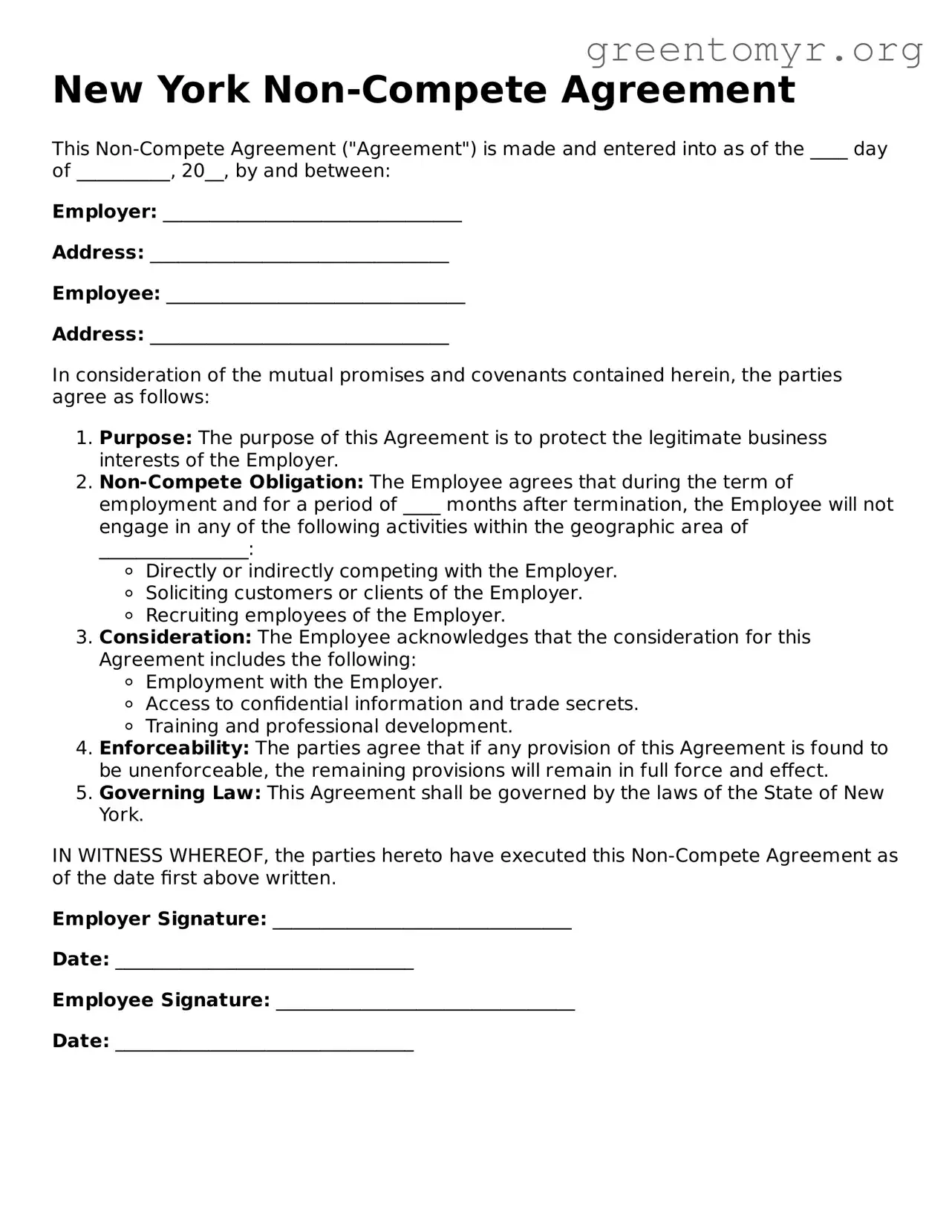
New York Non-Compete Agreement
This Non-Compete Agreement ("Agreement") is made and entered into as of the ____ day of __________, 20__, by and between:
Employer: ________________________________
Address: ________________________________
Employee: ________________________________
Address: ________________________________
In consideration of the mutual promises and covenants contained herein, the parties agree as follows:
IN WITNESS WHEREOF, the parties hereto have executed this Non-Compete Agreement as of the date first above written.
Employer Signature: ________________________________
Date: ________________________________
Employee Signature: ________________________________
Date: ________________________________
| Fact Name | Description |
|---|---|
| Definition | A non-compete agreement is a contract that restricts an employee from working for competitors after leaving a job. |
| Governing Law | New York State law governs non-compete agreements. |
| Enforceability | New York courts enforce non-compete agreements if they are reasonable in scope and duration. |
| Duration | Typically, non-compete agreements in New York should not exceed one to two years. |
| Geographic Scope | The geographic area covered by the agreement must be reasonable and not overly broad. |
| Consideration | For a non-compete agreement to be valid, there must be consideration, such as a job offer or promotion. |
| Public Policy | New York courts may strike down non-compete agreements that violate public policy or hinder an individual's ability to work. |
| Trade Secrets | Non-compete agreements can be used to protect trade secrets, but they should not be the sole means of protection. |
| Alternative Restrictions | Employers may also use non-solicitation agreements as an alternative to non-compete agreements. |
Filling out the New York Non-compete Agreement form is a crucial step in ensuring that both parties understand their obligations and rights. Completing this form accurately will help protect your interests and clarify the terms of your agreement. Follow the steps below to fill out the form correctly.
A Non-compete Agreement is a legal contract between an employer and an employee. It restricts the employee from working for competitors or starting a competing business for a specified period after leaving the company. In New York, these agreements must be reasonable in scope, duration, and geography to be enforceable. They aim to protect the employer's business interests, trade secrets, and client relationships.
Yes, Non-compete Agreements can be enforceable in New York, but there are important conditions. Courts will assess whether the agreement is necessary to protect legitimate business interests. Factors considered include:
If an agreement is deemed overly broad or unreasonable, it may be invalidated by a court.
When drafting a Non-compete Agreement, it’s important to include specific elements to ensure clarity and enforceability. Consider incorporating the following:
Being clear and precise helps protect both parties and reduces the chance of disputes in the future.
Yes, negotiating the terms of a Non-compete Agreement is not only possible but often advisable. If you believe certain terms are too restrictive, you can discuss this with your employer. Consider the following points during negotiation:
Open communication can lead to a more balanced agreement that protects the employer's interests while allowing you to pursue your career effectively.
When filling out the New York Non-compete Agreement form, individuals often make several common mistakes that can lead to misunderstandings or unenforceable agreements. One frequent error is failing to clearly define the scope of the non-compete clause. Without precise language outlining what activities are restricted, the agreement may be deemed too vague and therefore unenforceable in court.
Another mistake involves overlooking the duration of the non-compete period. Many individuals do not realize that an excessively long duration can render the agreement invalid. In New York, the duration should be reasonable and justifiable based on the specific industry and position held. A well-defined time frame helps ensure the agreement is enforceable.
Additionally, individuals often neglect to consider geographic limitations. A non-compete agreement should specify the geographic area in which the restrictions apply. Failing to do so can lead to challenges regarding the enforceability of the agreement. A broad geographic scope may be viewed as overly restrictive, which can weaken the agreement's validity.
Another common mistake is not seeking legal advice before signing the agreement. Many individuals may assume they understand the implications of the terms, but legal nuances can have significant consequences. Consulting with a legal professional can provide clarity and help individuals negotiate more favorable terms.
Finally, individuals sometimes forget to review the agreement in relation to their job duties. The restrictions outlined in the non-compete should be relevant to the specific role and responsibilities of the employee. If the restrictions are unrelated or excessive, they may be challenged in court. It is essential to ensure that the agreement aligns with the actual work performed.
A New York Non-compete Agreement is often accompanied by various other forms and documents that help clarify the terms of employment and protect both the employer's and employee's interests. Here are some commonly used documents that may be relevant.
These documents work together to create a comprehensive framework for the employment relationship. They help protect both parties and ensure clarity in expectations and obligations.
When filling out the New York Non-compete Agreement form, it is crucial to approach the task with care and attention. This document can significantly impact your future employment opportunities. Below are some important dos and don’ts to consider.
Taking the time to carefully evaluate the Non-compete Agreement can help safeguard your career and future opportunities. Make informed decisions to protect your interests.
Non-compete agreements can be confusing. Many people have misconceptions about them, especially in New York. Here are nine common misunderstandings:
Not true. In New York, these agreements must be reasonable in scope, duration, and geographic area to be enforceable.
This is incorrect. Employers can choose whether to require non-compete agreements, but not all positions necessitate one.
They only restrict you from working for direct competitors. You may still pursue opportunities in related fields.
These are different. A non-disclosure agreement protects confidential information, while a non-compete restricts employment options.
Signing does not prevent you from leaving; it may limit where you can work afterward.
This is a misconception. They can apply to employees at various levels, depending on the employer's needs.
Not necessarily. Non-compete agreements can expire after a certain period or may be challenged in court.
In New York, courts will review the agreement for fairness and may refuse to enforce overly broad restrictions.
Each agreement can vary significantly based on the employer's needs and the specific circumstances of employment.
When dealing with a Non-compete Agreement in New York, it is essential to understand the key aspects of the form and its implications. Here are some important takeaways to consider:
By keeping these points in mind, you can navigate the complexities of Non-compete Agreements in New York more effectively.