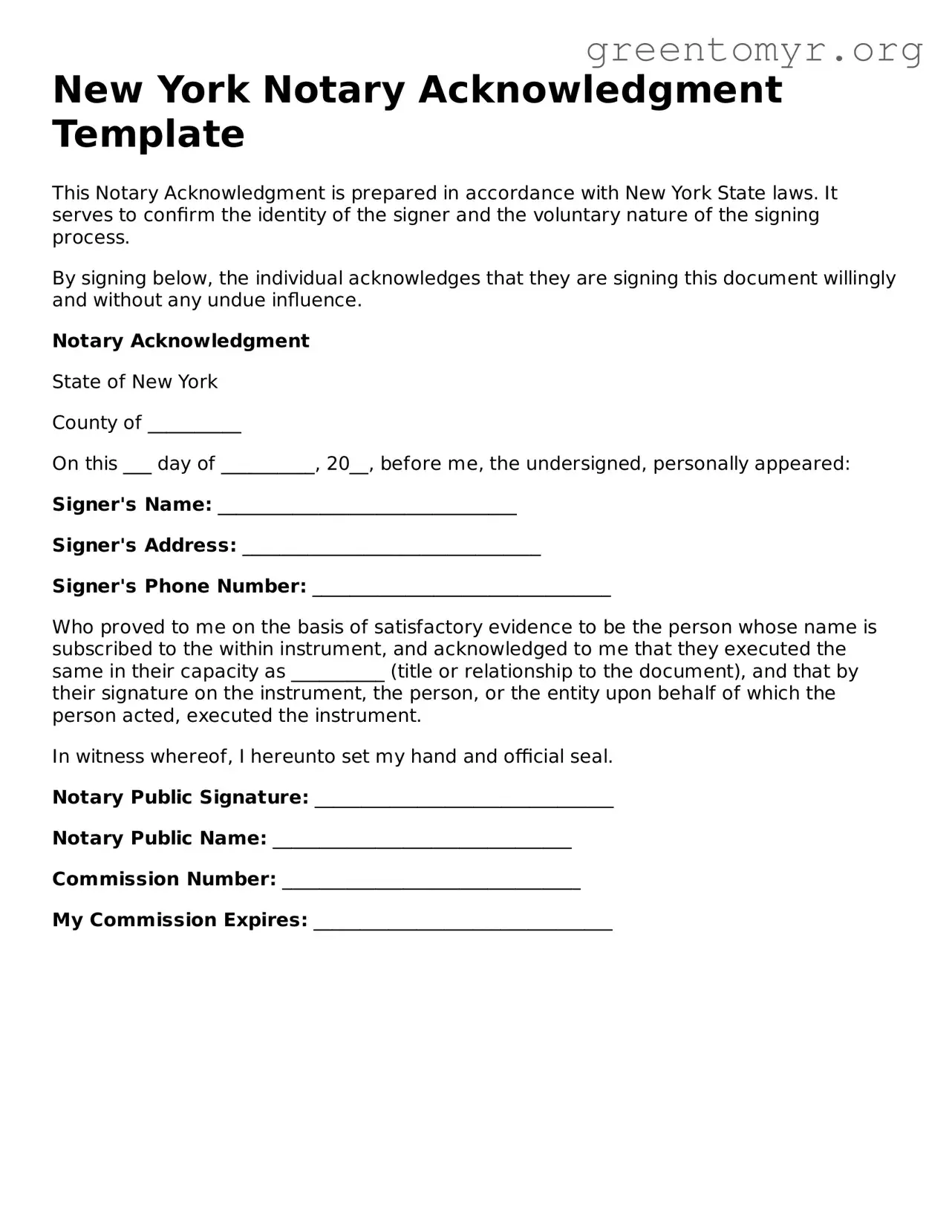
The New York Notary Acknowledgement form plays a crucial role in the legal landscape of document verification. This form is essential for ensuring that signatures on important documents are authentic and that the individuals signing them are doing so willingly and under no duress. When properly executed, a notary acknowledgment provides a layer of trust and credibility, which is often required for documents such as deeds, contracts, and affidavits. The form typically includes vital information such as the name of the signer, the date of the acknowledgment, and the notary's signature and seal. Additionally, it confirms that the signer appeared before the notary, thus affirming their identity. Understanding the components and significance of this form is paramount for anyone engaging in legal transactions in New York. Failing to use the form correctly could lead to complications or even invalidate the document in question, making it imperative to grasp its importance and usage.
New York Notary Acknowledgment Template
This Notary Acknowledgment is prepared in accordance with New York State laws. It serves to confirm the identity of the signer and the voluntary nature of the signing process.
By signing below, the individual acknowledges that they are signing this document willingly and without any undue influence.
Notary Acknowledgment
State of New York
County of __________
On this ___ day of __________, 20__, before me, the undersigned, personally appeared:
Signer's Name: ________________________________
Signer's Address: ________________________________
Signer's Phone Number: ________________________________
Who proved to me on the basis of satisfactory evidence to be the person whose name is subscribed to the within instrument, and acknowledged to me that they executed the same in their capacity as __________ (title or relationship to the document), and that by their signature on the instrument, the person, or the entity upon behalf of which the person acted, executed the instrument.
In witness whereof, I hereunto set my hand and official seal.
Notary Public Signature: ________________________________
Notary Public Name: ________________________________
Commission Number: ________________________________
My Commission Expires: ________________________________
| Fact Name | Description |
|---|---|
| Purpose | The New York Notary Acknowledgment form is used to verify the identity of a signer and confirm that they willingly signed a document. |
| Governing Law | This form is governed by New York State Executive Law, Section 135. |
| Signer's Requirement | The signer must personally appear before the notary public during the acknowledgment process. |
| Identification | Signers should provide valid identification to the notary, such as a driver's license or passport. |
| Language | The form can be completed in English or any other language, but the notary must understand the language used. |
| Notary's Role | The notary public certifies that the signer has acknowledged their signature on the document. |
| Record Keeping | Notaries must keep a record of all acknowledgments in their official journal, as required by New York law. |
After obtaining the New York Notary Acknowledgement form, you will need to complete it accurately to ensure its validity. This form is essential for confirming the identity of the signer and the authenticity of the signature. Follow the steps outlined below to fill it out correctly.
The New York Notary Acknowledgment form is a legal document used to verify the identity of individuals signing a document. It ensures that the person signing is doing so voluntarily and understands the contents of the document. This form is often required for various legal transactions, such as property deeds and contracts.
In New York, a notary public must be at least 18 years old, a resident of the state, or have a business address in the state. They must also complete an application, pass an exam, and receive a commission from the state. Notaries are responsible for ensuring that the signing parties are who they claim to be.
You will typically need a Notary Acknowledgment when signing important documents, such as:
Having a notary acknowledgment adds a layer of security and authenticity to these documents.
The Notary Acknowledgment form generally requires the following information:
All this information helps establish the validity of the document.
Yes, notaries in New York can charge a fee for their services. The maximum fee for a notary acknowledgment is $2 per signature. However, some notaries may charge additional fees for travel or other services, so it’s wise to confirm the total cost beforehand.
Finding a notary in New York is relatively easy. You can:
Many notaries are also mobile, meaning they can come to your location for added convenience.
No, you cannot notarize your own documents. A notary public must be an impartial witness to the signing of the document. This requirement helps prevent conflicts of interest and maintains the integrity of the notarization process.
If a signer cannot appear in person due to illness or other valid reasons, they may be able to use a remote notarization service. New York has laws allowing for remote notarizations, where the notary and signer can connect via video conferencing. However, specific requirements and procedures must be followed, so it’s essential to check the latest regulations.
A Notary Acknowledgment does not have a specific expiration date. However, the validity of the document itself may depend on the nature of the transaction. It’s always a good idea to use the acknowledgment as close to the signing date as possible to ensure its relevance and acceptance.
If you suspect that a notarized document is fraudulent, you should take immediate action. You can:
Addressing any potential fraud quickly can help protect your rights and interests.
When filling out the New York Notary Acknowledgement form, many people make common mistakes that can lead to delays or even invalidate the document. One frequent error is failing to include the correct date. The date is crucial because it indicates when the notary's acknowledgment took place. If this information is missing or incorrect, it can raise questions about the legitimacy of the notarization.
Another mistake involves the notary's signature. Some individuals overlook the importance of having the notary sign the form in the appropriate space. A signature placed in the wrong area can render the acknowledgment ineffective. It’s essential for the notary to sign where indicated to ensure the document holds up in legal situations.
People also often forget to include the name of the person whose signature is being notarized. This information should be clearly printed in the designated area. Without it, the form lacks essential context, making it difficult to ascertain who the document pertains to. This omission can lead to confusion and possible disputes later on.
In addition to these issues, another common error is neglecting to provide the notary’s official seal. The seal serves as a verification of the notary's authority and the authenticity of the acknowledgment. Without it, the document may not be accepted by courts or other institutions, which can create significant problems for the parties involved.
Lastly, many people fail to check the identification requirements for notarization. A notary must verify the identity of the person signing the document. If the signer does not present valid identification, the notary cannot proceed. This step is vital to prevent fraud and ensure that the acknowledgment is legally binding. Understanding these common pitfalls can help individuals navigate the process more smoothly.
When dealing with the New York Notary Acknowledgement form, you might encounter several other forms and documents that are often used in conjunction. Each of these documents serves a specific purpose and can help streamline various legal processes. Here’s a brief overview of some commonly associated documents:
Understanding these documents can help you navigate legal processes more effectively. Each serves a unique role, and knowing when and how to use them can make a significant difference in ensuring that your legal affairs are in order.
The Notary Acknowledgement form serves a specific purpose in confirming the identity of a signer and their willingness to sign a document. Here are nine other documents that share similarities with the Notary Acknowledgement form:
When filling out the New York Notary Acknowledgement form, it's important to follow certain guidelines to ensure the document is valid and accepted. Here’s a list of things you should and shouldn’t do:
Understanding the New York Notary Acknowledgement form can be challenging. Here are six common misconceptions about this important document:
This is incorrect. A notary must witness the signer’s signature in person to acknowledge the document properly. They cannot notarize a signature without the individual being present.
While notaries are generally authorized to perform various types of notarizations, some may have limitations based on state laws or their own training. It is essential to check the specific notary's qualifications.
This is a misunderstanding. A notary acknowledgment confirms that the signer appeared before the notary and signed the document, but it does not validate the content or legality of the document itself.
This is false. Notaries are not authorized to give legal advice or explain the contents of a document. Their role is strictly to witness signatures and verify identities.
This is misleading. A notarized document can be amended, but any changes must be made with the knowledge of all parties involved. A new notarization may be required for the amended document.
This misconception overlooks the fact that notarizations are required for various types of documents, including powers of attorney, affidavits, and contracts. The need for notarization depends on the specific document and its intended use.
When filling out and using the New York Notary Acknowledgement form, it is essential to keep several key points in mind. The following takeaways can help ensure proper completion and usage of the form:
By following these key takeaways, individuals can navigate the process of using the New York Notary Acknowledgement form with confidence and clarity.