When forming a Limited Liability Company (LLC) in New York, one essential document stands out: the Operating Agreement. This agreement serves as the backbone of your LLC, outlining the rights, responsibilities, and obligations of its members. It plays a crucial role in defining how the company will be managed and how profits and losses will be distributed among members. Key elements often included in this form are the management structure, voting rights, and procedures for adding or removing members. Additionally, the Operating Agreement addresses how disputes will be resolved, ensuring that all members are on the same page regarding the operation of the business. By carefully crafting this document, members can protect their interests and establish a clear framework for their LLC's future. Understanding the importance of this agreement is vital for anyone looking to navigate the complexities of business ownership in New York.
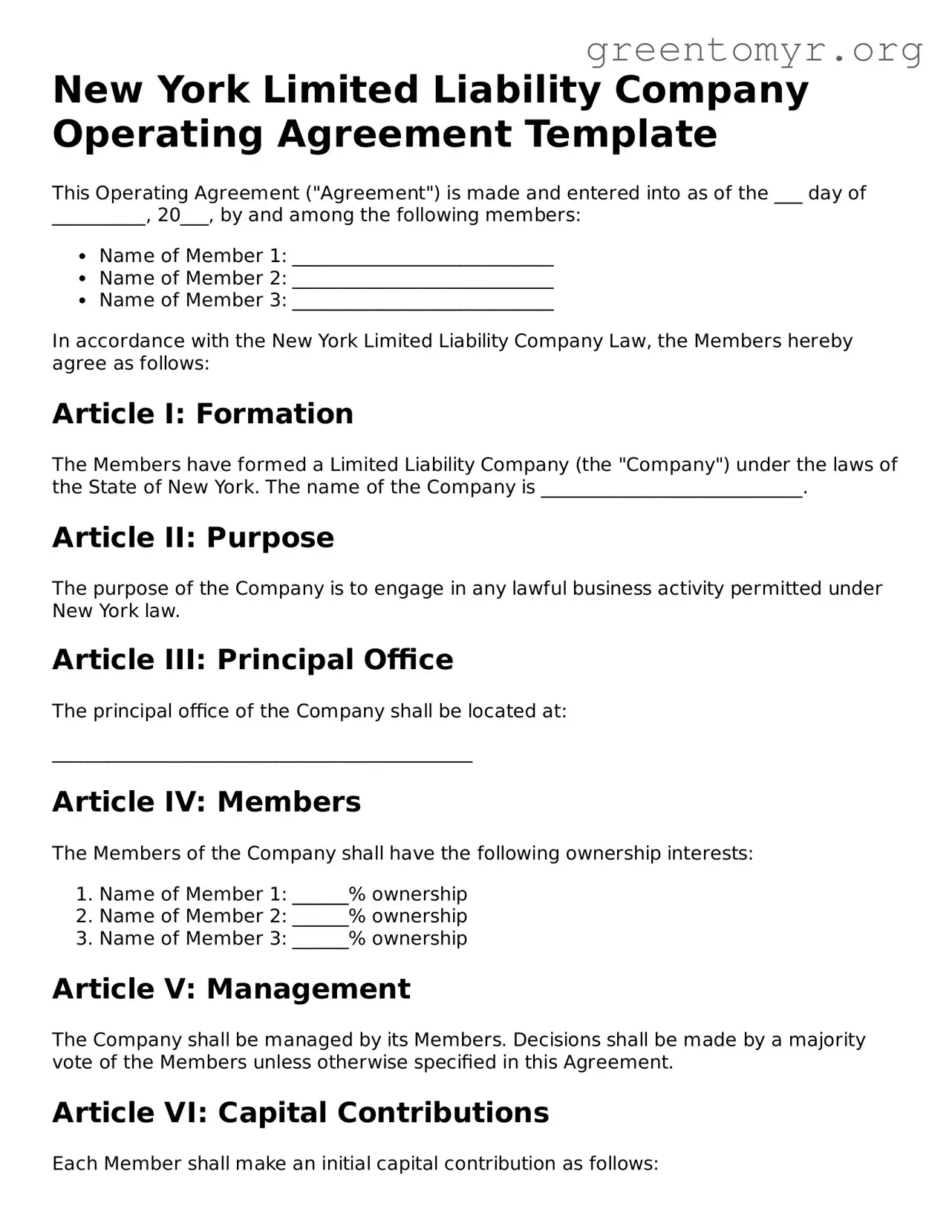
New York Limited Liability Company Operating Agreement Template
This Operating Agreement ("Agreement") is made and entered into as of the ___ day of __________, 20___, by and among the following members:
In accordance with the New York Limited Liability Company Law, the Members hereby agree as follows:
Article I: Formation
The Members have formed a Limited Liability Company (the "Company") under the laws of the State of New York. The name of the Company is ____________________________.
Article II: Purpose
The purpose of the Company is to engage in any lawful business activity permitted under New York law.
Article III: Principal Office
The principal office of the Company shall be located at:
_____________________________________________
Article IV: Members
The Members of the Company shall have the following ownership interests:
Article V: Management
The Company shall be managed by its Members. Decisions shall be made by a majority vote of the Members unless otherwise specified in this Agreement.
Article VI: Capital Contributions
Each Member shall make an initial capital contribution as follows:
Article VII: Distributions
Distributions of profits and losses shall be made to the Members in proportion to their ownership interests as outlined in Article IV.
Article VIII: Indemnification
The Company shall indemnify each Member against any losses or damages incurred in connection with the Company, to the fullest extent permitted by New York law.
Article IX: Amendments
This Agreement may be amended only by a written agreement signed by all Members.
Article X: Governing Law
This Agreement shall be governed by and construed in accordance with the laws of the State of New York.
IN WITNESS WHEREOF, the Members have executed this Operating Agreement as of the date first above written.
______________________________
Signature of Member 1
______________________________
Signature of Member 2
______________________________
Signature of Member 3
| Fact Name | Description |
|---|---|
| Purpose | The New York Operating Agreement outlines the management structure and operating procedures of a limited liability company (LLC). |
| Governing Law | This agreement is governed by the New York Limited Liability Company Law. |
| Member Rights | It defines the rights and responsibilities of members, including profit distribution and voting rights. |
| Flexibility | Members can customize the agreement to fit their specific needs, allowing for various management structures. |
| Legal Requirement | While not legally required, having an Operating Agreement is highly recommended for LLCs in New York to avoid disputes. |
Completing the New York Operating Agreement form is a vital step in establishing your business's internal structure. Once you have filled out the form, you will be prepared to outline the management and operational procedures of your business. This document will help clarify the roles of members, their responsibilities, and how decisions will be made.
A New York Operating Agreement is a legal document that outlines the management structure and operating procedures of a Limited Liability Company (LLC). It serves as an internal guideline for the members of the LLC, detailing their rights, responsibilities, and the operational framework of the business.
While New York law does not mandate LLCs to have an Operating Agreement, it is highly recommended. Having one can help clarify the roles of members, prevent disputes, and provide a clear plan for the management of the business. If disputes arise, a well-drafted Operating Agreement can serve as a critical reference.
An Operating Agreement typically includes the following key elements:
Yes, the Operating Agreement can be amended. It is advisable to include a section in the Agreement that outlines the process for making changes. Typically, amendments require the approval of a majority or all members, depending on what is specified in the original document.
The Operating Agreement plays a crucial role in maintaining the limited liability status of the LLC. By clearly outlining the structure and operations of the business, it helps demonstrate that the LLC is a separate legal entity. This distinction protects members' personal assets from business liabilities, provided that the LLC is operated in accordance with the Agreement.
Templates for New York Operating Agreements can be found online through various legal websites. Additionally, legal professionals can provide customized agreements tailored to your specific business needs. It is advisable to consult with a legal expert to ensure that the Agreement complies with New York laws and accurately reflects the intentions of the members.
Filling out the New York Operating Agreement form can be a daunting task, and many individuals make common mistakes that can lead to complications down the line. One frequent error is failing to include all members of the LLC. Every member should be listed to ensure that everyone’s rights and responsibilities are clearly defined. Omitting a member can lead to disputes and confusion later.
Another mistake is not specifying the management structure of the LLC. It is crucial to indicate whether the LLC will be managed by its members or by appointed managers. This distinction affects how decisions are made and who has the authority to act on behalf of the company.
People often overlook the importance of clearly defining the purpose of the LLC. A vague or overly broad purpose can create issues when it comes to compliance and taxation. Being specific about the business activities helps in maintaining clarity and legal standing.
Additionally, many individuals fail to outline the process for adding or removing members. Without a clear procedure, the LLC may face challenges if changes in membership occur. Establishing guidelines for these situations is essential for smooth transitions.
Another common oversight is neglecting to include provisions for profit and loss distribution. Members need to agree on how profits and losses will be allocated. This agreement should reflect each member's contribution and expectations, preventing misunderstandings later.
Some people do not update the Operating Agreement as changes occur. Life events, such as new members joining or existing members leaving, should prompt a review and update of the document. Failing to keep the agreement current can lead to legal complications.
Moreover, individuals sometimes forget to include a dispute resolution clause. This section can outline how conflicts will be handled, whether through mediation, arbitration, or litigation. Having a plan in place can save time and resources in the event of a disagreement.
Another mistake is not having the agreement signed and dated by all members. An unsigned document lacks legal validity and can be challenged in court. Each member should sign to ensure that the agreement is enforceable.
Some individuals also fail to seek professional advice when necessary. Operating agreements can be complex, and consulting with a legal professional can provide valuable insights and help avoid pitfalls. Skipping this step can lead to mistakes that might have been easily prevented.
Lastly, people often underestimate the importance of keeping a copy of the signed agreement in a safe place. Losing the document can create significant challenges, especially if disputes arise. A secure storage solution ensures that all members have access to the agreement when needed.
When establishing a limited liability company (LLC) in New York, an Operating Agreement is a crucial document that outlines the management structure and operational procedures of the business. However, several other forms and documents are commonly used in conjunction with the Operating Agreement to ensure compliance with state laws and to protect the interests of the members. Below is a list of these documents, each serving a specific purpose.
In conclusion, while the New York Operating Agreement is a foundational document for an LLC, these additional forms and documents play vital roles in ensuring the smooth operation and legal compliance of the business. Understanding each of these documents helps members navigate the complexities of running an LLC effectively.
When filling out the New York Operating Agreement form, keep the following points in mind:
When discussing the New York Operating Agreement form, several misconceptions often arise. Understanding these misunderstandings is crucial for anyone involved in forming a limited liability company (LLC) in New York. Below are five common misconceptions:
By addressing these misconceptions, individuals and businesses can better navigate the complexities of forming and managing an LLC in New York. An informed approach leads to stronger agreements and more successful business operations.
When filling out and using the New York Operating Agreement form, it is essential to keep several key points in mind. These takeaways will help ensure a smooth process and a well-structured agreement.