The New York Power of Attorney form serves as a crucial legal document that allows one person, known as the principal, to grant another individual, referred to as the agent or attorney-in-fact, the authority to act on their behalf in various matters. This form can be tailored to fit specific needs, whether it’s for financial decisions, property management, or healthcare choices. It is important to understand that the Power of Attorney can be either durable, remaining effective even if the principal becomes incapacitated, or non-durable, which ceases upon incapacitation. Additionally, the form must be signed in the presence of a notary public to ensure its validity. The principal also has the option to include specific instructions or limitations regarding the powers granted, providing a level of control over how the agent can act. Understanding these key aspects is essential for anyone considering this important legal tool, as it can significantly impact personal and financial affairs.
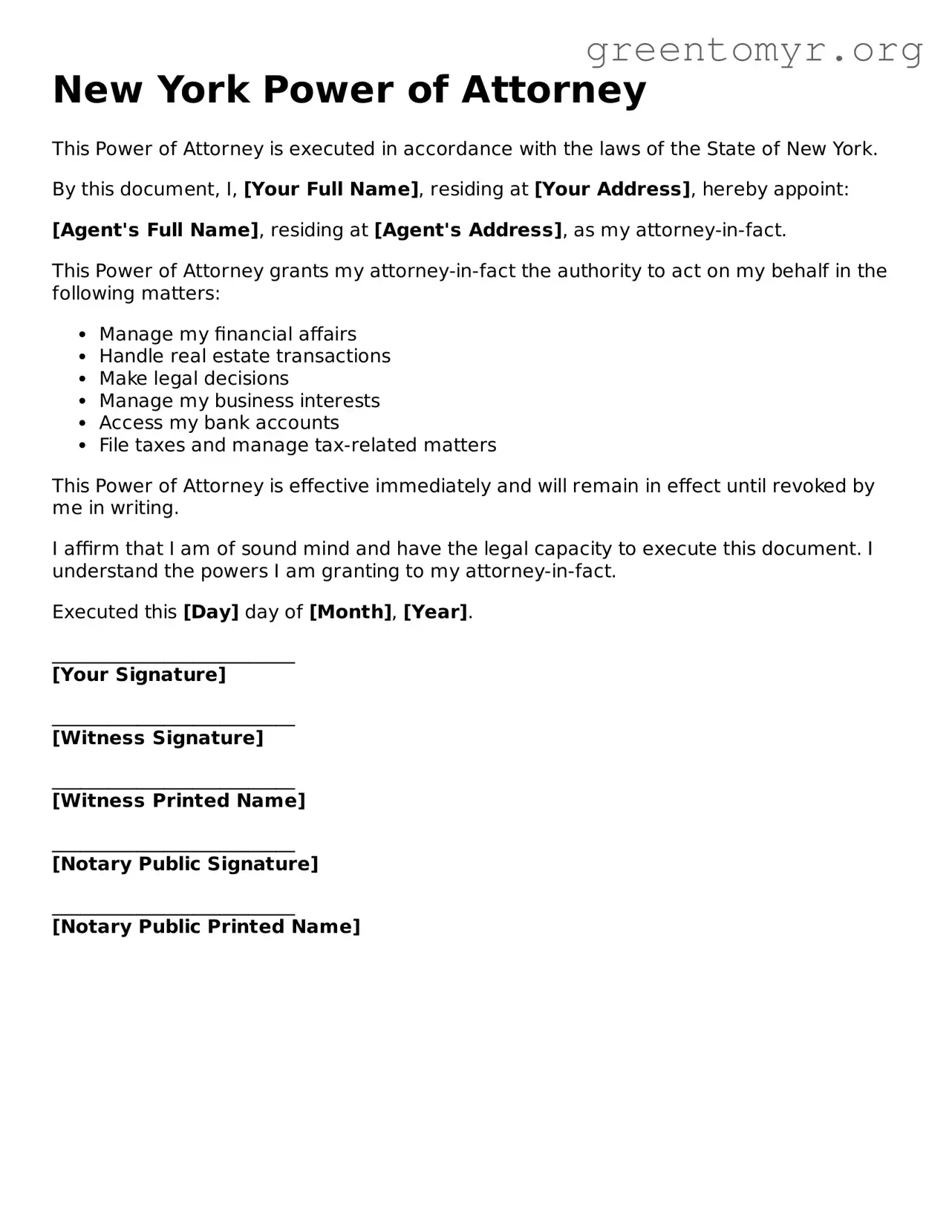
New York Power of Attorney
This Power of Attorney is executed in accordance with the laws of the State of New York.
By this document, I, [Your Full Name], residing at [Your Address], hereby appoint:
[Agent's Full Name], residing at [Agent's Address], as my attorney-in-fact.
This Power of Attorney grants my attorney-in-fact the authority to act on my behalf in the following matters:
This Power of Attorney is effective immediately and will remain in effect until revoked by me in writing.
I affirm that I am of sound mind and have the legal capacity to execute this document. I understand the powers I am granting to my attorney-in-fact.
Executed this [Day] day of [Month], [Year].
__________________________
[Your Signature]
__________________________
[Witness Signature]
__________________________
[Witness Printed Name]
__________________________
[Notary Public Signature]
__________________________
[Notary Public Printed Name]
| Fact Name | Description |
|---|---|
| Purpose | The New York Power of Attorney form allows an individual to appoint someone else to make decisions on their behalf regarding financial and legal matters. |
| Governing Law | This form is governed by New York General Obligations Law, Article 5, Title 15. |
| Durability | The Power of Attorney can be durable, meaning it remains effective even if the principal becomes incapacitated. |
| Signature Requirements | The form must be signed by the principal and acknowledged by a notary public to be valid. |
| Revocation | The principal can revoke the Power of Attorney at any time, as long as they are mentally competent. |
Filling out the New York Power of Attorney form is a straightforward process. This document allows you to designate someone to act on your behalf in financial matters. After completing the form, it must be signed, dated, and witnessed to ensure it is valid.
A Power of Attorney (POA) is a legal document that allows one person, known as the principal, to grant another person, called the agent or attorney-in-fact, the authority to act on their behalf. In New York, this document can cover a variety of financial and legal matters, including managing bank accounts, signing contracts, and making healthcare decisions. The powers granted can be broad or limited, depending on the needs and preferences of the principal.
In New York, almost anyone can be appointed as an agent, provided they are at least 18 years old and mentally competent. This can include family members, friends, or even professionals such as attorneys or accountants. However, it is essential to choose someone trustworthy, as they will have significant control over the principal's affairs.
To create a Power of Attorney in New York, follow these steps:
Once completed, provide copies of the document to your agent and any institutions or individuals who may need to recognize it.
Yes, a Power of Attorney can be revoked at any time, as long as the principal is mentally competent. To revoke it, the principal should create a written revocation document and notify the agent and any relevant third parties. It is advisable to also retrieve any copies of the original Power of Attorney to prevent confusion.
If the principal becomes incapacitated, the Power of Attorney remains in effect unless it is a springing Power of Attorney, which only takes effect upon incapacity. This means that the agent can continue to manage the principal's affairs even when they are unable to do so themselves. It is crucial to discuss this scenario with the agent beforehand to ensure they are prepared to take on this responsibility.
Yes, there are limitations on what an agent can do under a Power of Attorney in New York. The principal can specify the scope of authority granted to the agent, which may include restrictions on certain transactions. Additionally, agents are legally obligated to act in the best interest of the principal and cannot use their authority for personal gain. If an agent exceeds their authority or acts against the principal's wishes, they may be held accountable in a court of law.
Filling out a Power of Attorney (POA) form in New York can be a straightforward process, but many people make common mistakes that can lead to complications. One frequent error is not specifying the powers granted. The form allows you to outline specific powers, such as managing finances or making healthcare decisions. Failing to clearly define these powers can create confusion and limit the agent's ability to act effectively.
Another mistake is neglecting to date the document. A POA must be dated to be valid. Without a date, there may be questions about when the authority was granted, which could lead to disputes or challenges later on.
People often overlook the importance of having the form notarized. In New York, a Power of Attorney typically requires notarization to be legally binding. Skipping this step can render the document invalid, leaving your agent without the authority to act on your behalf.
Many individuals also forget to discuss their wishes with the chosen agent. Communication is key. If the agent is unaware of your preferences, they may make decisions that do not align with your intentions. It’s crucial to have a conversation about your goals and expectations.
Another common error is not reviewing the form for accuracy. Simple typos or incorrect information, such as misspelled names or wrong addresses, can create problems. Always double-check the information before submitting the document.
Some people fail to consider the need for alternate agents. Life is unpredictable, and the primary agent may become unavailable due to various reasons. Designating an alternate ensures that someone can step in if necessary.
Additionally, individuals sometimes forget to keep copies of the completed form. It’s important to retain a copy for your records and provide one to your agent. This way, everyone involved has access to the same information.
Lastly, many people do not update their Power of Attorney when circumstances change. Life events such as marriage, divorce, or the death of an agent can affect your wishes. Regularly reviewing and updating the document ensures it reflects your current situation and intentions.
A Power of Attorney (POA) is a vital document that allows one person to act on behalf of another in legal or financial matters. However, several other forms and documents often accompany a Power of Attorney to ensure comprehensive management of an individual’s affairs. Below is a list of these important documents.
Each of these documents serves a specific purpose and can work together with a Power of Attorney to create a comprehensive plan for managing an individual’s affairs. Understanding these forms is essential for anyone looking to safeguard their interests and ensure their wishes are honored.
The Power of Attorney (POA) form is a legal document that allows one person to act on behalf of another. Several other documents serve similar purposes, providing authority and decision-making power in various contexts. Here are six documents that share similarities with the Power of Attorney:
When filling out the New York Power of Attorney form, it is essential to approach the process with care. Here are five things to keep in mind:
By following these guidelines, you can help ensure that your Power of Attorney form is completed correctly and serves its intended purpose.
Understanding the New York Power of Attorney form is crucial for anyone looking to designate someone to act on their behalf. Here are ten common misconceptions about this important document.
Many people think a Power of Attorney is solely for financial decisions. In reality, it can also cover health care decisions, property management, and more.
While notarization is recommended, in New York, a Power of Attorney can be valid without a notary if it is signed by two witnesses.
People often believe that a Power of Attorney is permanent. However, you can revoke or modify it at any time as long as you are mentally competent.
Many assume that only legal professionals can draft this document. In fact, individuals can create their own Power of Attorney using templates or forms available online.
Some think that only seniors need a Power of Attorney. However, anyone can benefit from having one, regardless of age or health status.
People worry that signing a Power of Attorney means they lose control over their decisions. This is not true; you can specify what powers you grant and retain the right to make decisions yourself.
Many believe that a Power of Attorney takes effect right away. In New York, you can create a "springing" Power of Attorney that only activates under certain conditions, like incapacitation.
Some think that a Power of Attorney is only valid for a limited period. In New York, it remains in effect until you revoke it or pass away, unless specified otherwise.
People often assume that all Power of Attorney forms are interchangeable. However, different types exist, each tailored for specific needs and purposes.
Many believe a New York Power of Attorney is valid everywhere. While it may be recognized in other states, each state has its own laws, so it's important to check local requirements.
When filling out and using the New York Power of Attorney form, there are several important points to keep in mind. Understanding these can help ensure that the document serves its intended purpose effectively.
By following these key takeaways, individuals can effectively navigate the process of creating and using a Power of Attorney in New York.